

Introduction.
Welcome to a OneFinitePlanet EV video and page on the implications of bi-directional EV/EV hybrid charging. A lot to cover so you may jump to Chapters which cover what V2L, Anti-Islanding, V2H and V2G all mean, the economics of solar and V2G, then the gear: AC vs DC & inverters, bi-directional charging, “wall boxes” and vehicle requirements. Next the reality check: a look at the issues for EV makers, the politics and managing future energy costs, potential impact on future energy, and future vehicles.
V2X: V2L-V2H-V2G
What’s new: V2G is here!*
Australia, the country with the highest penetration of home solar, has just approved standards Vehicle to Grid, which makes Australia the logical current guinea pig for technology that will roll out globally, and talking to those in the industry at Everything Electric Australia revealed there is already a lot of international interest, and they expect it to spread quickly.
V2L: Vehicle to Load (AC)*


V2L is what most EV owners know. V2L is great on occasions, but despite what it can do, it has changed little for most owners. It powers the mains power point within an EV, or available through an adaptor that plugs into the vehicle charging port and provides the ability to run mains power appliance from the car main traction battery. An “inverter” within the car converts DC power from the battery into mains level AC power for 1 or more wall sockets .
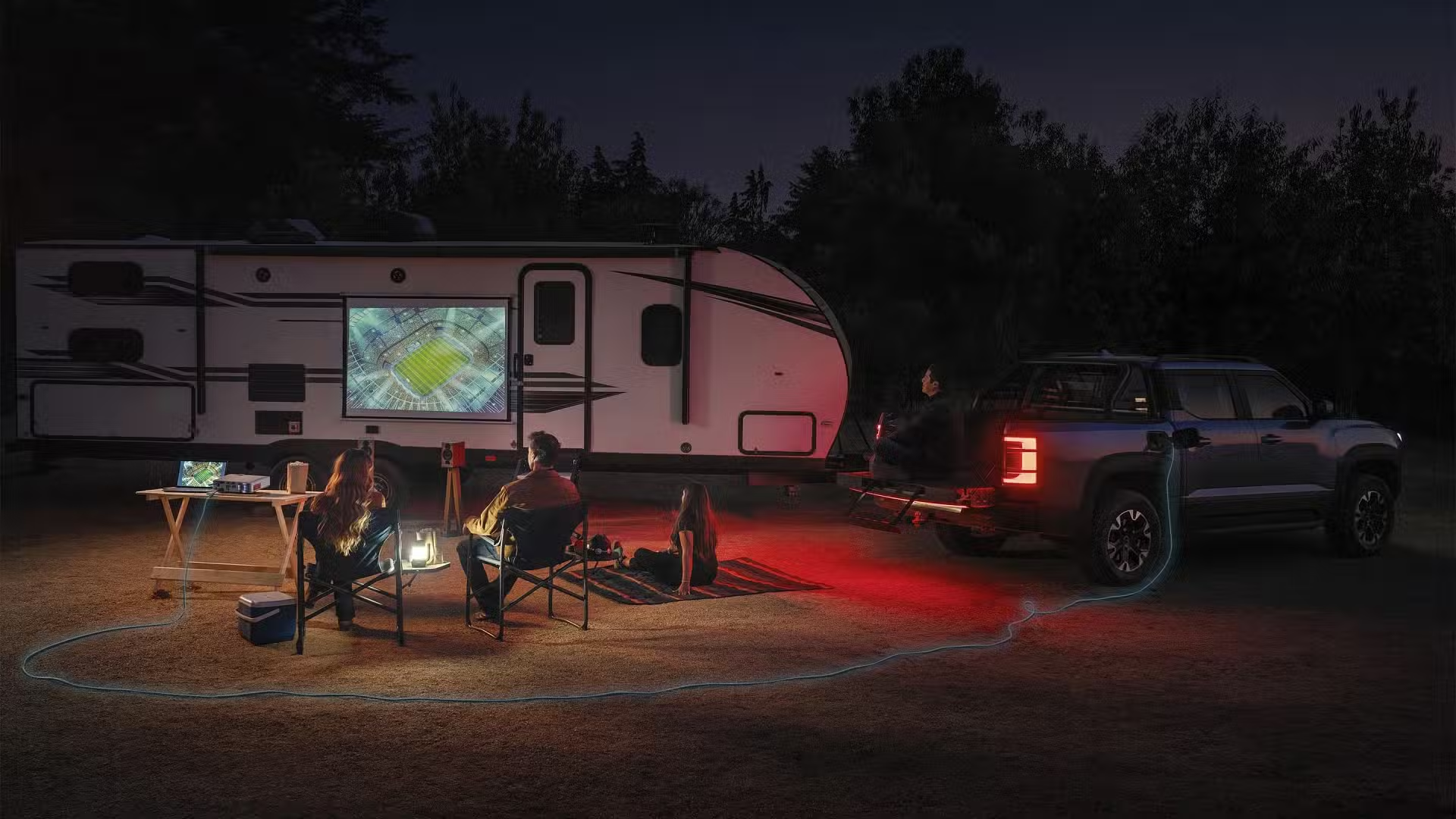
I carry a coffee machine and induction hot plate to enable picnic snacks in an EV, others run power tools or even electric BBQs. Other than for those who use it for work, few use it that often, although it is great when you can.
Most EVs, strangely other than Tesla, have offered V2L for some time, and it raises the question as to what more is needed to support vehicle to home? If the car can supply enough power, then “why not”?
Anti-Islanding: Separating home and grid.
Islanding, is a key part of what makes using V2L as a V2Home solution during blackouts more complex than it might at first seem. This is because any power connected into the home circuits can also flow back out into the local part of the grid even during a blackout, creating an “island of power” that can include neighbours, and potentially the part of the local grid that power workers will be trying to fix without being electrocuted.
With V2L for individual appliances, it is obvious that whatever you plug into the car is not also connected to the grid, but connecting all or part of the home requires either “unplugging” the relevant parts of the home from the grid, or activating a switch that disconnects the relevant circuits from the grid.
Anti-islanding, is a system that prevents power going back out into the grid during a blackout, and is the first thing that must be added to turn V2L into V2H. The simplest anti-islanding simply turns off power from local solar or batteries, which may make sense for homes with home solar given most blackouts are at night or during storms, once you add batteries, it makes sense to disconnect.
V2H: Usually more like V2G.
V2H is more complex than V2L because, unless you have an off-grid home that only has power when the car is connect, there will be the grid and/solar and maybe also a home battery to consider.
The end result is you could run V2H during a blackout using AC V2L, provided the house has a switch for disconnecting from the grid, but for automatically selecting the right source of power, a control unit will be needed, and if there is also home solar, even for off-grid homes, feeding the car battery power into the home power circuits becomes almost identical to a vehicle to grid (V2G) the system.
In the end V2H is not really a separate technology, but a choice between V2L into a house is first temporarily manually disconnect from the grid, and V2G.
V2G: Vehicle to grid.
Vehicle to Grid or V2G is system using a “wall box” to enable the same charger connection to charge a vehicle when desired, and also when desired supplement or supply home power, and optionally when desired and the grid will pay, sell power back to grid. Note these systems are aslo usually the most cost effective solution even for “off-grid homes”, otr those who will never send power to the grid.
As covered in V2H, supplying power to a home without physically disconnecting the home from the grid requires a power control unit or “wall box”. With V2g, other than during blackouts, the home can be left connected to the grid with the wall box used to control which of 3 scenarios is in play:
1: local battery and/or solar is providing less power than the home needs, and power
from the grid is either supplementing or providing all power to the home.
2: local battery and/or solar is configured to provide exactly the power the home needs, so no power is flowing from or to the grid.
3: local battery and/or solar is able and configured to provide more power than the home needs so power is flowing to the grid.
Disconnecting from the grid during scenario 2 is optional, but “anti-islanding” capability is normally required as it a requirement during blackouts or other times grid voltage falls below normal levels. At those times without anti-islanding disconnecting, unwanted home power home would flow to the grid.
It is hard to see how V2G could work using AC power from the vehicle, as controlling power sent to the grid requires fine control of the voltage from the inverter, and in-car inverters are not configured for that type of voltage control. Without precise voltage control, the grid would either too much power and overload the inverter or battery, or taking nothing at all and power still power everything! So V2G is using DC direct from the battery to the control box.
The Economics
Solar Economics: Solar without batteries.
The economics of solar vary over time. In a grid with very little solar power, grid providers may even pay those with home solar to feed their excess solar power to the grid, but as the amount of solar in the grid grows, grid operators become overloaded with power during the times when the sun is providing the most solar power. At times of peak solar output, homeowners can even be penalised for providing power to the grid!
It gets worse, because the rules of supply and demand mean power prices fall when the sun is shining, so the money saved by having power when the sun shines also fall. In Australia, there are already energy plans which provide free power around midday, and demand pricing can even mean there are times when customers can be paid to consume power.
The inverters of many solar systems have no capacity to control blending of their power with grid power, so they simply send the full power from solar to the house, on the basis that if it is more than the house needs, the excess will be welcomed by the grid. At some point, if solar uptake continues, these inverters will need to be replaced with “smart inverters” like those from V2G systems, that can choose to supply exactly the needs of the house without sending power to the grid at times when sending power to the grid would incur charges.
By making power free when the sun shines, and more expensive when it doesn’t grid operators can preserve revenues from homes with solar.
“Baseload power” can mean power that cannot be scaled back must always be consumed, and too much “baseload power” can be a big problem if demand falls below the baseload because people have solar.
The end result is that if suppliers add baseload power, they want people to pay when even when not using grid power, and in any event, suppliers can just shift energy prices to when solar is not available, enabling them to collect the same totals even from people with solar. As people use less from the grid, they can raise prices for what is used in order to maintain revenues, unless people don’t need power at all.
V2G Economics.
V2G can make sense even without having solar, because batteries can be charged up when electricity is at its lowest price, and supplied to the grid during times the grid is struggling to meet demand. When the grid needs power, the price per kW grid operators will pay to avoid needing to shut down parts of the grid are very high. Getting $ back from the grid is mostly about earning great rewards during a few hours each year, but I know of one V2G Nissan Leaf owner who earned over A$6,000 in 2024, with almost A$500 of that being within one 2-hour period.
The Solar/V2G combination.
Ultimately the only solution that remains economic for the consumer as more people join, is having solar with a small home battery, backed by a V2G EV or EV hybrid.
At the prices of solar cells in 2025, anyone who can install solar should get their money back, and quite quickly! However, adding solar without providing for a home battery and V2G risks having to continually replace the unit known as the “wall box” or “inverter” or “control unit” as the system grows and the economic evolve.
While the prices of home batteries are falling, “last mile delivery” and sometimes even installation costs make home batteries typically more expensive than buying an EV or EV hybrid for the value of the battery alone. Large batteries having their own transport system creates genuine savings. With EV hybrids (see separate video) able to cost less than an equivalent traditional combustion engine car, and still being able to be fuelled with gasoline/petrol any time charging is not desired, it is like any time a new car is purchased, there may be the option to get an effectively free home battery as a bonus.
Tech: What you need.
Electricity & bi-directional charging.
V2G is based around the principle that electricity is inherently bi-directional as it always flows from the point with highest voltage to the point with lowest voltage. This means electrical circuits will by default allow the flow of power in either direction.
A house consumes power from the grid because an appliance that consumes power slightly lowers the voltage at its plug, causing electricity from the grid to flow into the home and through to that plug. Have an appliance, or any point on the home grid, that can raise the voltage and power flows out of the home.
The same with charging an EV. Whilst AC charging on an EV uses the vehicles onboard inverter, which means there is no direct connection to the battery, DC charging is a direct connection to the battery. Connect a charger that supplies a slightly higher voltage to than the battery, and charge flows into the battery, connect a voltage below the voltage of the battery, power flows out of the battery. This means the DC connection for charging an EV can also be used for accessing power from the battery. Obviously, this needs to be done correctly, and the voltages are lethal to humans, and correct control is required to ensure a voltage drop that results in the desired flow of current, but both ends of V2G are based around the bi-directional nature of electricity. [diagram – flow]
V2G can incorporates both charging for an EV battery, and of use power from an EV battery, as well as allow power to flow from the grid to house, or from house to the grid.
Full system requirements: AC, DC voltage & flexible inverters.
While current, as measured in “Amps” is how much power rather than the type of power, different voltages change the type of power, as does being DC which is like 0 Hz AC, or every different frequency of AC. None are interchangeable, and everything needs electrical power within its limits. Every change in voltage, or change from AC to DC or back, or between different frequencies of AC require circuitry to change the power into what is needed. Mostly this is done by “inverters” and if enough people indicate in comments that is wanted, I will create a video on inverters and link below, but going from solar to home/grid AC, from home battery to home/grid AC, and from EV battery to home/grid AC all require different things from an inverter.
V2G wall boxes: getting it all in one.

V2G units such as those from RedEarth are becoming available and provide one unit capable of meeting all the needs of a home system, whilst units designed for home solar or even solar with home battery, will normally not have the capacity or handle voltages needed for v2g.
Where possible, having one unit from the outset will be less expensive, and trying to get different units to work together is not really practical.
Buying solar without planning for V2G will normally mean not having an inverter that can also manage V2G, so if V2G is added later, it will normally mean replacing a significant part of the original investment in solar. Many in Australia, already have a unit that would need replacing, but for anyone looking at adding solar now, I would recommend comparing costs with and without also having V2G. Although V2G units may fall in price, they would have to fall a lot to make not getting a unit from the outset worthwhile.
Vehicles: What is needed from the EV/ EV hybrid?
So, what is needed from the EV /EV hybrid? I have a separate video which will be linked below on EV hybrids and EV PHEVs, but to keep it simple, the following three things are required from the vehicle:
- A DC charging port, such as CCS2, CHAdeMO, or NACs
- A battery with sufficient total life capacity to make V2G/V2H practical.
- Software in the vehicle which supports V2G/V2H via the DC port.
The first, the DC charging port, as pictured here, is required. Some vehicles with a plug can only be charged by AC, and although they may support V2L which can allow powering appliances during a blackout, there are not suitable for connection to a house that is connected to the grid.
Second is a battery with sufficient “total life” capacity, where “total life” is the total battery capacity multiplied by the number of cycles the battery type can sustain.
The average home in Australia consumes 18kWh per day, meaning average power consumption per home is below 1kW, in the USA the number is 29.3kWh, making average consumption just over 1.2 kW.
OneFinitePlanet.org August 2022: A deeper look how EVs impact the power grid.
Both the total energy, and power requirements are easy for any EV.
If the home has solar, then some power will come directly from solar. With heating and cooling being the biggest uses of power, in a warm country like Australia, air conditioning during the day will typically be the biggest use of power and could be met by solar. In any event, not all of that 18kW per day could possibly come from the battery, given batteries cannot supply power when being charged (like below).
Even half from the battery on average should be conservative.
Batteries now typically last over 3,000 cycles, particularly under the low loads than are typical for home power. How low is the load? 18kWh/ day is less than 1kW on average. 3,000 cycles is just over 8 years of cycles if cycling once every single day.
Still, I would be suggesting at least a 15kWh LFP battery to completely avoid needing the grid, and even then, it could need replacing in around 10 years depending on the total kms driven, in addition to powering the home. Closer to 30kWh LFP would be safer for ensuring a real 20-year battery life for someone also driving beyond typical annual driving distance.
This brings us to point 3, software support from the car brand.
Note, not just future cars, but every vehicle with a suitable battery and charging port already on the road in Australia right now, should be able to support v2g with a zero-cost software upgrade.
Reality check
Will EV manufacturers support it?
Will manufacturers support it? V2G has been part of the CHAdeMO standard since 2014 and although that does not mean all cars supported it most did. However, the almost no-one has officially declared support for V2G on the now almost universal in Australia and Europe, CCS2. Almost all cars can support it, but manufacturers have to decide to update software, and be happy the result will not increase warranty costs.
The 2022 ISO 15118-20 standard requires hardware capable of bidirectional power conversion, and compliance with standards to manage authentication & negotiation, but real-world implementation capable of V2G is limited.
is CCS2 where the 2022 in Europe & Australi
- V2G and ISO 15118:
- Technical Requirements:
- Hardware: Both the EV and charger must have hardware capable of bidirectional power conversion (e.g., onboard inverters for AC or DC systems).
- Software: Compliance with ISO 15118-20 is required to manage authentication, power negotiation, and safety protocols.
- Current Adoption:
- While the standard technically supports V2G, real-world implementation is limited. Most CCS2-compliant EVs and chargers today focus on unidirectional charging.
- Pilots (e.g., by Volkswagen, Ford, and Hyundai) are testing CCS-based V2G, but widespread adoption awaits industry alignment and infrastructure upgrades.
- Comparison with CHAdeMO:
- Unlike CHAdeMO (which has V2G widely implemented), CCS-based V2G is newer and less common, though CCS is poised to dominate as the standard evolves.
- Conclusion:
- V2G is theoretically supported in CCS2 via ISO 15118-20, but practical deployment depends on automakers and charging providers adopting the necessary hardware and software. It remains an emerging feature rather than a standard capability today.
- —
If V2G is primarily used for a household’s own power, then even an extra 10kWh per day of would be equivalent to an around an extra 20minutes of driving at 110km/h, but doing that every day is like an extra 10,000km per year in terms of battery usage, but without another part of the car being worn. The simplest solution would be to have people sign up to additional conditions and metrics on the battery warranty to have V2G enabled, although for full sized batteries EVs, it should be a non-issue, as even a person not only running their house but supplying as much as 25kWh of power to the grid for the few hours they would be paid, is not going to take the battery close to the expected cycles within the warranty period.
The EV market in Australia has a lot of competition right now, so there will be brands seeking every advantage they can get. Expect more clarity by July 2025.
Politics and energy costs.
With such a high take-up of home solar, Australia could play a significant role in the deployment of V2G globally. It gets complex and would be long so I will leave the full crunching of numbers for another video, but Australian Energy Market Operator (AEMO) has already forecast that home solar could account for 50% of electrical generation by 2050, and South Australia already reached 23% in 2023. All this without accounting for any impact from V2G. I will crunch those numbers, and I feel home solar combined with V2G could single handedly solve Australia’s new power generation needs between now and 2030 if politicians and fossil fuel companies, would not just allow it, but support it.
V2G probably won’t reduce energy prices, but it can dramatically reduce the amount you need to buy, and that hurts energy companies, and the economy! Any time consumers save money it takes money out of the economy, and there can be a push back from politicians. Covid increased work from home, and politicians responded that less spend on commuting and consumption outside the home damages the economy. Better to have a consumer who buys coffee at a cafe and wastes hours per day commuting, that one that can use that time, saves on fuel and public transport and makes their own coffee!
23% of power in south Australia already being home solar means already 23% of power bills no longer contributing to the numbers for the economy. The dollars at risk if that percentage grows is sufficient incentive for lobby groups to be busy trying to ensure government policy is for everyone to live in denser housing unsuitable for rooftop solar, even in a country with all the space of Australia. The message is, what is needed is more gas powered generators, because more gas supply will lower prices, and even though Australians pay world pricing to these majority foreign owned gas companies, surely increasing the amount of world gas that come from Australia to beyond the current 10% will lower global gas prices, and thus those paid by Australians? Or is it all about Australia collecting lower resource taxes than any other major supply country, which means companies make more on Australian gas? Yes, there will be steps to protect fossil fuel company revenues, and with reduced consumers paying, prices may rise for those left behind. Perhaps another case of social injustice, but just giving in and paying not a solution.
Conclusions: It’s complex.
V2G can seriously impact the economics of owning an EV or at least an EV hybrid, and that could dramatically accelerate uptake. On the flip side, it gives fossil fuel companies an even bigger reason to fight, and given this could save consumers money, which takes money out of the economy, and governments generally favour the economy over saving money for consumers, it could turn into a very complex political problem that will be impacted by whatever happens to global temperatures over the next few years, with both of those topics to be in videos to be linked below.
A future where saving on power requires not just solar but also batteries and owning an EV or EV hybrid is the lowest cost way to buy batteries, looks highly likely.
Background: Home Solar in Australia.
As of 2023, home solar (rooftop PV systems) accounts for approximately 11.2% of Australia’s total electricity generation, according to the Australian Energy Market Operator (AEMO) and the Clean Energy Regulator (CER). This makes rooftop solar the largest renewable energy source in Australia’s electricity mix, surpassing even grid-scale solar and wind in some states.
Key Details:
- Installed Capacity:
- Over 20 gigawatts (GW) of rooftop solar is installed across Australian homes (enough to power ~8 million households).
- Over 3.4 million households (about 33% of all homes) have rooftop solar systems.
- State Variations:
- South Australia: Leads with rooftop solar contributing ~23% of the state’s total electricity (and up to 77% of demand during sunny midday periods).
- Queensland and Western Australia: Rooftop solar meets ~15-20% of state demand.
- Victoria and NSW: ~10-12%.
- Annual Generation:
- Rooftop solar produces ~25–30 terawatt-hours (TWh) annually, out of Australia’s total electricity consumption of ~265 TWh (2023 figures).
- Growth Drivers:
- High electricity prices, government rebates (e.g., Small-scale Renewable Energy Scheme), and abundant sunshine.
- Declining costs: Solar panel prices have fallen ~80% since 2010.
- Challenges:
- Grid stability: Excess midday solar generation can strain networks, prompting curtailment or incentives for batteries.
- Policy focus: Australia is investing in storage (e.g., batteries) and grid upgrades to manage solar’s growing share.
Context:
While rooftop solar covers ~11.2% of electricity generation, it accounts for a smaller fraction of Australia’s total energy needs (including transport, industry, etc.), which are still dominated by fossil fuels. However, its role in decarbonizing the grid is pivotal, with AEMO forecasting rooftop solar could reach ~50% of total generation in some regions by 2050.
For the latest data, see reports from the Clean Energy Regulator or AEMO’s Quarterly Energy Dynamics.