
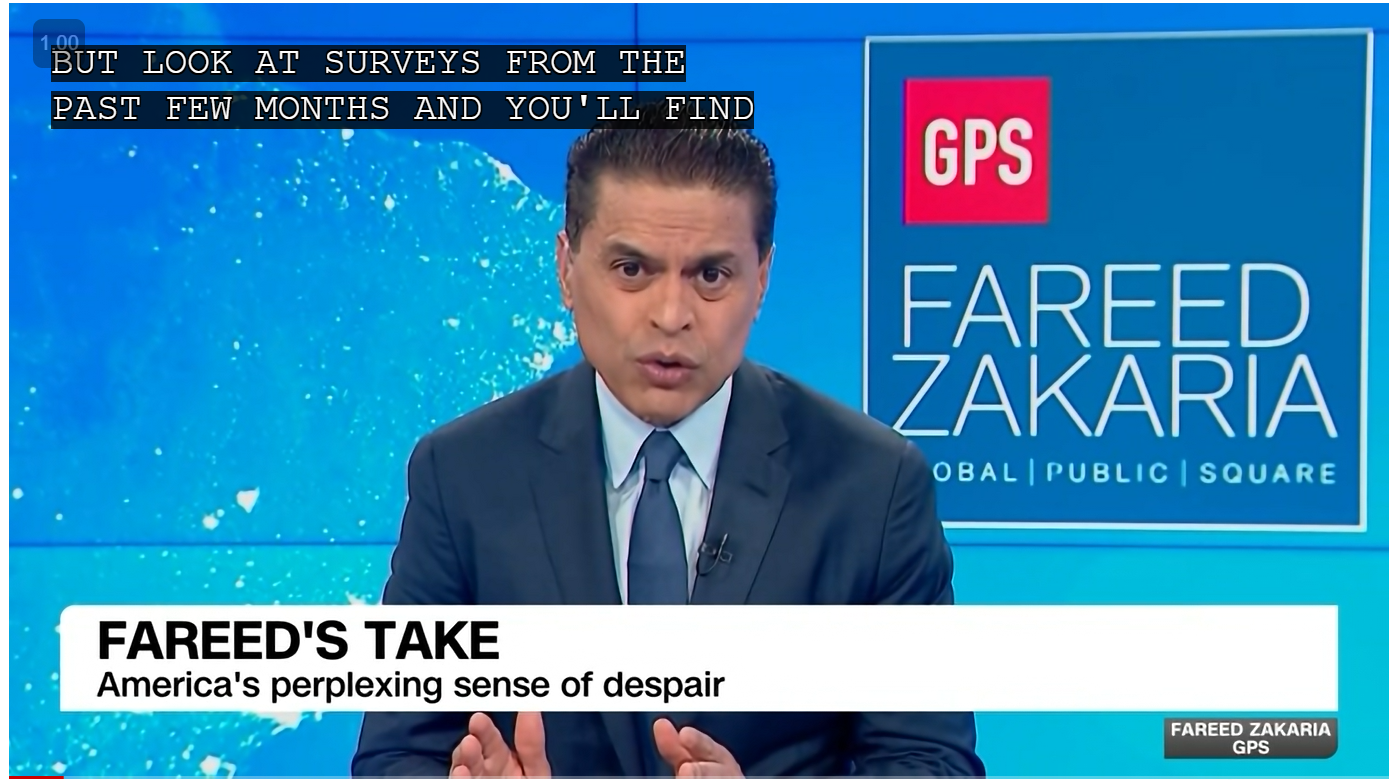
Synopsis: Is the press a core problem?
As detailed below, it becomes very clear that view of the presenter in the video from CNN are that “being on the right track” is all about a prosperous and growing economy, over and above the happiness, longevity, equality and freedom of the people. This is despite it becoming increasingly recognised that the metrics for the economy can fail at measuring that which benefits the population rather than just business.
So why would a news network presenter hold such views? Normally people apply confirmation bias, which means that which is in your own self-interest can determine what you believe is right.
Well for big, national businesses, the economy determines the scale of their market, provides growth for shareholders and bonuses for executives. While the news on CNN is largely free, who pays the bills? Those same big, national businesses, who place advertisements which are funded by part of the price of almost everything anyone buys which that “ideally” perpetually growing economy.
Not only is CNN itself a quite large national business, but it earns most of its revenue from the advertising budgets of even larger national or global businesses, and those advertising budgets come from an allocation within the price of everything we buy. Note that CNN is considered to be a “lean left” voice, so would be one of the least impacted by this form of confirmation bias.
It is easy to think that personally it is only other people who are influenced by advertising, but the levy is in the product price regardless of whether that advertisement influenced you personally or not. In the end, the networks get paid by us, and we probably pay more than we would be willing to pay if we paid by subscription directly and had lower prices on products as a result. A complex point to be covered elsewhere in more detail, but the key point for now is this whole process can distort our view of the world because it shapes the propaganda/news that gives us a window on the world.
The two big distortions are:
- The false claim that the bigger the economy the better our lives.
- The story that population growth is always positive.
A commentary on the commentary: The dream “right track”?

The world sees what America does not. Fareed explains.
The presenter states polls indicate up to 3/4 of Americans think America is on the wrong track: “This profound sense of despair is perplexing because I don’t find much objective data to support it”.
He then quotes object data in support of his claim:


- Inflation is dropping sharply, and wages are up.
- The US Economy grew at a 5.2% rate in the third quarter of 2023.
- Manufacturing employment is experiencing a boom.
- Per capita growth, US out performing UK and Europe for 20 years.
- US is the world’s largest producer of oil and gas, larger even that Saudi Arabia or Russia.
- Tech sector dominates the world, and top 10 US tech stocks higher than total value of Canada, UK, France and Germany combined.
- The USA achieve certainty of population growth that evades Europe and Japan despite families electing to have less children by accepting around 1 million legal immigrants per year.
In summary, the right track is economic growth, and population growth that drives economic growth. While there is mention of the often-forgotten per capita growth, there can be questions as to how well shared this per capita growth is in a society with increasing levels of inequality,
What is beyond the focus of being on the right track?
Happiness and livable cities seem to have been forgotten.
CNN runs articles every year on the happiest counties in the world, and the USA never makes the top 10.
Plus, CNN runs stories on the world’s most livable cities, and no city in the USA makes the top 10.
Why did it not occur to the presenter to place the happiness of the people and liveability of cities on the list and for a direction to be working to improve these rather than only on growing the economy?
The reality is the USA is far happier and more livable than other comparable size countries, and it is countries with smaller economies and populations that top the list.

Note that Finland, that world’s happiest country, manages this happiness despite the “disaster” of not having any significant population growth. Problem is that inconveniently suggests that growing the population and the economy may not always be the path to happiness, as opposed to corporate bonuses.
As does the problem of rising inequality.
CNN runs many articles on rising inequality:
- American inequality is rising despite higher wages.
- This former CEO is scared by America’s complacency with inequality.
- Buffett: Inequality is getting worse.
- Why is the U.S.A. so unequal?
- Who’s to blame for income inequality?
- ‘Growth is hurt by extreme inequality’
- Is economic inequality crisis snowballing?
- Inequality in America was huge before the pandemic. The stock market is making it worse.
- Zakaria on global inequality: Years of progress have been undone in months.
Ok, the last one is by the same presenter, so he should be aware of inequality as an issue. And in this video, he states that while inequality has been rising in the USA, prior to the pandemic it had been falling globally, so he should be aware.
And life expectancy, incarceration rates and gun deaths.

On the latest life expectancy data I have, USA is positioned at 30 and below almost all comparable rich nations, which given the cost of the medical system, is surprising.

But perhaps the rate of gun deaths being double any other country is also a factor in the low life expectancy?
(Notably “happy” Finland, was 2nd behind the USA in 2010 as per Wikipedia, but the small population means one event distorts figures, but even in time there were less than half the deaths per capita as in the USA, despite people having as many guns as in the USA, and reporting far lower gun deaths in other years.

Then there is the incarceration rate. Only 5 countries: El Salvador, Cuba, Rwanda, Turkmenistan, and American Samoa lock up as many citizens.
Like gun laws, there is no suggestion this statistic is worsened by population growth or the push for economic growth, but still surprising that when faced with statistics questioning national direction, for the presenter, neither of these statistics was at all significant enough compared to the economy to be given any thought.
Population growth wars: An economy that farms people?
The economy is like an egg farm run by a hierarchy of chickens.
There are some similarities, but yes of course also differences.
Similarities arise because the goals of the economy and the goals of an egg farm. The size of the economy is measured in terms of GDP or “Gross Domestic Product” as the measure of total production which corresponds to the total value of eggs produced being the measure production of an egg farm. The goal of the economy is not the happiness of the chickens, and even if the chickens don’t benefit from increasing their numbers, the more chickens, the greater the total production.
Difference stem from that in actual real egg farm, all the chickens are basically equal, and they don’t get a share of the profits. True the chickens can enjoy a better life if the farm is more profitable, but as with the people in the economy, the spoils are not always shared amongst the masses.
Just as the greater the population of chickens in an egg farm the more eggs, the greater the national population, the greater the national economy.
Managing to increase the population delivers more customers for every nationwide business, providing economic growth just for continuing business as usual. The only problem is the growth does have to stop at some point and becomes uncomfortable for the chickens well before limits are reached.
The wars: When is population growth beneficial, and when it isn’t.
More on this will be added later, but simplistically, when the people are choosing to have sufficient children to grow the population as we the case in the USA all the way up to and through the 60s, 70s and 80s pf the 20th century, then the population is welcoming growth because population growth works for the people.
However, now in the 2020s, with the people having birth rates below replacement level such that without interference the actions of the people would result in population easing, there is an argument that the population growth has reached levels where it no longer works for the people.
However, even if population growth no longer works for the people, it still works for the economy and
Now it is the actions of the government that intervene and ensure population growth through immigration. It could be argued that then using immigration to override the actions of the population and impose population growth, may lead to reactions of the population expressing concern over immigration levels.
War victim: The morality of immigration programs and goals.
Countries like the USA, Canada and Australia which use population growth through immigration see “illegal” immigrants and refugees attract far greater focus politically than “legal migrants” despite population increases and any resulting negative consequences being driven by “legal migrants”.
The result is that people who need a home get less places, and “legal migrants” who have often been trained by poorer nations at the expense of those nations, are sometimes lured from where they are more needed without compensation.
While the US population is currently over 330 million “legal immigrants” and growing by over 1 million legal migrants per year, the “illegal immigrant” population peaked at 12.5 million 2005 and has never reached the same annual rate of growth.
It is not that all legal immigration is a bad thing, just that an immigration program with a goal of economic growth can put corporate profits before people. Measures to increase levels of legal immigration in order to boost the economy, can come at the expense of the per capita economy in the country attracting immigrants, and also at the expense the national economies in countries losing their most skilled workers and being used as a “people farm” by more developed nations.
Keeping the countries supplying immigrants at a disadvantage ensures a continued supply of immigrants who will often work for lower wages than the domestic work force. While use of immigrant workers can help keep national wages from rising, this is only one of the reasons it can also contribute towards resentment. Another potential problem is in most developed nations, birthrates are at less than 2.0 children per woman very likely because the population feel conditions are not appropriate for population growth, which is not the best environment for an influx of immigrants.
However, any negative consequences from government immigration policies to boost the economy, arguably often at the expense of the average individual, are blamed on “illegals”.
Focus on a strong economy wins votes: “It’s the economy stupid!“
The “It’s the economy stupid” phrase encapsulates the idea that the key to winning office in the US is to present as best able to manage the economy. While this may represent a degree of exaggeration, it is clear that managing the economy is seen as extremely important.
But why is the economy so important to voters, given that it does not relate particularly well with happiness or necessarily even the wealth the average citizen? One possible reason is that voters get their information from the press, and that information reflects the greater importance of the economy to the press, rather than it’s impoertance to the average person.
It could also be that support of the press and large political donors, or donor groups, are key to being in the contest to win an election even if these the actual winner comes down to voter appeal.
You can’t win an election without the public getting the message, and that depends on either the funding to push the message, and/or cooperation of the media. While there can be regulation to ensure candidates are funded by the public, these regulations can’t prevent the media giving free promotion through news coverage, nor can they prevent “donor” groups that do their own advertising rather than directly fund the candidates, much like super PACS in the US elections, or perhaps campaigns by candidates targeting goals other than actual victory such as Clive Parmer in Australia.
Ask Donald Trump and he’ll tell you journalists wield a lot of power over the U.S. political process.
It’s true that the media have played an important role in politics since the First Amendment established freedom of the press as a cornerstone of American democracy. Voters need information to make educated decisions, and it’s journalists’ job to give it to them.
But can the media really alter the outcome of an election?
Six ways the media influence elections
Television ads, logos, stickers, staplers and staffers. They are all needed to run political campaigns. And they all cost money.
Fundraising is one of the key components of political campaigns. Candidates spend a significant period of time talking to donors and mobilizing grassroots donations in order to keep their campaigns alive.
It takes lots of money to win elections. Here’s what you need to know.
Money is indispensable in American electoral campaigns. Without it, candidates cannot amplify their message to reach voters and it’s harder to motivate people to take interest and vote.
Money in elections doesn’t mean what you think it does
Updates:
- 2024 Jan 11 : First published.