
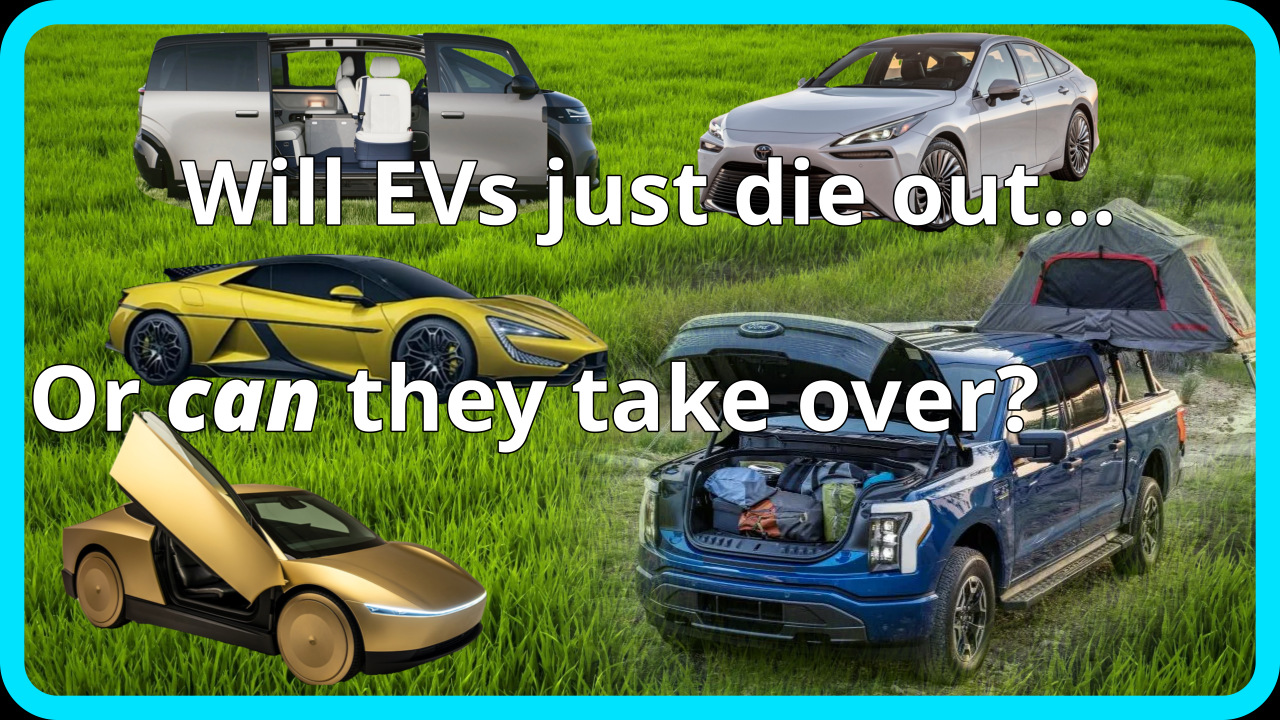
Introduction:
The future of cars. Tucks n other vehicles will be a separate page/videos. Some of this will be controversial, perhaps even radical, and you may not agree, but hopefully it’ll provide food for thought on the future of cars.
I will first look at whether self-driving could mean in future every one will only use robo-taxis and no one will still buy cars, and then, what the trends will be assuming people do keep wanting to own cars. A Trump led shift, back to fossil fuels because everyone is sick of hearing about climate? Or will it be hydrogen, e-fuels, or ever more EVs and EV hybrids? And lastly, the barriers that could stall an EV transition leading to a bigger role for EV hybrids.
Welcome to a one finite planet video on the future of cars and trucks. I have had a lot of practice predicting the future in roles as a product developer and ceo in technology companies, but practice makes better, not perfect, so i am very interesting in feedback and the thoughts of others.
Background: A time of change.

There is a lot to consider in predicting the future, because everything is connected, and in world facing a radical drop in population growth, the rise of robots and AI, economies playing out real world monopoly where, while things head towards a few owning everything, so far, something always resets the game before that end, and my stance of stop with “save the planet”, because its a trap! doesn’t mean i think there is no risk, or that we can assume future climate events won’t lead to an even greater call to action-on-emissions in coming years.
Car (& personal trucks): Far more than just transport.
To save time, I use the word “car” to include any vehicle primarily designed, or used, to carry the owner, their friends and family, and the “stuff” any of those people want to transport. This means I include a “pickup”/”ute” “backie” (what ever various people call them) when i say “car”, despite some people preferring to call their vehicle by the more “macho” sounding “truck”, also because if i call those “trucks”, what do i call vehicles that carry purely commercial loads?
Robotaxis: Great, but not a replacement, as cars are far more than just transport.
Next, the “robotaxi” thing, and let me say, I am not convinced by the “in the future people won’t need to own a car”, largely because I see owning a car as a mix of need and want.
A lot of people get a lot of joy from car ownership. To me, it’s a bit like saying “in the future, hotel rooms will become much cheaper so no-one will need their own home”, and will just rent rooms for the time we need them.
Car (& personal trucks): Not just transport, but mobile living spaces.
To me, cars aren’t just transport, they’re movable private spaces that are an extension of a home. Consider for example, the number of people who have made out, had sex, or even been conceived in a car. It’s just a lot more restrictive in a taxi with a meter running, even without a driver. Plus many people own very individual vehicles like “pick-ups”, and the owner often has a lot or personalisation and keeps things permanently in the vehicle.
I find it hard to see robotaxis being a full substitute. I suggest the same self-driving technology than enables robotaxis, could enable your car to drive itself to you, or home after dropping you off, and could reduce the need for taxis, and the rent vs buy equation may not end up as compelling as some think. More content on this linked below, and i would love to hear what other think.
As for self driving tech. I think it will get there, but has further to go than many assume. Currently people find many safety system cut in when not needed, but before cars can drive themselves, all the self driving tech should be able to on all the time, demonstrating the tech can always prevent accidents whenever possible, showing it safe for the car to be in control. Again, more on that will be linked below.
OK. Hydrogen cars? Hydrogen for green steel and aluminium etc, yes. But for fuel, i just don’t see it. The whole “abundance” thing is an attempt to mislead, as “ready to use” hydrogen is far from abundant. You could make the same claim about electrons, as they are even more abundant. I cover this in other content linked below.
What is realistically promoted, is that you can extract hydrogen from water using clean electrical energy, then supply it to cars that only emit water. The biggest problem I see, is that while hydrogen made this way has lower cost production than “e-fuels”, the cost of compressing, handling and transporting the hydrogen ends up making it more expensive, and both are inherently several times more expensive than directly using the clean electrical energy. Hydrogen gas tanks are at 700 bar, which 10,000 psi. Your BBQ gas tank is typically at 8 bar or 120 psi. This is almost 100x the pressure, and not only does that compression require a lot of energy, and generate a lot of heat, it makes the tank an explosion risk even without thinking about the Hindenburg.
E-Fuels? Well they make a lot more sense than hydrogen. They work with current engine technology, and can be distributed through regular gas stations. No new distribution infrastructure saves at least billions , and still net zero overall emissions. We could do it now, except it is lower cost to have 2 billion vehicles burning fossil fuels, because their emissions are “untaxed externals”, so the supplier can ignore the cost of removing the emissions. At least, so far, and there is a lot of money against changing that.
Fossil fuels vehicles vs EVs? Could we just drop EVs given the current political environment? Well no, beyond uncertainty whether the political environment will change again, there’s another reason why the EV revolution, will continue regardless politics, even without emissions rules: cost!
EVs inherently cost less, and have only been more expensive so far because of “wright’s law” (see links below), which could be paraphrased as “for a while, producing stuff produced which is based on new technology, will be crappy and expensive”. Consider mobile phones, computers, flat screen tvs…. when they are first released, they cost a bomb and were nowhere near as capable as today, and only sold initially because they had some feature enough people were willing to buy despite the cost. New technology needs some initial hook, because if the only selling point is it can be cheaper, that just wont work until you can at least get somewhere near the scale of the previous technology. For EVs the main cost is the power unit, which for an EV is the battery, not electric motors. To get that, consider, if you need to power your house during a blackout, a combustion engine generator can do it, a battery can do it, but an electric motor doesn’t make power, and won’t help. It must be supplied with power, to turn the power supplied into motion. Power in, motion out. So the comparison is between batteries and combustion engines. Now consider the data on the history of battery prices of batteries……..
The bottom line is, EVs needed incentives and climate motivated buyers to get past that early “crappy and expensive” phase, but are now entering the “cheaper and more reliable” phase where buyers no longer need to be any more “environmentally” motivated than they do to install home solar: it becomes all about price regardless of climate beliefs.
EVs will end up cheaper, so logically, most vehicles should end up being EVs, but only, provided EVs can equally meet people’s needs. This will be controversial, but I am going to say, we are a long way from EVs meeting everyone’s needs. I drive an EV. It cost less to buy, and less to run than equivalent ICE or internal combustion engine vehicle, and fully meets my needs, but are there are some real barriers to making this work for everyone. ….
The major EV barrier: Private charging.
First, consider that charging an EV, is basically the same as charging a mobile phone, and very different from filling a gas tank. Most of us have locations for “private charging” of our phones. Places where will already be spending enough time for our phone to charge, and where we can count on a charger being available exclusively for our use.
Without private charging, we’d have to use public chargers like those lockers available in some shopping malls. Imagine needing to use them all the time, well that’s what owning an EV could be like if you must rely on only public chargers.
I suggest, if you can’t count on access to private charging, either at home, or a dedicated parking space at work, than think carefully before buying an EV. It is not that it can’t be done, it is just that in most cases, you have to want that EV. To test it, i’ve even intentionally used only public charging for periods, and I know EV owners who rely on only public charging, but in every case, it requires making adjustments to the persons day, which EV owners can be happy to make, but not everyone would be happy to make. Like :”I sit in the car and read emails, as i am going to read them somewhere anyway” or “I park at the charger and go for a walk, because i go for a walk to exercise every day anyway” or “I go for a coffee and chill out”. Plus it is not only finding time at the right place, because the reality is that sometimes, there is no vacancy at the desired charger location.
Then there’s cost. In Australia, while there are also some free public chargers, most are not free, and can cost up to 10x what people are paying to charge at home. The operating costs of a EV, will still result in savings, but those savings can range from almost nothing, to almost zero fuel cost. This is discussed further, in content on “public charging” linked below.
The second EV barrier: road trip charging.
Even if you can charge at home, this is sort of the equivalent of needing a power bank, or public charging for your phone or laptop, for those occasions the power wont last through the day.
For those, who take the approach with road trips of taking a break every two hours as recommended, then when everything comes together road trip EV charging stops, can be even more convenient than with ICE ( on screen- internal combustion engine) vehicles. You park, plug in, take your break, and when you are ready to go, your vehicle has gained enough charge already, so you just leave. speech
But there is a whole list of things that can block this ideal scenario, ranging from minor through to more major:
Your car may be charged before you are ready to go, and it may be necessary to interrupt your stop and move your car. Well, this makes the stop comparable to with an ICE vehicle when for the stops that include refuelling [because it is rare you can just leave a gas car a the pump], but, currently, lower highway range means EVs need “refilling” during most stops. Interestingly, faster charging could make this worse.
Or, your car may not have enough charge, when you’re ready to go. I have a fairly slow charging, but quite efficient EV, and the end result is for me, normally stops are long enough, and needing to wait longer is rare. I have more often had that previous problem with alert from my phone “charging ended”, and left before I would have otherwise. As EV charging speeds increase, needing long stops should happen less. I don’t look forward to 5 or 10 minute charging, because it I would not be able to do anything but wait while charging, but for some, it could be good.
Plus, you can need to plan your trip, around charging locations. Stopping at a lookout, stream or other nature spot, and using the car power to make your own coffee would be great, but for current EVs, you can need almost every stop to be where there is charging.
All chargers can be busy or broken. Waiting for a vacant charger is potentially far worse than waiting while your car charges. While your car charges, you are in control, and can go back to your car when you are ready, but waiting for a charger often means waiting at the chargers for a time you cannot predict, and not being able go and get food or other things while you wait. Plus, no matter how fast your car charges, you have no control over having to wait while another car charges. This doesn’t happen often but could add an hour to a long trip if it does. I recall one long trip at a very busy time of year i needed to allow for this, but arrived over an hour earlier than i needed to. The biggest hassle is that it could happen.
Lastly, there are people, who don’t want to stop and take breaks. Of course, almost no one would stop for a break during an urban fuel stop, but there are people, or trips for some people, when for those people taking a break while at at the charger, would be considered just time wasted. The only solution here is longer range EV, as most people will stop at least once on a day of driving, and every year, on average, EV range of new typical vehicles increase.
So what is the solution for these barriers, and other limitations?
Range extended EV hybrids: A solution for EV limitations?
There are vehicles described as EREVs, (ex…) and confusingly, some described as PHEVs, but not all, that are effectively EV hybrids, as they as they were designed and operate like an EV that has been equipped with an onboard gasoline power generator, for when plugging in to charge is impractical. Others, which i call ICE PHEVs, are based on an ICE vehicle, with an added EV system, with limited range and limited power, but to improve rated fuel economy, even if not always practical.
The key point of difference, is EV PHEV electric motors can provide full, or almost full power, allowing the vehicles to be driven as an EV in any almost any situation, and can be less expensive as they do not need a regular gearbox. ICE based PHEVs like the Ford Ranger PHEV, or historically most European PHEVs, have not only very limited EV only range, but also very limited EV only power, and usually come at a price increase over a non-PHEV version of the same car. Compare the expensive ICE based Ford Ranger PHEV with 75kW of electric power, with the lower cost usually better equipped BYD Shark PHEV with 320kw of electric power. This, “at least near full power from the electric motors” results in vehicles that have, not just a hybridised drivetrain, but are genuinely a hybrid of both EV and a hybrid vehicle. They can provide ICE hybrid economy when fuelled on gasoline, and EV only operation when charging is available.
As further discussed in content on EV hybrids linked below, there have long been both EV PHEVs, like the Chevrolet Volt and BYD PHEVs, and ICE based PHEVs, like Volvos and most Europeans PHEVs. Arguably the EV hybrids can be the best of both worlds, while some ICE PHEVs are compromised as an EV and often even compared to non-plugin hybrids. Note: I specifically mention BYD EV PHEVs, because they for some time dominated the cost effective EV PHEV market, but now BYD is beginning to face impressive competition with EV only range exceeding 400km, as shown here! (stellar)
The limiting factor, for early EV hybrids like Volt, was that “Wrights Law” problem, where new technologies, even when they should cost less, are initially expensive until design and production evolve. Although BYD began producing EV hybrids in 2008, it was only in 2022 when their EV hybrids, finally cost less than a regular ICE vehicle, that BYD stopped production of regular ICE vehicles altogether.
So to sum up. I don’t see hydrogen for vehicles as having a future, but I see e-fuels as a way, to indefinitely allow continued use of combustion engine vehicles. Still, expect the combustion engine will progressively be increasingly only be used as part of EV hybrid drivetrains, and only offered when there are reasons that justify the increased cost of both production and operation, over and above and EV. For a long time, cases where the cost is justified, may include long distance heavy towing, military scenarios, or other places where there is no grid, but a large store of power may be required.
Wrights law should result in more improvements in EVs and EV hybrids, than in the more mature combustion technology, and I feel we are now at the point where both EVs and EV hybrids are beginning to provide more vehicle for the same price, than conventional ICE vehicles. While many pure EV enthusiasts, would prefer it is EVs alone that will take over, I feel there are still barriers to overcome before that can happen. Expect increasing cost of fuel to mean even vehicles with combustion engines use those engines less and less, but if we could also move to e-fuels, there’s no reason to end use of combustion for those willing to pay. What do you think?