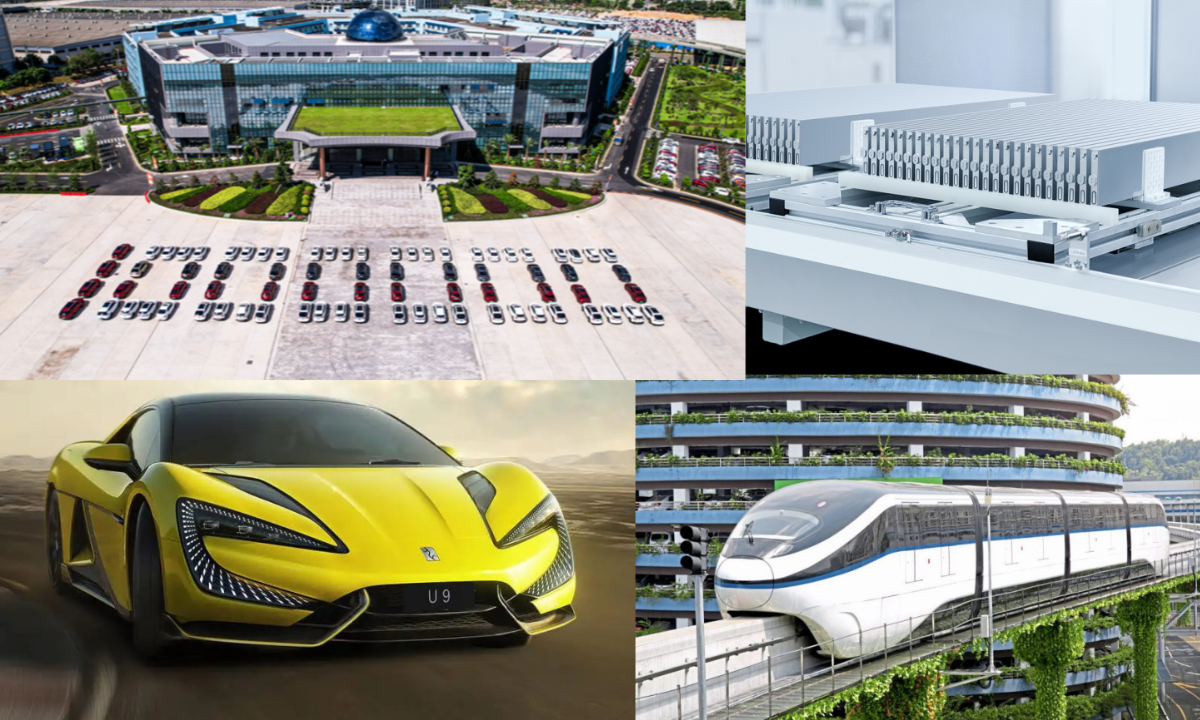
BYD swaps places with Tesla for being 1st or 2nd biggest EV brand in the world, and is second to only Toyota in hybrids, and with BYD DM EV based hybrids is the world leader in plug-in hybrid sales and the world's second largest battery company. In 2024, BYD is a rising star in top 10 automotive companies for sales of all vehicles briefly overtaking Ford for 4th place inAugust 2023.
In of March 2023, the Atto 3 from BYD rose to 3rd bestselling EV globally behind the Tesla Model Y and Model 3, but the world outside of China is only just starting to see the capabilities of BYD and quality of their vehicles and batteries.
BYD swaps places with Tesla for being 1st or 2nd biggest EV brand in the world, and is second to only Toyota in hybrids, and with BYD DM EV based hybrids is the world leader in plug-in hybrid sales and the world's second largest battery company. In 2024, BYD is a rising star in top 10 automotive companies for sales of all vehicles briefly overtaking Ford for 4th place inAugust 2023.
In of March 2023, the Atto 3 from BYD rose to 3rd bestselling EV globally behind the Tesla Model Y and Model 3, but the world outside of China is only just starting to see the capabilities of BYD and quality of their vehicles and batteries.
BYD: The brand bringing Chinese Vehicles to the world stage.
Introductions to the brand that start with the claim that BYD stands for “Build Your Dreams” indicate a lack of research or simply being gullible.
Yes, BYD is often promoted as the initials of “Build Your Dreams”, but that is notthe origin of the company name, and in reality, was just an attempt at a slogan that has been invented to try to explicate the letters and reveals no more about BYD and the origin of its name than “Ultimate Driving Machine” reveals about BMW. The company name in Chinese is 比亚迪 which when spoken in Mandarin sounds like “Biyadi” and has its origin in the name of the companies first address. The company name is Chinese is three Chinese characters 比 亚 迪, and three Latin Script letters B Y D were chosen as most closely matching the sound or the Chinese name.
BYD is also often described as the largest company you have probably never heard of, but just how big they have grown is rarely made clear. BYD is the only Chinese brand in the top 10 carmakers worldwide at number 4 as of August 2023, as well as being the only EV based carmaker in the top 10. Within China, BYD has rapidly risen from outside the top 10 to number 1 overtaking VW and Toyota in late 2022, and again is the only EV brand in the top 10. BYD is also the only carmaker that is also a battery maker, and #2 in the world in batteries with supply contract to other brands from Tesla to Mercedes. More vertically integrated than any other carmaker, they also make many things from light rail, electric buses, integrated circuits though to building around 50% of all iPads for Apple.
Starting as battery company in 1995, they bought an existing Chinese car company in 2002 to learn automotive manufacturing before launching the world’s first plugin hybrid (PHEV) vehicle in 2008. In 2022 BYD ceased production of ICE vehicles and has since produced BEVs and PHEV in approximately equal numbers. BYD has a history of first entering segment where EVs may have a range problem though PHEVs. Unlike many other PHEVs which are basically ICE vehicles with an added quite low range and a low power EV system, BYD PHEVs are more EV focused and could be considered EREVs using a combination of what was in 2020 the world’s most efficient internal combustion engine to extend the range of an underlying EV architecture capable of full performance and typically over 100kms of range in full EV mode.
The growth has been astounding. BYD produced their 6 millionth EV in November 2023, and almost half of those EVs were produced in 2023.
The 6 millionth BYD NEV is the Bao 5, the first model of the company’s personalized brand Fangchengbao, which saw its first delivery yesterday.
BYD stopped production and sales of vehicles powered entirely by internal combustion engines in March 2022, shifting to focus on NEVs, including battery electric vehicles (BEVs) and plug-in hybrid vehicles (PHEVs).
The 6 millionth NEV milestone is just slightly longer than three months from the 5 millionth.
On August 9, BYD saw the 5 millionth NEV, the N7 SUV from its sub-brand Denza, roll off the production line.
On November 16, 2022, BYD sees its 3 millionth NEV roll off the line, an all-electric Seal sedan.
It took BYD 13 years to see its NEV production reach its first million units. After that, its production rate accelerated significantly, and it took just one year to reach its second millionth NEV.
From the 2 millionth to the 3 millionth NEV rolled off the production line, it took BYD just six months.
BYD sees 6 millionth NEV roll off production line
BYD EVs: The Chinese EV brand with a Tesla like EV impact.
BYD Overtakes SAIC to become fully #1 Automobile company in China in 2024.
When BYD overtook VW and Toyota to become China’s best-selling vehicle brand in 2022, at the time I assume that also meant BYD had become the biggest car maker in China, but it turns out that it was a little more complicated, because the SAIC joint ventures with both Toyota and GM in addition Wuling and SAIC’s own brand meant that all SAIC subsidiaries combined until 2024 still produced more vehicles than BYD.
Last year, BYD became the best-selling brand in China, the first time a Chinese brand had held the position since the start of joint ventures. BYD has now gone one better and become the largest automotive group in China. In September, BYD officially replaced SAIC in the top spot.
SAIC’s claim to the top spot was always rather dubious, thanks to its dependence on the Volkswagen, General Motors, and SAIC-GM-Wuling joint ventures, with SAIC’s wholly owned brands making up a relatively small proportion of total sales.
When you consider the list of best-selling Chinese cars in China, and no, this is not just EVs as evidenced by the Geely Xingyue_L in 13th place, it looks impossible for anyone to be close to BYD. However, what is missing from that list, is the foreign brands manufactured by Chinese companies.
Rapid rise to #1 Car brand in China: From nowhere in 2020 to #6 in 2021, #1 in 2022.
No, BYD is not just “a Chinese EV brand”. It is the Chinese EV brand and even more broadly the largest carmaker from China. Whether Tesla or BYD leads on sales globally depends on how you count the numbers, but no other Chinese brand comes close to BYD, and gloablly only Tesla is in the same league with respect to EVs. In global EV sales by company in 2022, BYD was either #2 behind #1 Tesla, or with those positions reversed depending on whether PHEVs are included. The only other Chinese company in the top 10 was Wuling, with what based on including sales numbers for what is a technically a “quadracycle” that sells for around US$5,000.
When a review positions BYD as “one of the EV brands emerging from China”, that does not really capture the reality.
Market dominance inside China: EVs.
In China BYD, sells around double EVs of Tesla and Aion, and around 9x more passenger car EVs than any other brand, excluding quadracycle vehicles by Wuling.
At this time, other Chinese brands available in many markets outside China such as MG (SAIC) and Ora (Great Wall) do not even make the top 10 list of EVs in China.
This dominance has as a result of remarkable sales growth.
Since the 2020 launch of the first vehicles using the blade battery, BYD sales of now risen by a factor 10x!
The next step is for BYD to bring these vehicles to the global marketplace.
Market dominance inside China: BYD vs sales of all other vehicles.
BYD not only sells far more vehicles than any other Chinese EV brand, but BYD is in fact the top selling maker of all vehicles in China, having overtaken previous leaders such as VW-SAIC and Toyota. Yes, in the world’s largest car market, a brand making only plug-in vehicles, now outsells the traditional brands even their ICE vehicles sales. Vehicles like VW Golf and Toyota Corolla are no longer able to propel their makers to number 1 in sales. You now need to also be big in EVs.
This rise of BYD to #1 in China has been recent, and rapid.
BYD grew from over three-fold from 2020 to enter the top 10 car brands in China in 2021 at position 6, and then again over three-fold again in 2022 to overtake Toyota and VW to become not just the largest EV maker in the world’s largest car market, but the largest maker of all vehicles, despite themselves no longer producing any ICE vehicles.
In western press there is a tendency to generalise about “Chinese vehicles”, with the implication that all Chinese brands are the same, which would misleadingly imply that other brands from China are comparable to BYD.
JPMorgan believes BYD’s (HKG: 1211, OTCMKTS: BYDDY) efforts to expand into global markets will see a key milestone in 2026, when full-year deliveries are expected to reach 6 million units.
By 2026, BYD’s global deliveries could reach 6 million units, with about 1.5 million in overseas markets and the rest at its home market, analyst Nick Lai’s team said in a July 9 research note.
That means BYD’s share of the global light-vehicle market will expand from 3 percent in 2023 to 7 percent in 2026, and its share of the new energy vehicle (NEV) market will remain at about 22 percent, the team said.
BYD sold 3,024,417 NEVs in 2023, a year-on-year increase of 62.30 percent, according to data compiled by CnEVPost.
In the first half of this year, BYD sold 1,612,983 NEVs, up 28.46 percent year-on-year.
If all others brand sales remained steady, this would place BYD in 3rd or 4th place globally, however since the 3 million extra sales for BYD have to come from somewhere, sales of all other brands cannot remain steady.
In August [2023], the global car sales in 37 principal markets hit 5.55 million units. Amidst this, BYD exhibited resilience with a 5% month-on-month increment in car sales, despite a softened demand in China’s auto sector. The company was nipping at the heels of third-place Honda, trailing by a mere 0.1 percentage point in market share.
Yes, everyone seems to trust the source, but these are sales figures for just on month. Not for an entire year or even year to date.
Data on the basis of one month can fluctuate significantly, so what does it really mean?
The reality is that BYD sale numbers have just steadily climbed, so BYD being in position 4 is taken as significant. However, as BYD started the year at a much lower position, the overall year sales at the end of 2023 with not record a position of #4 for the entire year. BYD has reach #4 in sales but will not have held that position for a year as soon as December 2023.
Also, it may seem a little odd that Honda is listed as #3, given Honda ended 2022 as #7 and Ford was #6, not #4. Clearly, GM and Stellantis are regarded as now having fallen and this data separates Hyundai and Kia, but Honda rising to #3 was not noted, as Honda will not be likely to hold that position, whilst BYD will be likely to hold #4 in coming months.
#1 in EVs and headed to top ten overall. Source: EV Volumes.
BYD Globally: From nowhere in 2022, to #6 in 2023?
In Q3 2022, BYD has projected a target of 4 million vehicles in 2023, up from 1.8 million sales in 2022, and if BYD achieves that 4 million mark, it will be around 6th of all vehicle brands on the global stage and would be an even more distant #1 plugin vehicles sales. Achieving #1 globally of all car makers and overtaking Toyota and VW globally, if even at all possible, is still further away than just one extra year.
Although even brands like VW depend more on China than any other market, BYD is still even more dependant than VW and Toyota on China, and 2023 could be an “interesting” year in China for car sales.
The position of BYD in global sales, is courtesy of BYD dominating the market in China, and China representing over half the global EV market, as well as 1/3 of the global vehicle market.
While BYD is expanding internationally, the import duties that Donald Trump introduced for Chinese vehicles into the USA, means 7 of the world’s top 10 selling plug-in vehicles, and the most affordable 7, are not scheduled for release in the USA.
But the USA is not that far behind the rest of the world, because most of the rest of the world is only just now starting the receive BYD vehicles.
The BYD vehicle being received 1st in most markets is the Atto 3.
BYD Brand: Quality.
J.D. Power has put the magnifying glass on Chinese electric vehicles (EVs) and plug-in hybrids (PHEVs) to see which are the most trouble-free.
The 2024 China New Vehicle Energy Initial Quality Study SM is based on responses from 9791 vehicle owners across 81 Chinese cities who purchased their cars between July 2023 and January 2024.
China vehicle quality ratings in 2023 have BYD in 3rd place of 26 EV brands, and with a quality score above all 62 ICE brands. This means 3rd of 88 overall. For comparison, the two Toyota brands are #8 and #10 on the ICEV list, is Tesla is #22 on the EV brands list. The reason there are two Toyota brands is western ICEVs in China are manufactured by JV partnerships, and many brands have two partnerships including both traditional leaders VW and Toyota.
The reliability ratings are impressive, and the brand is known for engineering, although they are not currently a standout out in software, and are not a premium brand, although they have recently launched a premium brand with two vehicles set to hit the market soon.
To get a sense of scale: BYD employs more than 90,000 employees in its research and development departments, and more than 4,000 of them working on L2-level smart driving. BYD says it has 230,000 employees in total spread over 50 campuses across the world.
BYD already has an in-depth layout for more advanced L3 smart driving, and became the first Chinese car company to receive an L3 test license in July 2023, Wang said.
With now over 4,000 of those over 90,000 BYD engineers allocated to work on AI and self-driving, it is starting to pay off.
While many Chinese electric vehicle (EV) makers have demonstrated their assisted driving capabilities via social media videos over the past few years, BYD (HKG: 1211, OTCMKTS: BYDDY) was an exception.
BYD today shared a 2-minute, 40-second video on Weibo using a Denza N7 SUV (sport utility vehicle) to show how its HD map-independent driver-assistance technology performs on complex roads in urban areas.
“This is the debut of BYD’s map-free city pilot assisted driving feature in real-world testing, with smooth 0 takeover throughout the entire journey, successfully traversing a complex urban village at night,” BYD wrote on Weibo today.
The video shows the Denza N7 navigating narrow and complex roads that are challenging for even human drivers without having to take over the entire time.
BYD aims to rapidly expand the adoption of its proprietary autonomous driving technology, intending to make it standard in vehicles priced at 150,000 yuan (20,700 USD) or less within the next three years.
BYD began as a battery company, entered the vehicle industry in 2003 by taking over a failing car company in order to “learn the ropes” of vehicle manufacturing before launching the world’s first PHEV in 2008. BYD cars were for some time quite ugly prompting many including Elon Musk to dismiss them, before they engaged experienced designers and improved.
But things really took off with development of both the blade battery and the DM-i/DM-p technology from the year 2020, which led the EV sales climb on the remarkable trajectory quoted above.
The following is how I originally tried to describe BYD
BYD, the largest car company most people in the world anyone, other than EV fans, have never heard of, outsold Tesla within China in in 2021, and as BYD exports grow, has the potential to start outselling Tesla globally.
BYD batteries are in phones including iPhones, and their electric busses are already worldwide.
Warren Buffet Berkshire Hathaway group as significant shareholder.
For world’s largest automobile company by 2030, some predict Tesla, others that it will still be Toyota, and I am not alone in predicting BYD will be the largest, and they have had that plan since 2010.
There is a belief in some circles that affordable plug-in hybrids will be the ones that will really start eating into the market share of full ICE vehicles in China. There is also a strong belief that many families that do not yet own cars in China may be more comfortable starting with a plug-in hybrid than a full BEV for now. Perhaps this is one of the reasons BYD is continuing with its range of “Super Hybrids” in its DM-i (Dual Mode Intelligent) and DM-p (Dual Mode but more powerful all-wheel drive) range.
BYD clearly is doing a lot right in China, but there is some question as to whether they have found the formula for creating brands and model names that will aid in a push onto the global marketplace.
The BYD name: No, it is not really “Build Your Dreams”.
Chairman Wang Chuanfu explained in 2022 that the “BYD” name as simply the pinyin initials of the company’s Chinese name Biyadi, which itself was created to be unique and distinctive from existing trademarks; however, the company later back-formed a slogan, “Build Your Dream”, to fit the “BYD” name.
银柿财经 (Silver Persimmon Finance), “王传福:比亚迪“Build Your Dream”是这样来的” (Wang Chuanfu: origins of BYD’s “Build Your Dream”), 2022-04-02
“In Mandarin it’s 比亚迪. Literally Biyadi. It has no meaning. Build your dreams is just made up to make BYD mean something.”
The name of the company is “Biyadi” and B-Y-D is simply the “Latin script” letters that best sound out the name “Bi-ya-di” using the names of letters.
Wikipedia has now added a quite complete explanation:
Chairman Wang Chuanfu explained in 2022 that the “BYD” name is the pinyin initials of the company’s Chinese name Biyadi, which itself was created from company’s original trademark Yadi Electronics (亚迪电子, named after the Yadi Road in Dapeng New District, where the company was once based) and the character Bi was just conveniently added to give the company an alphabetical advantage in trade shows. However, the company later back-formed a slogan, “Build Your Dream”, or more commonly “Build Your Dreams”, to fit the “BYD” name.[16][17]
The company has really struggled with how to present itself outside China. Yes, there is a story that BYD stands for “Build Your Dreams” and the founder also once joked perhaps it should stand for “Bring Your Dollars”, but the “build your dreams” was created as an official back-formed slogan, much as LG, the former Lucky Goldstar created “Life’s Good”, but more compromised than slogans that are not back-formed like the Audi “Vorsprung durch Technik” slogan, or BMW “Ultimate Driving Machine”.
In fact, BYD has ended up with a name following a trend common with Chinese companies in the 1990s of instead of the more traditional choice of typically 3 Chinese characters for a name, choosing the three English characters that when sounded out most sound like their name and using these Characters even in China. In many cases the English characters are used exactly like Chinese characters, in that they do not spell a word or form an acronym, and it is only that the name results from the sound from reading the characters.
Even before seen quotes from the founder, I had read that this slogan was added later, and it always seemed far more likely. In the 1990s in some Chinses cultures it was common to name a Chinese company with three characters, and those who wanted to be international chose three “western” (or “English”) characters either instead or in addition to Chinese characters. Names built from Chinese characters build words the same way Latin/Western style characters, as characters themselves are like words. Just as Chinese characters don’t need to stand for anything, I found many companies with three western characters where it never occurred to them the characters needed to stand for something.
Given the original logo looked a bit like the BMW logo, I do suspect they thought in choosing the three-letter form of “BYD” instead of just “Biyadi”, they were looking like BMW by having 3 letters.
The adoption of “Build Your Dreams” as an attempted backstory has had very questionable success outside China and does not seem to be marketing winner. They would probably be better off promoting: “It started with a humble company named after the street”.
BYD Sub brand names.
BYD has so many brands it seems like BYD is trying to emulate General Motors. There are two rival mainstream “brands” or series, the Ocean Series and Dynasty Series, each with its own styling theme and in China, dealerships, with in many cases each series having its own version of the same vehicle, almost like Kia and Hyundai, but in the same company. Then there is not only “Denza” which is like the Hyundai “Genesis”, but in China also “Fang Chang Bao” which has both premium off-road vehicles and has also had a show car for a quite exotic sports car, and “Yangwang” which is their ultimate extreme high-end vehicle brand.
So far BYD has the premium sub brand “Denza”, the possibly slightly more premium brand “Fang Cheng Bao” and the most premium brand “Yang Wang”.
While the company has international ambitions, they really need work on coming out with global branding, with neither “YangWang” (two Chinese characters) nor “FangChengBao” (again, three Chinese characters) seeming easy to sell internationally.
Even within the base BYD brand, having both the Ocean series and Dynasty series is challenging to make sense when entering new markets. Then there is the whole naming models after types of battleships, which may not work well in any market not comfortable with the idea of battleships from China.
Of course, the US has been sending a model named after a type of battleship to other countries for years, but then “Corvette” is not as widely associated with a battleship as “Frigate” or “Destroyer” and there has been talk of a “Landing Ship” morel or even series of MPV models.
BYD Vehicles.
Vehicle Brands and models.
While Tesla has just 2 models in many markets, and even in total only 5 models counting the Cybertruck, BYD has so many it is hard to keep track. This is common with Asian brands, as can be seen from comparing how many laptop models (80 as of Dec 2023) a brand like Asus (this is a list of the models for home use) has in comparison with the brand Apple, with Apple making it at least seem like only 6 models, while Asus seems to make it feel like over 100 models in total. Tesla is at one extreme of the scale of how many models, and while it does feel like BYD may have even more models than Toyota, despite at this point only selling around 1/3rd as many cars as Toyota, the array of models in the VW group are also difficult to count. While BYD has already surpassed both VW and Toyota in China and on current trends is heading in that direction worldwide, BYD is not there yet, and may need even more models and perhaps even brand acquisitions to get there.
Brands and Sub Brands (list still under construction):
More traditional PHEV with EV power and more flexible ICE assist.
dm-o: Off road specific, used by Fengchang bao vehicles.
Notes on DM-o Platform.
Provides 1200km range, 50% more than ICE cars 7.8L/100KM, 35% more fuel efficient than ICE 500kW motor > 5.0T traditional ice motor -> allowing the 4.8s 0-100 compatible w/ double wishbone Compact vertical layout improves passenger ergonomics Independent control/steering of 4 wheels thru front/rear motors CTC has 5-layer protective structure + improves space utilization & impact resistance of chassis is 10x ICE cars
BYD Pre E-platform 3.0 vehicles: Tang and Han.
Han
By the measuring tape, the Han is a large sedan, and more of a Model S rival than a Model 3 rival. It’s 196 inches long, 75.2 inches wide, and 59.9 inches high, and rides on a long 115.0-inch wheelbase. The curb weight starts at about 4,400 pounds, which makes it somewhat lighter than the Model S.
At 3.9s 0-100km/m (0-62mph) the Han is no match for the model S in performance, and although now updated for 715km range (440 miles) from the previous 610km, expect more like 350km on an EPA range test, so still not quite a match for the range of the Model S.
As of early 2022, this is the BYD flagship sedan, as used to as transport for Prince Harry in the Bahamas (see below).
Tang
2022 Tang.
The Recently updated ‘Dynasty’ series Tang model, is on sale in Norway and coming to other European markets. In China, also available as a domestic only plug-in hybrid.
The 2022 Tang EV is 4900 mm, 1950 mm, and 1725 mm in length, width and height, and its wheelbase is 2820 mm.
In terms of power, the model has two motors with a maximum power of 180kW + 200kW, and it takes 4.4 seconds to accelerate from 0 to 100km/h.
Prince William and Catherine Middleton drove on BYD Tang and later also BYD Han in the Bahamas. It shows the progress the BYD Company has made through the years.
Prince William and Catherine Middleton went to the Bahamas on their third stop on their Caribbean tour. On arriving at the airport, they got a convoy of BYD cars. In the photos, we can see that Princess Catherine sat on a black BYD Tang EV. There is also a black BYD Han on the images. It is fascinating that BYD cars are the official state cars in the Bahamas. These BYD cars have a crown sign on a number plate.
There are several pages here on the BYD Atto 3. If small SUVs continue their popularity, I believe that the Atto 3 could possibly evolve to become the world’s bestselling vehicle.
BYD Seal: Sedan or a new series?
The Seal sedan is a very direct Model 3 competitor and is the only Seal model shipping as of Dec 2023 to my knowledge. There are many reviews, of the Seal covered elsewhere, but I may add some links here later.
The Seal U is a vehicle that has been seen in Australia and test driven by European reviewers, but seems very underwhelming and I uncertain it will be released in the current form, which is reported to be the same as the BYD Song Plus Champion Edition.
BYD Dolphin.
In addition to in China, exported to in Thailand and announced for other markets including Australia, and ideal for Europe, this could be one of the lowest cost, mainstream EVs in many markets. I think of it as a Corolla equivalent, the car that passed the Beetle for best seller. As of late 2023, the Dolphin is the entry level export vehicle from BYD.
The Upcoming BYD Ute/Pickup.
BYD has a Ute/Pickup slated for first release in Q4 2023.
Indications so far at that the at launch this will be a PHEV with front and rear electric motors totalling around 390kW of power combined with the 80kW (110ps) Xiaoyun 1.5 litre gasoline engine.
The 1.5 litre Xiaoyun engine was in 2020 (and perhaps is still) the most efficient combustion engine ever made, but it is not suitable to power a large ute by itself.
While the engine has enough power to maintain a constant speed, lack of acceleration would be dangerous, and it would slow down for hills. This engine is designed for PHEVs that operate like an EREV.
There are two possible BYD drivetrains, but both require battery power to drive the vehicle, with the combustion engine ensuring the batteries don’t run flat. Neither can be powered by fossil fuel engine alone, and they run out of fuel before the battery goes flat.
How efficient the whole thing will be is interesting. You have an extremely efficient petrol engine that is too small to power the vehicle alone being supplemented by electric power to make it workable. But yet to see if it can match a diesel for efficiency in a ute/pickup on a long trip without charging stops.
All impressive. But are those numbers sufficient to see a B-Segment vehicle with only a 55-kW motor succeed outside China? Very roomy for its size that is only just beyond the size of the A-segment which despite all the calls for smaller cars, may actually be dying out.
The slightly longer but perhaps less roomy Honda Fit/Jazz has vanished from many markets but did get an update in 2019/2020. However very few new models of A-Segment cars are being released, and there just may be a problem achieving safety ratings.
This safety rating question was brought to my attention by a claim that a vehicle the size of the Seagull may face challenges getting a 5-star safety rating. My first thought was “there are other vehicles, and even smaller!”. For example, the Kia Picanto is smaller, but on checking I found it has a 4-star safety rating obtained in 2017 that expires this month.
But then further research led me to the Fiat 500, also known as the Fiat 500e, as the new vehicle is all electric. In Australia, the new model shows as “unrated”, but in Europe the vehicle did obtain 4 stars in 2021. All evidence is that getting 5 stars for a car of almost segment-A size could be very difficult, but depending on what has changed for 2024 from 2021 is too onerous, then 4 stars should be achievable.
Exports: What’s next for Worldwide and Australian export models.
Background, and the relevance of BYD vehicles sold in Australia.
Until mid 2022, it appears BYD was not focused on exports passenger vehicles, and likely that most exports were the result of either approaches by local sales offices or would be distributors seeking to import BYD vehicles to their market.
One such importer, “EV Direct” from Australia, has been said to have the import rights for Australia, New Zealand and the Pacific, and was already dealing with BYD prior to the adoption of a global export strategy in 2022 that mandated dealer networks.
But during 2022, in my opinion in part due to warning signs in the Chinese economy, BYD appears to have decided to get serious about exports. The decision was taken to favour leveraging existing dealer networks over direct sales, and it seemed every month deals for new national dealership agreements were announced. BYD even committed to buying its own ships, and one has already been trailed.
In a bold bet on continued high demand, some Chinese car companies are ordering their own carriers. In 2022, China’s top electric vehicle manufacturer BYD reportedly ordered six ro-ros (with options for two more) at a cost of approximately $689 million. The vessels are expected to feature a capacity of some 7,700 CEUs each. Other Chinese automakers, like SAIC, have ordered several of their own ships as well.
So yes, on this page there a is focus here on models released in Australia, but it just maybe that the Australian market started at a pivotal point for BYD, and as Australia and markets with the same importer are in total are moderate sized markets that require “left traffic” aka “right hand drive” vehicles, it seems likely that the vehicles reaching Australia will be representative of vehicles planned for worldwide release.
A combination of logic for the vehicles to be global models, together with a very aggressive market strategy currently targeting quickly becoming one of the top 5 brands nationally, gives Australia an interesting exposure to BYD export strategies.
BYD Auto has announced an ambitious new model and sales assault on Australia, where the Chinese car-maker says it plans to quickly become a top-five automotive brand on the way to becoming the most popular auto brand Down Under.
The first global model, the BYD Atto 3 began deliveries in Australia in September 2022, and had approximately 10,000 units delivered by sales by October 2023 when deliveries of the Dolphin began. Seal deliveries began in December 2023.
More details to be added on other markets, but by November 2023, BYD exports have reached over 30,000 units per month, which is more vehicles than many EV brands sell per month in total.
While Markets like Norway had the BYD Tang and/Han for some years, and those vehicles continue to be a component of global sales, it is the newer vehicles that are part of the global push that has driven the rise in export numbers. So far, mostly the BYD Atto 3, but over the next 6 months the Seal and Dolphin may have a major impact.
Prices of BYD products in Australia and other Asian market are far more competitive against benchmarks such as the Kia Niro and EV6, or the Telsa Model 3 and Model Y. Whilst tariffs may partly explain the pricing difference, the SAIC MG vehicles are also more competitively priced against BYD vehicles in Europe than in Australia. On possibility is that BYD are taking things slowly in a market like Europe with its own manufacturers until BYD factories come online.
Outlook for 2024/25: “Seal U”, pickup, U8 and…….
Early 2024, the Seal U? EV fans, this may not be the vehicle for you.
Despite the various compelling candidates for a true Tesla Model Y competitor, it seems certain that the Song Plus Champion Edition PHEV will be the first new “global” export for 2024.
The opening of the centre is timed to coincide with BYD’s plans to introduce the first of its DM-I Electric Platform Hybrids onto the Australian market. Mr Todd said these hybrids are “ground-up EVs with dual-motor technology”. “This allows for petrol driving for long journeys to eliminate range anxiety while still enjoying the benefits of driving an electric vehicle.” BYD first launched its hybrid as well as a follow-up PHEV using the same technology in late 2020. It first exported hybrid cars in March 2022 to Columbia. It plans for the hybrids to be available early 2024 in the Seal sedan model and possibly the upcoming dual-cab ute.
It has been spied testing in Australia, and many sources seem to confirm the Song Plus Champion edition, a vehicle on platform for both PHEVs and BEVs, as opposed to the newer e-Platform 3.0 will also be headed to Europe and strangely branded the “Seal U”.
Unless things change, this will be released as the “Seal U”, which to me sounds like yet another naming disaster. To me the name is quite bizarre as this would be a Dynasty Series vehicle given an Ocean Series name, and a name in contradiction with other names in the Ocean series. The Sea Lion 07 has been revealed and news of future Seal Lion 05 and 06 seemed to suggest this would be “Sea Lion” would be ere the suggestions is the SUVs would be Sea Lions! Perhaps the name is not locked in, but even the Australian articles have a confusing quote about a PHEV Seal coming early in 2024. Performance specifications of the “Seal U” are also very pedestrian for an EV, but the perhaps the PHEV version will allow both ICE and battery to supply power for the motor(s) in parallel for better peak power?
Many people, me included, have hoped for either the Song L or the Sea Lion 07, either of which could quite direct competitors for the Tesla Model Y. Between the Sea Lion, Song L, and Denza N7 all on e-Platform 3.0 and the Song Plus Champion Edition, there are quite a few approximately Model Y sized vehicles.
From my experience, EV followers and EV buyers will be disappointed as they feel the Song Plus Champion edition is the least appealing option of those available. People who have been looking for a BYD alternative to the Tesla Model Y, may need to keep waiting.
So why the Song Plus Champion Edition, how could anyone decide this is the best choice? I start with the assumption that even though I find the choice hard to understand, the people involved in the decision are not complete fools, so either they know something I don’t, or there is another perspective.
More information can start with the pricing, consider the pricing in China, which for the Seal U start at $159,000 Yuan:
Speaking about the Song Plus DM-i, it has two trim levels equipped with a smaller battery for 110 km of electric range. It costs 159,800 – 169,800 yuan (22,300 – 23,700 USD). And two other versions with 150 km cost 179,800 – 189,800 yuan (25,100 – 26,500 USD).
while for the BYD Seal sedan, the special new base model starts from 189,000 Yuan:
It is called Champion Edition and costs 189,800 yuan (27,400 USD). That is 23,000 yuan (3,300 USD) less than the previous base model, which started at 218,800 yuan. According to information from a BYD dealer, reported by Zhidian Mobility, the new base trim will have an 11% lower cost. The Seal Champion Edition will likely be an RWD with a 550 km range and a 170 kW electric motor. The Seal launched in May last year with a price range of 212,800 – 289,800 yuan.
New BYD Seal base model to launch 11% cheaper on May 7 for 27,400 USD
While the Song L is also aggressively priced relative to the Seal sedan, it is still more expensive than the Song Plus:
BYD Song L officially started sales today in China for 189,800 – 249,800 yuan (26,700 – 35,200 USD). The price is about 30,000 yuan (4,200 USD) lower than the presale price.
So, in China at least, the “Seal U”, and especially the PHEV version, is actually less expensive than the Seal Sedan, despite being a larger vehicle. With a pure EV range of 110km or 150km depending on version but in both cases probably CLTC, if priced below the base model Seal, then there may be a very different potential market in terms of shoppers with a mindset of buying a hybrid instead of an EV. Personally, I would choose the Song L given that relative pricing, but it seems BYD is going after hybrid buyers.
BYD will introduce first of its DM-i Electric Platform Hybrids into the Australian market in 2024, commencing with a mid-sized SUV, followed by a pickup later in the year, according to Mr Todd.
“What we are introducing next year is the new DM-i technology, which are hybrid vehicles which nobody has yet seen in Australia,” he said.
“The hybrid that’s typically on-sale with our competitors across Australia at the moment is a petrol vehicle that’s had a battery introduced to it. BYD has a state-of-the-art technology that’s called DM-i, which is Dual-Motor Intelligence.”
Mid to late 2024: The BYD Pickup / Ute PHEV version.
In some markets, including Australia, the BYD pickup PHEV will follow, but this is unlikely to a fully global vehicle.
While in Europe pickup vehicles are not popular, in the USA, Canada, Australia, New Zealand and many other markets they are amongst the most popular of all vehicles, and at least in Australia, BYD is aiming for the goal of the most popular of all pickups.
“(HiLux and Ranger) have been around for a long time. We respect them, but we don’t fear them,” he says.
“Just look at the platforms that are being built (in China). Look at the Seal – this is better technology than anything that’s coming out from any other automotive manufacturer in the world.
“It’s why we’ve got so much confidence in the pick-up. It’s the same thing – it’s a ground-up platform that’s been purposely built, same design team, and then we’ve had the Australian influence as well as some American influence as well because of their desire for pick-ups.
“So that’s why we’re confident for best-in-class.”
First, though, will be a “best of both worlds” ute that can travel 100kms in pure electric mode, or around a 1000kms when the petrol tank and battery are combined.
“It’s called DMI, or Dual Motor Intelligence. And it’s not a hybrid as you know them,” Mr Todd says.
“For Australia, in my opinion, I’m so happy that we ended up bringing this one first and not the pure electric, which will come probably a year or so later.
Luke Todd, the managing director of local BYD importer, EVDirect, reached the deal in direct discussions with BYD Chairman Wang Chuanfu at the Japan Mobility Show this week.
Pitched at the equivalent of $240,000 in China for the launch Premium Edition, the 2025 BYD U8 shapes up as a huge step for the BYD brand in our market, even if pricing is far from set as yet.
BYD will have a luxury-soaked answer to the Toyota LandCruiser 300 Series, Mercedes-Benz G-Class and Range Rover Sport in Australia, with the brand confirming right-hand-drive development is about to begin on the rugged, and expensive, Yangwang U8 SUV.
A flagship product for the brand – sitting below only the U9 supercar – the U8 scales new heights for BYD, with Chinese pricing now confirmed and converting to around $235,000 AUD.
The brand’s ongoing success in Australia, thanks to models like the Atto 3 and demand for the Dolphin and Seal, have given its local representative, Luke Todd, a sizeable seat at BYD’s global planning table, and “one of the first questions” he asked was when he could secure the U8 for Australia.
PHEV version is currently low at the front while floating.
The U8, currently shipping as an EREV, with pure electric to follow next year, is in all forms a quite astounding vehicle, and it is understandable that Governor Newsome of California called it “another leap in technology“. It can crabwalk. It can tank turn, even on tarmac. It has climbed sand dunes not previously tackled by production cars. And it can even not only float, but power itself and turn while floating, although the PHEV version is a little front heavy while floating and the balance is to be adjusted.
2025 Pure EV ute, and real Model Y rival?
While the as yet unnamed BYD Ute/Pickup will initially be only available as a PHEV, the importer has been quoted as saying the pure EV will follow one year later.
Will the BYD Seagull ever arrive in export markets?
A vehicle many people are requesting is the BYD Seagull, but as discussed in the main section on the Seagull, there have been some suggestions that getting the right safety rating for such a small vehicle in 2024 maybe problematic, and surprisingly, this may be true. The BYD Dolphin was lengthened for export, and it is likely a solution could also be found for the Seagull, but it takes time, and the Dolphin was significantly delayed between release and reaching export markets.