Topics and Subtopics.
All: EV barriers – politics – alternatives

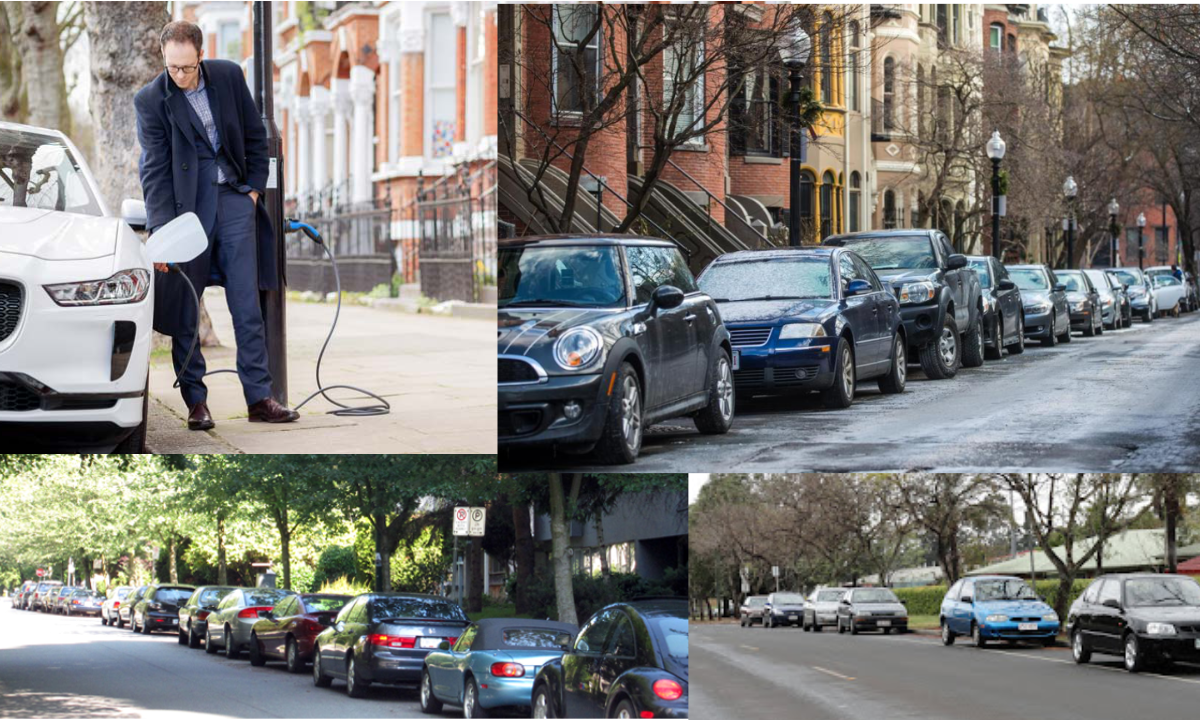
Surviving with an EV and no driveway: on street charging.

People have for decades owned cars without needing to refuel at home, so it may not seem obvious just how important home charging is for owners of EVs. Various surveys confirm that 80% to 95% of EV charging happens at home and given that less than 80% of people have access to a space to be able to charge at home, those who can’t charge at home are less likely to buy an EV.

To understand the problem, try living with a mobile phone without charging at home, or at work.

Read More »

Decades long EV transition with no green quick fix.

Despite many claims that EVs have a dirty secret in that they are not really green at all, the real secret is how long it takes for the green payback. The claims are based on two realities: 1) the driving of EVs still results in emissions when EVs are charged from our current dirty electrical grids, and 2) the building of EVs also creates emissions, and sometimes increased emissions over building ICEVs.

However real data from critical studies shows that even in the worst case, overall, an high build emission inefficient EVs charged from a dirty grid still result in less emissions than ICEV. Just in that extreme case, only a marginal reducing in emissions!

However, already not all grids are “dirty grids” and as vehicles have an average lifespan of over 20 years either dirty grids will improve during that 20 years or we may have bigger problems. Build emissions from EVs largely track EV prices, and Wright’s law dictates both EV prices build emissions will soon fall below those for ICEVs.

The real conclusion from examining this question, is there is no quick fix green EV transition, but any delay in reducing production of ICE vehicles is creating a problem for the future!

Read More »

The electrical grid, V2G and EV Home Charging: Missing an opportunity for the planet.

Move to renewables for energy, and electricity for transport, and we solve the climate problem.

But renewables require storage, and uptake of EVs requires home charging, and there is a cost to both.

But what if electric vehicles could solve the “green power grid” problem, provide energy security, and avert a threat of increasing inequality, and reduce costs? It turns out this dream scenario is definitely possible but can be fully realised only if the home charging problem is solved.

Read More »

Why Hydrogen Cars are not the future, and EVs are here to stay.

After friend told me “I am not interested in electric cars, because I will wait for hydrogen cars”, I did the research, and found that such a future no longer makes any sense and will never happen. It turns out that hydrogen cars were never desirable and only viable if EVs remained impractical. Hydrogen vehicles have now been surpassed for charge times and range and they were only ever anexpensive to build and operate, higher emissions, limited interim stop gaps, for the time until we reduced the limitations of battery EVs.

Read More »

EV barriers – politics – alternatives

Parent / Sub topics
2025: The future of cars, robotaxis & EVs. Will EVs die out, or eventually take over?

2025: The future of cars, robotaxis & EVs. Will EVs die out, or eventually take over?

This page (and the video) look at key questions on the future of cars & EVs: Will robotaxis mean really no one will want to own a car anymore? Even if people do still want cars, will EVs just die out or eventually take over? What about hydrogen, e-fuels, or the countries like the USA dropping any climate agenda? EV have improved a lot, but need to do more before they are fully suitable for _most_ people. If EVs & infrastructure are just not yet ready for most people, what's the next step?
Cars, Trucks & EVs: Can the EV save the car?

Cars, Trucks & EVs: Can the EV save the car?

This is the lead webpaper for all content related to personal vehicles, cars and trucks and their future. While most content is on the EVs and hybrids that I see as the future of transition of personal vehicles, the overall focus is on the future of car ownership. Many, even including Elon Musk, claim that in the future, people won't need to own a car. I suggest that sentiment misses that cars don't get gets us from A to B, but instead are places we spend the part of our lives while getting from A to B, and sometimes are even our home base when simply at B instead of A. In fact, a future where only the wealthy can own their own vehicles is heading towards the direction of reducing personal living space and "caged humans" where it could also be suggested "people won't need their own home". While site embraces moving to EVs, but no the agenda that EVs most be only ever smaller city cars, or better still just electric bicycles. EVs should allow the vehicles we want to own to be sustainable, that is provided we don't also succumb to living in cities that seek ever denser population densities.
Webpapers
Decades long EV transition with no green quick fix.

Decades long EV transition with no green quick fix.

Why Car Makers are Lying about the storm.

Surviving with an EV and no driveway: on street charging.

Surviving with an EV and no driveway: on street charging.

Why Hydrogen Cars are not the future, and EVs are here to stay.

Why Hydrogen Cars are not the future, and EVs are here to stay.

The electrical grid, V2G and EV Home Charging: Missing an opportunity for the planet.

The electrical grid, V2G and EV Home Charging: Missing an opportunity for the planet.

Vehicles And Mobility: Road Trips and Other Superpowers.

Vehicles And Mobility: Road Trips and Other Superpowers.

ScoMo Ingenious EV Plan: Australian Prime Minister Scott Morrison, leading climate action blocker, stretching the truth again?

ScoMo Ingenious EV Plan: Australian Prime Minister Scott Morrison, leading climate action blocker, stretching the truth again?