

Early version, stay tuned for updates.
7 Keys to the technology of the BYD Shark 6.
BYD Shark 6 June 2024 preview: The first real EV Ute/Pickup?
Specifications so far:
- 365 kW total power.
- 1.5l turbo with 100kW as generator
- 5.7s 0-100 km/h
- 30kWh battery
- Payload 835kg bed 1450L
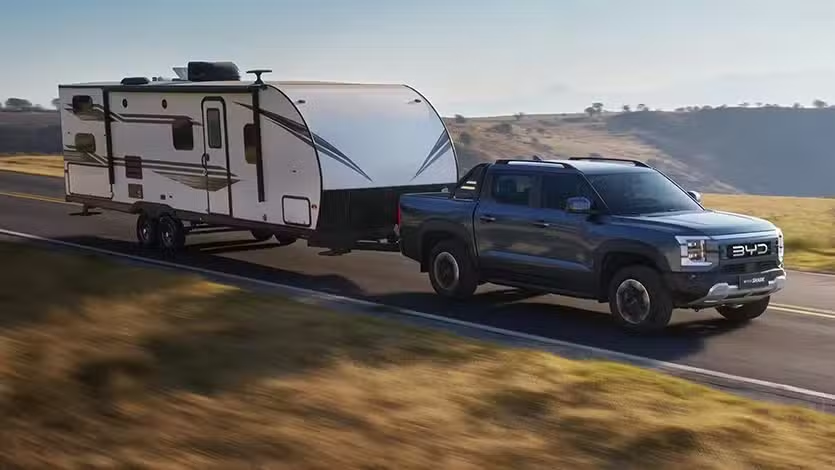
- Tow rating braked 2500kg
- 5,457mm l, 1,971mm w, 1,925mm h
- Wheelbase 3,260 clearance 282mm
- Price?
- In Mexico the Shark starts from just under 900,000 MXN, while a Ranger Raptor is 1,080,200 MXN to 1,268,000 MXN, and the BYD Seal is from 778,800 MXN to 888,800 for the performance version. Expect the Shark to be slightly above the price of the AWD BYD Seal.


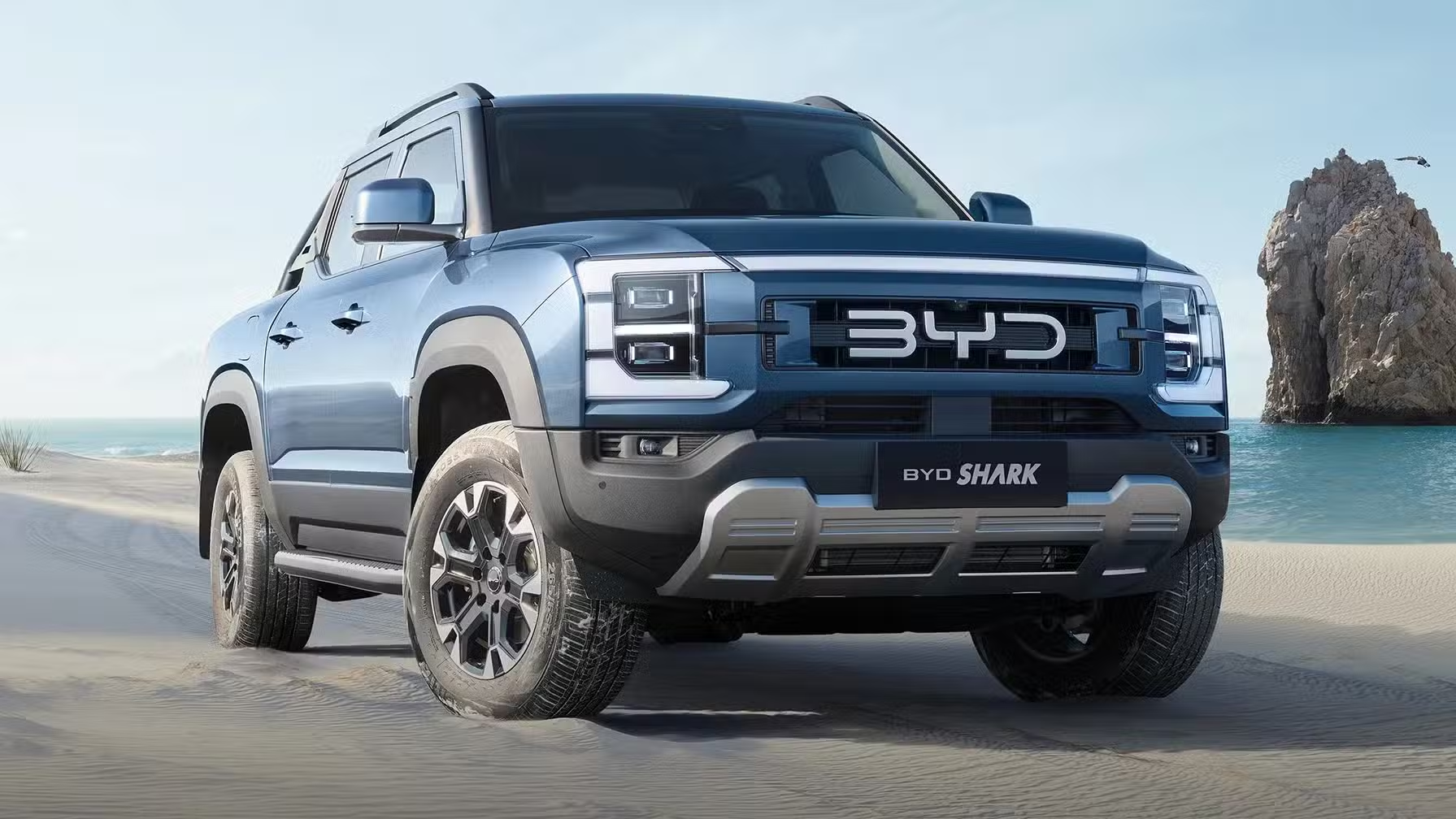
Ford Ranger Rival: Faster than Ranger Raptor, Economy of a small diesel Ranger.
Slightly larger than the Ford Ranger, with a slightly larger bed, but with a better towing capacity than the Ranger Raptor which has a 708kg/2500kg unbraked/braked towing capacity, rather than the 1000kg/3500kg of other Ranger vehicles. With the Shark having a “rare for a Ute” independent rear suspension that even the Raptor doesn’t, the Raptor may be the most relevant competitor.
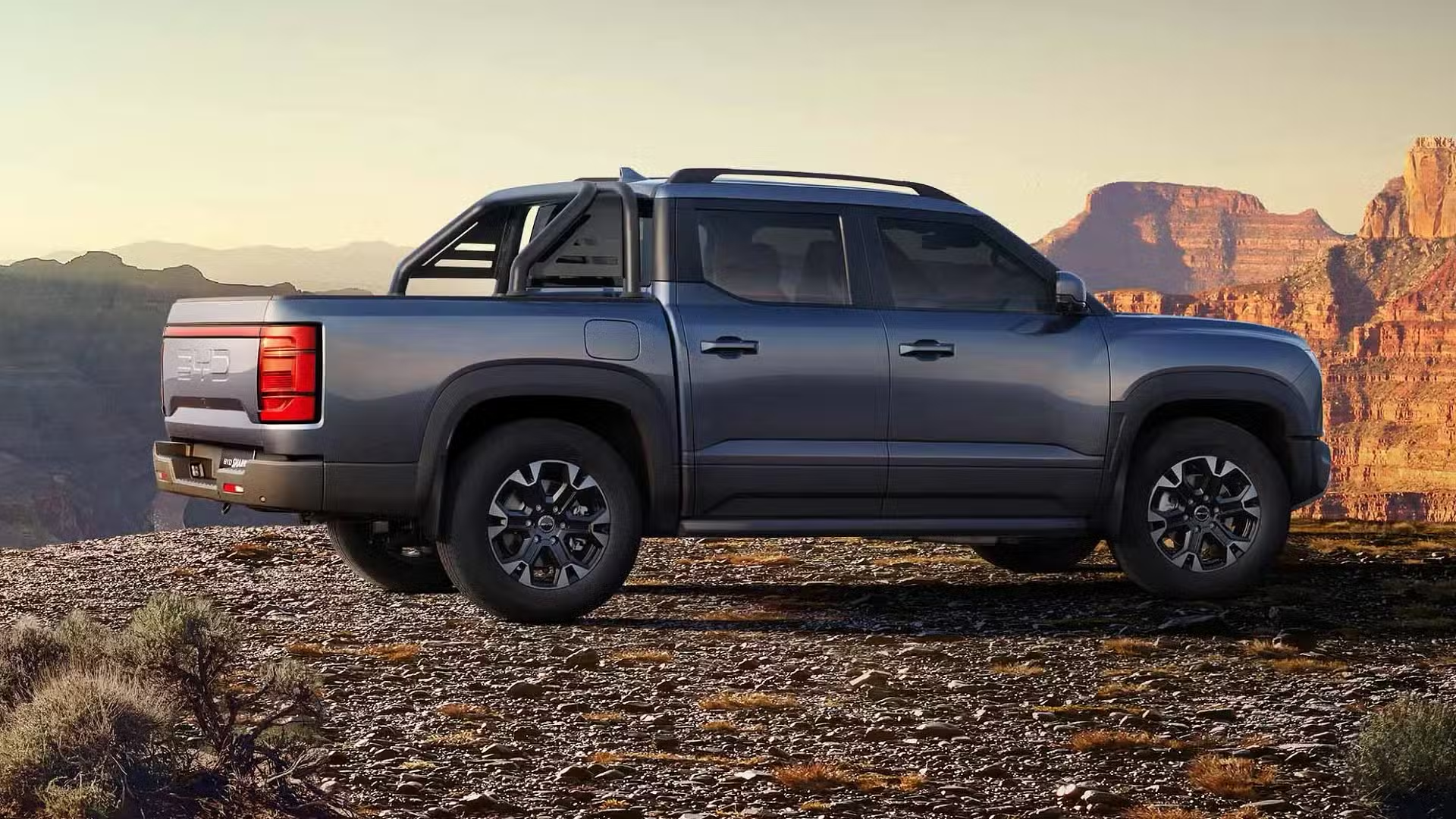
Based on a ladder-frame chassis – with independent front and rear suspension – the Shark measures 5457mm long, 1971mm wide and 1925mm tall, on a 3260mm wheelbase.
It is 87mm longer nose to tail, 53mm wider and 39mm taller than a Ford Ranger Wildtrak, but has a 10mm-shorter wheelbase.
BYD quotes a payload of up to 835kg, and a 2500kg braked towing capacity – down on the 1000kg and 3500kg respectively of the benchmarks in the ute class – plus a 1450-litre tray volume, compared to a Ford Ranger’s 1233L.
2025 BYD Shark plug-in hybrid ute revealed: Quicker than a Ranger Raptor, in Australia this year
While the Shark is not substantially faster than the Ranger Raptor, it is a little faster although people have reported managing a 0-60 mph as fast as 5.8 seconds for the raptor, and no one has yet done sufficient testing on the Shark.
BYD claims a 0-100km/h acceleration time of 5.7 seconds in hybrid mode – as quick as a Honda Civic Type R hot hatch, and about four seconds quicker than Australia’s top-selling four-cylinder diesel Utes.
It is quicker and more powerful than the latest Ford Ranger Raptor – Australia’s quickest ute, excluding full-size V8-powered US pick-ups – which has a 292kW/583Nm 3.0-litre twin-turbo petrol V6, and has completed 0-100km/h in 6.0 seconds based on Drive‘s testing.
2025 BYD Shark plug-in hybrid ute revealed: Quicker than a Ranger Raptor, in Australia this year
The highway economy, assuming battery is just maintained at the low 20% level, is rated as close to far slower the 2.0 litre diesel raptor, but not close enough to at least so far, give the 1,000km range possible with a large fuel tank equipped small diesel. The 840km “close to 1,000km range”, while way better than the range of a Ranger Raptor, is not groundbreaking, even if around town for those with access to charging, and particularly for those with access to solar, the actual annual economy could be truly groundbreaking.
BYD claims up to 100km of electric driving range from the Shark’s plug-in battery pack – or, in hybrid mode, fuel consumption of 7.5L/100km, and a total driving range of 840km, based on NEDC lab testing.
For context, a dual cab Ford Ranger bi-turbo diesel quotes 7.2L/100km – with auto engine stop-start technology fitted – and a claimed driving range of approximately 1100km.
2025 BYD Shark plug-in hybrid ute revealed: Quicker than a Ranger Raptor, in Australia this year
Can BYD win over Ute buyers in Australia?
To the right is a surprising positive take from a Youtuber who has a history of being very negative about BYD, and about electric vehicles in general, and could be an example of the very type of person normally difficult to convince. More updates and research on this subject to follow.
Does PHEV make sense for a Ute / Pickup?
From the video to the right of Tom Moloughney and Kyle Conner discussing pickups in the USA.
Tom asked Kyle to choose between Cybertruck, F150 Lighting, Rivian R1T, Chevrolet Silverado or Ram Range extender:
“Well for honestly, I’m not a ram guy, I never been a Ram guy, but I would take that range extender, that’s, that makes it a usable truck. I’d live with all the Ram Stelantis stuff that just I never get along with, and I would take that range extender”.
The reality is, while battery technology now enables EVs to be better to live with than ICE vehicles in many situations, there are still applications where the trades swing back in favour of ICE vehicles, and today’s battery capacities for a vehicle like a Ute or pickup, EVs can introduce significant compromises, which can be solved with a range extender.
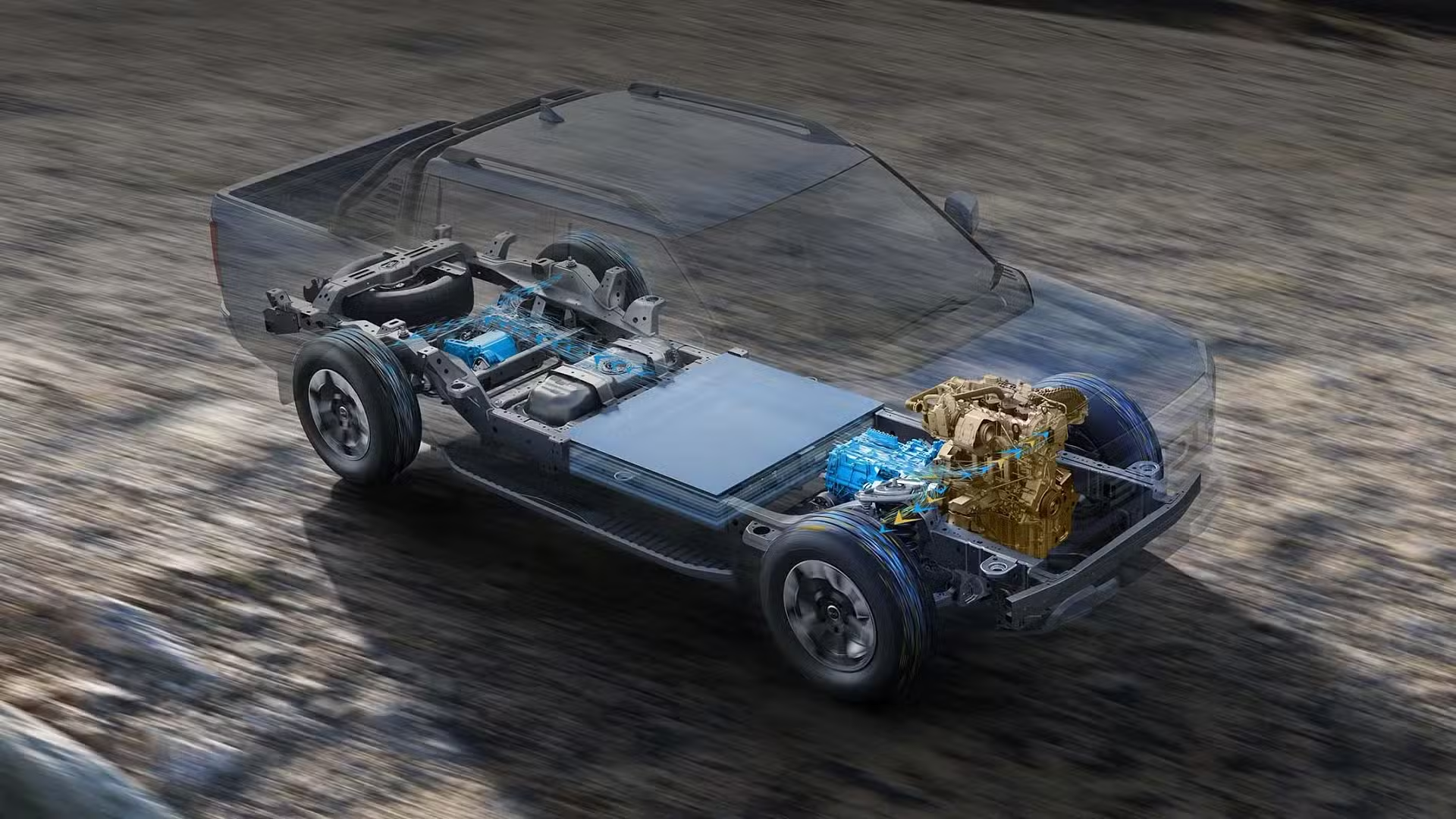
BYD Auto New Zealand brand manager Warren Willmot says that initially, the vehicle will utilise the brand’s ‘DM-i’ system. This pairs a mid-size battery with a 1.5-litre turbocharged petrol engine, a generator, and two electric motors. The drive is predominantly electric, with the petrol engine only taking over at higher speeds.
BYD ute set for Fieldays 2024 debut
Ok, the basic DM-i system mostly pairs the 1.5 litre naturally aspirated Atkinson cycle, yet multiple reports state the Ute / Pickup with have a turbo ICE. This is because it would not be basic DM-i, and will likely turn out to be instead DMO.
DMO or not, the ‘ICE’ will probably be the 1.5-liter BYD476ZQC Xiaoyun turbocharged I4 petrol engine with 102.9kW.
BYD hasn’t detailed the plug-in hybrid powertrain at this stage, though previous reports have indicated it will consist of a 1.5-litre turbocharged engine mated with two electric motors for a total system output of 365kW.
BYD’s first ute breaks cover, in Australia in 2024
Expect big numbers for the power of the two electric motors that if added to the 100 kW ICE engine would exceed 365kW, but the 365kW is probably correct, and you can’t really combine the numbers from DM powertrains in the same manner can with an ICE based PHEV, as the ‘parallel mode’ has reduced power to the electric drive train. All you can really be sure of is equal to the maximum power available from the electric motors, and since the Seal 4wd can provide 390 kW and 670 Nm, provided the battery and engine together can provide close to the 390 kW to power the electric motors, then the 365 kW could be correct. Normally, to deliver that power, it would need quite a big battery. The Seal DM-i only achieves 261 kW with its largest battery option, which is a 38.88kWh battery, but battery tech keeps getting better, and the BYD BOA 5 achieves over 500kW with similar sized battery and ICE power unit.
Yes, DM-i means on the highway a vehicle can operate for long distances on ICE power alone. Having seen the power readout in an EV being averaging around 20 kW or less when travelling at the most common Australian 110 km/h speed limit, it becomes clear that most of the time 30kW average power would be more than enough even for a Ute or pickup. Power requirements fluctuate widely from average, whenever power to accelerate or tackle hills is required, but at these times the main drivetrain, the electric one, can provide boost power. With a load, or trailer, average power could even double, but provided the ICE can keep up with the average need, range can continue with optimum power until gasoline runs low.
A marketing challenge could be getting people to understand that a 1.5l gasoline engine is sufficient, particularly after people have years of experiencing hybrids where the main motor is the internal combustion engine. DM-i truly is the reverse, and the ICE is only auxiliary power. If that 365 kW is achieved, together with close to 670 Nm of torque from zero rpm, then performance should provide the answer.
Although it can sound like a waste to not have the gasoline engine drive the wheels at low speeds, consider the Nissan e-Power Xtrail which never drives the wheels with the gasoline engine. The gasoline engine still feeds power to those electric motors, adding to the power from the battery, and providing more power than would ever be available from a small battery alone.
When?
As of June 2024, there has not yet been a type-approval for Australia, which means it seems unlikely for any deliveries prior to August 2024.
The Shark was “unveiled” in New Zealand on June 12th as part of Mystery Creek Fieldays, but the unveiling was really quite preliminary and pricing and final specification is still to be finalised “around about September time” with deliveries on confirmed to be “before Christmas 2024”.
The Global Launch was in Mexico on May 14th, with several attending the event posting summary videos.
We now know that the BYD pickup is called Shark. As can be seen from BYD’s teaser poster the company isn’t giving much away ahead of its launch at the Beijing Auto Show on April 25 however we have uncamouflaged spy shots from amigos in Mexico.
The fact that the BYD poster is in English rather than Chinese is telling showing that the pickup has primarily been designed with overseas markets in mind. Many of the spy shots seen have come from overseas and right hand drive as well as left hand drive versions have been spied indicating there should be little time lag for sales to begin in important RHD markets for pickups like Australia and South Africa.
April 22 2024: BYD Shark pickup truck to launch this week
- 2024 Jun 12 : Fieldays NZ reveal not so revealing.
- 2024 Jan 10: carnewschina: BYD pickup truck revealed in new spy photos
- 2024 Jan 8: BYD pick-up truck spied testing – to debut as 496 PS 1.5L plug-in hybrid; full EV version to launch later
- 8 Jan (china): BYD pickup spy shot taken without camouflage
- 4 Dec BYD Ute: Australian testing helping shape plug-in hybrid HiLux rival
- 22 nov drive: First BYD ute prototype arrives in Australia, showroom version imagined
- 13 nov China calls in the Aussie experts! Ford and Holden engineers are developing BYD’s first ute to ensure the dual-cab can take on the HiLux and Ranger in Australia
- 31 oct EVs&Beyond: BYD ute set for Fieldays 2024 debut
- 2023 Oct 16: China’s electric vehicle leader BYD enters the pickup truck market
- 2023 Feb 23- Spy Shots: BYD Pickup Truck For The Lifestyle Segment In China