
Synopsis: Welcome to the future with the Sealion 6.
The BYD assault on the larger market beyond EVs has begun with the Sealion 6 DM-i hybrid, which heralds the start of a future where more advanced hybrids become a lower cost alternative to previous hybrids and traditional non-hybrids, while offering more performance and economy.
So, can the BYD Sealion 6 deliver on the promise of lower prices for an equivalent equipment level, together with the better performance and economy of a state-of-the-art EV based hybrid? The answer does seem to be: yes!
There are two types of competitors. The Mitsubishi Outlander is the most direct competitor in terms of the type of hybrid, but the Toyota RAV4 is the main target competitor as it leads the broader field of family sized SUV hybrids vehicles, and a comparison to each is provided below.
Overall, the 2WD Sealion 6 is a contender for class leading economy and features for the price, while the 4WD adds class leading performance to the equation. The biggest criticism would be that the Sealion 6 is no sportscar, and the driving experience is one targeting comfort over sportiness. My own impression is the car is quicker and better handling than it feels, but and the main limitation is how it feels, not the level of competence. The Sealion 6 will get to you from A to B in comfort at the same time as alternatives. Acceleration times reveal the pattern, with the stopwatch and a race telling you the Sealion can be the faster vehicle even when it doesn’t feel that way.
For urban use and short trips, choose between the lower cost of running as an EV when charging is available or driving as a very efficient hybrid, and for longer trips, have the range of a 1,000km long-range hybrid and running costs of an EV without needing to charge.
In the future, EVs will be the lowest cost product, followed by hybrids, with ICE vehicles the most expensive of all. BYD stopped selling non-hybrid cars in 2022, with their hybrid technology already in China at a lower price than conventional ICE vehicles. BYD are on that path to the future.
In the last 3 years, BYD went from selling around 40% to 100% as many pure EVs as Tesla, and catching Tesla in EV sales, and not just because Tesla has some issues.
Now BYD is selling around 40% as many hybrids as Toyota and is way ahead of Toyota in plug-in hybrids. If BYD, who even Toyota seem to say make the best PHEVs, can provide DM-i at ICE vehicle prices and less than Toyota ICE based hybrid prices, then just maybe in another 3 years they can catch Toyota in hybrid sales.
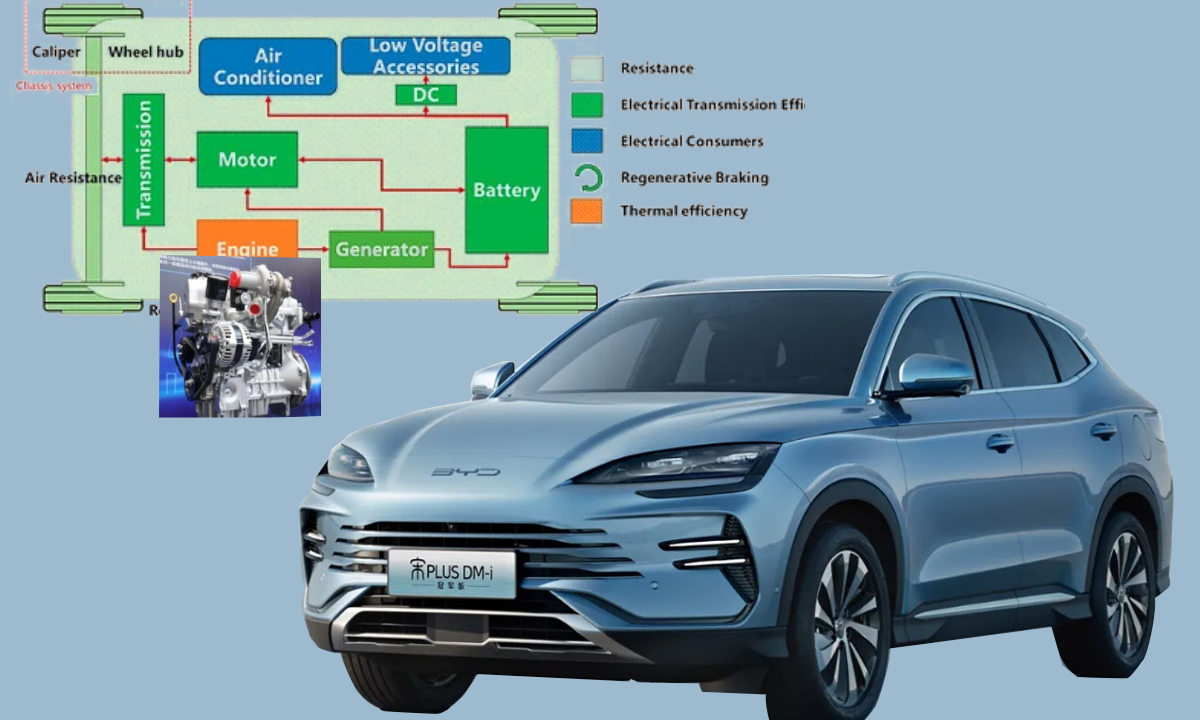
Not all hybrids are the same. BYD hybrids are like EVs with a combustion engine added for better range, in contrast with hybrids are gasoline vehicles with electric motors added to reduce fuel consumption. Not only is the result an “EV first” hybrid that drives like an EV until extended range is needed, but they are also now extremely cost competitive and mature technology which may even be adopted by Toyota:
BYD Now Targets Toyota’s “Step To EVs” with DM-i technology.
Reviews: OFP and Other Reviews (preliminary).
I have not completed my own OFP (OneFinitePlanet) review of the Sealion 6 being done in conjunction with the Carnormous you tube channel, but I can confirm the build quality does reach the level expected from brands like Mercedes Benz and is beyond most Korean or even Japanese brands. Stand by for more, but meanwhile here are some other video reviews.
Earlier video reviews
Note the climate control can be controlled using three finger touch control at all times.
Quotes: “I think the Sealion 6 is a really, really compelling offering. I’m very comfortable in saying it is probably the best Chinese branded Chinese car that I’ve driven so far.”
“It’s super well equipped, it’s a really good size and the value is really hard to ignore”
In the test by Bjorn, the Sealion has class leading luggage space behind the 2nd row, despite other reviews suggesting lower than average luggage space. The difference appears to result from the angle of the 2nd row seats when measuring.
How far can a BYD PHEV go?
I recently (Aug 2024) saw a review for the GLC63 AMG S E PERFORMANCE Wagon, which is in fact a similar size PHEV to the Sealion 6, and wondered, what would it take for BYD to bring a version of the Sealion up to this level? Clearly, even if the equipment levels are in fact not that different, the MB does bring performance and handling that justify a very different price tag to the current Sealion 6, but could BYD do something to address this for far less money if they tried?
EV first PHEV or HEREV: The best of an EV and a regular vehicle?
For up to around 80kms, the Sealion can be driven as pure EV. This means anyone who can charge at home, can drive the Sealion as a pure EV on any day they will travel less than 80kms.
The second bonus over a regular ICE or hybrid, is the more power for the price, as electric motors are far less expensive than internal combustion engines.
These are the EV type benefits of an EV first hybrid over an ICE vehicle or regular hybrid, and for these benefits there are no minuses, as the EV first hybrid can be treated just like a regular hybrid. While it could be argued there is the loss of changing gears, most modern cars try to make that unnoticeable, so for most people, this is not really a minus.
But what are the downsides compared to owning an EV?
The downside is that it will still be necessary to, on some occasions, visit a gas station. However, the main time it will be necessary to visit gas station are when on road trips, when EVs need to make far more visits to high-speed DC chargers, which are for many the worst aspect of owning an EV. While slower charging t home is like charging a mobile phone and happens while you do other things, at a high-speed DC charger, the driver often has to wait, and potentially even queue for lengthy periods of time, plus driving at highway speed on electric power at the more expensive prices from high-speed chargers, will most often cost more than driving the Sealion 6 on gas power.
Sealion 6: Look out RAV4? (Sealion 6 was previously “Seal U”)

The names can get really confusing, as prior to release, this vehicle has gone through several names, and now has different names in different markets. The name on current Australian certification is “Sealion 6”, not Sea Lion as two words, and just “6” and not “06”. Although a bit long, pronouncing it as “Sealine 6” is about as long as can stick.
Sealion 6 DM-i Specifications:
Priced from $48,990 before on-road costs, the entry-level, front-wheel-drive Sealion 6 Dynamic almost matches the Toyota RAV4 XSE FWD ($48,910), while the top-of-the-range Sealion 6 Premium AWD is available for $52,990 – undercutting the RAV4 Cruiser AWD ($54,410).
A Mitsubishi Outlander PHEV is between $57,290 and $73,790 before on-road costs, while a Mazda CX-60 PHEV is even dearer at between $73,600 and $86,800 plus on-road costs.
2024 BYD Sealion 6 pricing and features
Note that final price to the customer for Toyota cars includes higher dealer charges than for BYD, and the Sealion 6 Dynamic includes many items not included in the Toyota RAV4 XSE specification, so the price advantage over the RAV4 is clearer than the above quote suggests.
The entry-level BYD Seal U Dynamic will be the price-leader and, according to government homologation documents, is equipped with a 72kW combustion engine and a 145kW? electric motor, combining for a maximum power output of 150kW.
The BYD Sealion 06 Premium gets a considerably more powerful output of 238kW (combined), thanks to a 96kW combustion engine and dual e-motors – 150kW front and 120kW rear.
Carsales.com 2024 BYD Seal U details emerge
The Premium is all-wheel drive, combining a 96kW petrol engine with a 150kW front electric motor and 120kW rear electric motor for a system output of 238kW.
Drive: 2024 BYD Seal U plug-in hybrid SUV: First details for Australia
Two battery sizes are offered overseas (18.3kWh and 26.6kWh) [note: Australia gets 18.3kWh] and they’re claimed to deliver between 110km and 150km of range, although that is based on the NEDC efficiency standard, which is more optimistic than the stricter and more widely used WLTP standard.
The BYD Sealion 06 will be offered in front-drive and rear-wheel drive configurations, which is something that rivals like the all-wheel drive Mitsubishi Outlander PHEV and front-drive MG HS Plus EV don’t offer.
Compared to the Outlander PHEV, the BYD Sealion 06 is 65mm longer thanks to its sizeable 4775mm length and 2765mm wheelbase.
Carsales.com 2024 BYD Seal U details emerge
Which car is offered in Australia compared to other markets?
There has been a lot of confusion, mostly leading from the Sealion 6 (Seal U) going through all the naming hoops to try and get BYD vehicle names to make sense. This is explained in more detail in Ocean vs Dynasty below, but in summary. BYD in China has a “Song Plus” in showrooms for Ocean Series, and Dynasty Series, and only the Ocean Series matches exactly the car heading to “global” export markets. Many of the stories about a “second generation” and “DM-i 5.0” appear to relate to the Dynasty Series model in China, and it is likely there will be no new Sealion 6 changes during 2024.
Government approvals in countries like Australia were clearly for the existing model, and it makes little sense to introduce a model so close to when it will be updated. So not update soon after launch, and a switch to DM-i 5.0 unlikely during 2024.
With the Sea Lion 07 being launched in China in April, it does clear the way for that mode to be also released in Australia soon after the “Sealion 6”.
Seal U EV for Europe means Sealion remains Seal U DM-i for Europe?
The Seal U EV model based on the Song Plus Champion EV edition appears confirmed for UK, Germany, Norway and other European locations, but as far as I have seen, so far only in Pure EV form.
It seems like the Seal U EV arrived in Europe too early for the name change to Sealion, which means for now, Europe keeps the Seal U name.
As of April 2024, the EV version of the Seal U is listed as a current model on the BYD Europe website.
While those in markets only receiving the DM-i version of the Sealion 06/Seal U/Song Plus may feel they are missing out, it does not sound like the EV version of the Seal U is very impressive to drive, with 0-100km times of 9.3 or 9.6 seconds for the two versions. For those wanting an EV, the Sealion 7 seems a far more desirable vehicle, and may be available in markets without the Seal U EV.
Name changes and will it really be called the Seal U Sealion 6?
Initially, the Sealion 6 in Australia was to be called the Seal U, even initially certified for sale in Australia as the Seal U. As of 7th April 2024, the EV version of this same vehicle is listed on the BYD Europe site as the “Seal U”. At least for now, it may be that the pure EV version will remain the Seal U.
Finally, a name that at least makes sense. The Sealion 6, or “Sea Lion 06” in China, is the 3rd name for this vehicle, and this section was originally titled “will it really be called the Seal U” because the “Seal U” name when the page was first written had many contradictions, and even “Seal U” was a change from the original “Song Plus Champion Edition”.
While “Sealion 6” is still problematic as “sealion” already has 3 syllables so adding the “6” even when leaving off the zero is rather long, but at least it is finally a name that actually fits a naming scheme. One solution would be to pronounce it as “sealine 6”.
The name confusion from the BYD Song Plus.
When, name aside, will the Sealion 6 DM-i be released in Australia and elsewhere?
May 16th, 2024. That is when the press embargo ends, so also the effective release date. As far as I know, so far, the only PHEV version has been sighted in Australia, and is the vehicle now approved for sale and about to be released. Further, Australian “type approval” has been obtained and was updated March 28th, 2024, for two versions of the Sealion 6:
- length 4775
- width 1890
- height 1670
- clearance 173
- standard
- tare-mass 1905
- towing 750 braked / 750 non braked
- premium
- tare-mass 2065
- towing 1300 braked / 750 non braked.
There was no further revision to the type-approval or delay, and the Sealion 6 in Australia was released on schedule.
BYD Brands and Series: Ocean, Dynasty and more.
There is still a lot of confusion around how the vehicle in Australia is connected to what is sold in China, where there are two different cars currently called the “Song Plus”, although even in China, there are indication the vehicle we get in Australia will at some point become the BYD Sea Lion 06.
The picture with BYD sub brands is behind the confusion:
BYD has so many brands it seems like BYD is trying to emulate General Motors. There are two rival mainstream “brands” or series, the Ocean Series and Dynasty Series, each with its own styling theme and in China, dealerships, with in many cases each series having its own version of the same vehicle, almost like Kia and Hyundai, but in the same company. Then there is not only “Denza” which is like the Hyundai “Genesis”, but in China also “Fang Chang Bao” which has both premium off-road vehicles and has also had a show car for a quite exotic sports car, and “Yangwang” which is their ultimate extreme high-end vehicle brand.
BYD Sub brands
The vehicle now called the “Sealion 6” or “Sea Lion 06” was first released in China as a new “Song Plus Champion Edition”, but as the Ocean Series version of the very popular “Song Plus”, which had always been the alternative “Dynasty Series”, named after the “Song” Dynasty.
Ocean vs Dynasty: A history of two Song Plus DM-i models.

The original Song Plus DM-i was released in March 2021.
First, song plus DM-i has two versions. Both are equipped with Xiaoyun plug-in hybrid special 1.5L engine, with a maximum power of 110 HP and a maximum torque of 135 N.m. The difference lies in the pure electric range, which is 51km and 110km respectively. Both versions use lithium iron phosphate blade batteries. Among them, for the 51km range model, the acceleration time of 0-100kmph is 8.5s, and the fuel consumption during low battery status is just 4.4L/100km. Under the condition of full fuel and full power, the comprehensive range can reach 1150km. For the 110km range model, the acceleration time of 0-100km / h is 7.9s, and the fuel consumption during low battery status is 4.5L/100km. Under the condition of full fuel and full power, the comprehensive range can reach 1200km.
BYD Song Plus DMi: Review of the Super Hybrid Technology – China Cars Trading
Then in June 2023, the car now called the Sealion 6 was first released as a “facelifted” Song Plus DM-i Champion Edition.
The Song Plus Champion Edition got the Ocean X Face design, getting closer to the BYD’s Ocean series.
New BYD Song Plus hit pre-sales in China with a starting price of 23,800 USD (carnewschina.com)
So, in China the full name was initially the Song Plus Champion Edition, now with Ocean series styling but with the name not saying, “Ocean Series Song Plus Champion Edition”.
Having an Ocean Series car with a Dynasty name was confusing.
The next name given was the “Seal U”, which for people like me who initially did not realise this was from the outset an Ocean Series version, sounded like moving the Song Plus from Dynasty series into the alternate Ocean series, and vehicles from these two families follow very different styling. I initially thought “how can a Dynasty series model become part of the Ocean series” until it was brought to my attention this “Champion Edition Song Plus” never had the design of “Dynasty” models in the first place.


Normally all Dynasty models have the “Dragon Face” as in these pictures of the normal “Song Plus”, Song L, Song Pro, Yuan Plus (Atto 3), BYD Tang and Han.
Prior to the release in 2023 of the “Champion Edition”, the Song Plus was styled like other Dynasty models. What I, and others, at first did not realise, was that the old style until sold out remained in Dynasty showrooms, and this new model destined for Ocean showrooms, leaving a gap in the Ocean lineup between the clearance of older Song Plus models and the release of a new model.

There was now the Song Plus Champion edition with the appearance of the Ocean series and styled far more like the Seal and described as having an “ocean inspired” design. It does seem more similar to the Seal than Dynasty models. But the old Song Plus is still being sold. Having both versions having had the same name is a bit like the Toyota Corolla, which in many years has been the world biggest selling model name, although behind the name, there are very different cars in different markets that share the same name.
Moving the name to Seal U at least fit with the Ocean Series, but as Ocean Series naming has been evolving, that evolution meant there was still a problem with the Seal U name. In the Ocean Series, the new rule seems to be that Ocean Series sedans are to be named as “Seal XX“, with the original BYD Seal to be the Seal 07, and for SUV vehicles of that Ocean Series to be as a “Sealion 0X” with the Sealion 7 (Sea Lion 07 in China) being the first announced, with promises of a Sealion 5 and Sealion 6. Well, it seems now we have the first version of the Sealion 6, and the naming is at least finally consistent.
BYD may be good at batteries and even plug in vehicles in general, but English language naming does not appear to have so far been a strong suit, which means the backstory to the name is complex.
The 2024 DM-i 5.0 Second generation Dynasty Song Plus (August), and Sealion 6?
July 25, 2024, Update: DM-i for both Dynasty and Ocean series:
For both cars, the DM 5.0 system is built around a 1.5-liter engine with a maximum power of 74 kW and 126 Nm of torque. This is coupled with an electric motor of 160 kW and 260 Nm torque. It is the same BYD472QC engine with 46.06% thermal efficiency that originally debuted with the system in the Qin L and Seal 06 DM-i cars. For the Song L and Song Plus DM-i cars, there are three battery pack options of 12.9 kWh, 18.3 kWh, and 26.6 kWh, corresponding to pure electric ranges of 75 km, 112 km, and 160 km, respectively, using the CLTC cycle. BYD likes to use NEDC calculations to show the fuel consumption, and these for the three powertrains are 3.88, 3.90, and 3.93 l/100 km, respectively – it should be noted that using the WLTC figures that MIIT usually quotes the consumption figures are actually 4.93, 4.95 and 4.98 l/100 km. Comprehensive range is up to 1500 km.
BYD Song L and Song Plus launch with DM 5.0 PHEV powertrain – range up to 1,500 km

With production for both versions converting to DM-i 5.0 at the same time, it suggests BYD do not wish to keep making the older DM-i 4 vehicles anymore, and most likely it costs more to make the older system. This would mean they will probably update the versions we see in Australia quite soon!
This means increased efficiency and increased range. No, it was never 50% increase in range some report, as that is comparing old model WLTP range with new version CLTC range, which is even more low speed biased than NEDC so gives even higher numbers. It is however a 20% increase in CLTC range which is quite impressive.
Reports are that it is less than a 20% increase in WLTP range, which would mean the biggest improvements are in economy at lower speeds, as WLTP test conditions include more higher speed driving. Still means an improvement of around town economy of 20% which is not to be sneezed at.
Note: when most people thing of “range” we actually think of “pure highway driving range” which is normally less than either WLTP nor NEDC figures which both include around town driving speeds.
May 2024 picture.
Yes, there are reports this will be an update to the Sealion 6 or at least the Ocean Series Song Plus in China, but while it is almost certain this will be for the new model Dynasty Series Song Plus DM-i or Song L DM-i, it is less certain when it will reach production for the Ocean series Song Plus, and again even less certain when that would flow through to export RHD vehicles.
Product schedule for August 2024
BYD’s 2024 product planning leaks, Seal S coming in September
The second generation of the Song Plus EV will debut. Song Plus EV is branded as Seal U for overseas markets.
BYD launched the annual facelift of this electric SUV in 2023, Champion Edition, and shipped it to Europe, where the car had a public debut at the September IAA Mobility Munich auto show. With the second generation in work, we can expect significant changes.
I suspect this report is mistaken and the update is not the “Seal U” but the Dynasty series Song Plus which may get called the Song L DM-i. I thought they had the naming wrong earlier in 2024 with the Seal U name being the final name, and it turned out they were fallible then.

Some sources state that the vehicle pictured here is the new, clearly Dynasty “Dragon Face” model is to be the new Song Plus, but it is also suggested by others to be a new PHEV version the “Song L” which is a new flagship version of the Song family, but in either case it is at least is a true dynasty model.
BYD is set to launch its fifth-generation DM system, with the DM-i branch enabling the vehicle to consume as little as 2.9 L of fuel per 100 kilometers, and drive close to 2,000 kilometers on a full tank of fuel and full charge, 36kr cited a source at the meeting as saying.
BYD’s new model, the Seal 06, will be the first to feature the fifth-generation DM-i hybrid system of the new energy vehicle (NEV) maker, local automotive media Yiche reported today.
The model will have a combined range of over 2,000 kilometers and is likely to consume less than 3 L per 100 kilometers at low charge as per NEDC standards, according to the report.
The report doesn’t provide anything more on BYD’s next-generation DM-i technology.
CNEVPOST Apr 8 2024: BYD Seal 06 reportedly to be 1st model with next-gen DM-i tech with over 2,000 km range
Second Generation?
This has all proven correct as of June 2024, with the Seal 06 Ocean Series, and the Qin L Dynasty Series both effectively being the same vehicle with DM-i 5.0.
But the “second generation” is a little confusing. It turns out the Song L is the second-generation Song Plus of the Dynasty series, with the Sealion 6 style Song Plus already being the second generation, although initially on DM-i 4.0 underpinnings. This means there is no significant update to the Sealion 6 beyond the addition of the DM-5.0.
Sealion 6 and DM-i 5.0?
It looks like the next car to get BYD’s fifth generation PHEV system will be the Song Plus DM-i after the launch of the all new Qin L and Seal 06 cars last week. Unlike those the Song Plus is not a new car but will gain the upgraded powertrain. The Song Plus is known as the Seal U in Europe.
https://carnewschina.com/2024/06/04/byd-song-plus-seal-u-to-get-dm-i-5-0-treatment-with-new-phev-powertrain/#comment-573640
The was sourced from this page on Chinese site, “Fast Technology”, and as it quite directly translates the Chinese page which also mentions a rename to the Sea Lion 05. If there is an error, it is with the source. This also could be confusion arising from two vehicles currently sharing the same name, and one Song Plus is getting the rename, but I suspect to Sea Lion 06, and the other Song Plus getting the update.
Consider, the reports are the Song Plus will first get an update to update to DM-i 5.0 and then by August get a more complete update to become a second-generation vehicle. This means BYD just released the Sealion 6 released internationally into both LHD and RHD markets, then within months will be firstly updating the architecture of the current generation, and then releasing a second-generation model.
Also consider this alternative interpretation. BYD have just released the Ocean Series Song Plus as the Seal U/Sealion 6 internationally and are about to release a second-generation of the Dynasty series Song Plus in China that will have DM-i 5.0 on release. However, even if this is correct, that would not stop the Ocean series model also getting the DM-i 5.0 update, so only one drivetrain is being produced, and as reported above, this is what happened.
There were reports that the Ocean Series “Song Plus Champion Edition” in China could also get a Sea Lion name in China, perhaps the name change would happen when it also gets an update to DM-i 5.0, but so far, no name change. While the naming with “Song” for an Ocean series is confusing, it does help the Song nameplate with bestseller rankings.
The update to DM-i 5.0 is quite a considerable update. A significant redesign of the whole drivetrain is not simple, and there may be special steps needed for the 4WD model.
While China does not receive the international 18kWh 4wd model, in China the WLTP consumption in “extended range” mode is set to drop from 5.3L/100km to 4.95L/100km, while rated electric motor power increases and ICE power decreases with, if anything, possibly a hard to detect improvement in performance.
Sealion 6 vs RAV4 et al: Competitor comparison.
While the EV-First hybrid architecture suggests to some the most logical competitor to the Sealion 6 would be the Mitsubishi Outlander, in practice the main competitors would be ICE First Hybrids:
- RAV4 Hybrid
- Havel H6 Hybrid
- Hyundai Tucson Hybrid / Kia Sportage Hybrid (coming soon)
- Honda CR-V Hybrid
- MG HS PHEV
- Mitsubishi Outlander PHEV
- Mazda CX-60 PHEV
Toyota RAV4 Hybrid.
Of these, the main rival will no doubt be the Toyota RAV4 hybrid. In Australia Toyota has now dropped non-hybrid versions of the RAV4 and of several other model, in a move somewhat similar to BYD dropping all non-PHEV versions of its vehicles back in 2022. While Toyota does save on the cost of transmissions with the E-CVT being far simpler than another Toyota transmission, unlike with EV first BYD vehicles it is less clear that the ICE units in Toyota hybrids can also provide cost savings over those in non-hybrid models.
Specs (Sealion 6 >> RAV4)
- length 4775 >> 4,570–4,600
- width 1890 >> 1855
- height 1670 >> 1660
- clearance 173 >> 205?
- luggage capacity 574 >> 580
- standard
- ICE 1.5l >> 2.5l
- kW 160 >> (127 2.0 non-hybrid to 160kw 2WD hybrid)
- tare-mass 1905 >> 125
- towing 750 braked / 750 non braked >> 800 /750 (480 kg 2WD hybrid)
- 0-100 8.3s >> 8.1s
- premium
- 1.5t >> 2.5l
- kW 238 >> 163 (4WD hybrid)
- tare-mass 2065 >>1760
- towing 1300 braked / 750 non braked >> 1500 / 750
- 0-100 6.5s >> 8.1s
Obviously, the Toyota name will still make the RAV4 the choice of most buyers regardless of the specification advantage. But if the Sealion 6 can win on power, economy, features and price it could make quite an impression.
“One thing for sure is the sealion 6 is leaps and bounds a nicer place to sit in than the rav4, much better tech, upholstry, HUD, acceleration (importantly very quiet acceleration). The rav4’s CVT hybrid is a noisy whiney droney and annoying thing to be behind the wheel of if you like to “give it the beans” at anytime. I’d hand it to the Sealion as a much better car.”
Comparison by a potential buyer considering both brands
Mitsubishi Outlander PHEV.
While BYD has been in plug-in hybrid production cars longer than anyone else, the Mitsubishi Outlander PHEV (Wikipedia) goes back almost as far to 2013 and was the first plug-in hybrid SUV, and as the electric motors are capable of providing the full vehicle power, it qualifies as an EV Hybrid.
The two main features the Outlander introduces are a degree of off-road capability and 7 seats. However, as pointed out in this video, lack of a room for a spare wheel limits the use of the off-road abilities and as seen in the videos, below, the 7 seats are best reserved for emergencies.
The current has 95kW front + 100kW rear electric motors supported by the 98kW 2.4 litre ICE providing total power of 185kW.
Towing 750kg/1600kg.
Performance: 0-100 7.9 (rated 8.2), but very slow 100 to 120km overtaking.
Mazda CX-60 PHEV.
With 240kW peak power and only 100kW of electric power, the CX-60 is still predominantly ICE powered.
With all of the goodness produced by its combination of a 2.5-litre four-cylinder direct-injection petrol engine, a 100kW electric motor and a 17.8kWh lithium-ion battery – good for “more than 60km” of electric-only driving – on tap in Sport mode, the CX-60 gets up and goes. Its 0 to 100km/h time of 5.8 seconds feels entirely believable, and when you plant your foot and push through the detente it fairly leaps away.
EV Central: Mazda CX-60 PHEV first drive
The CX-60 is more performance PHEV than EV based PHEV, and EV mode is really secondary. Compared to the Sealion 6, while the Mazda is no faster 0-100 than the 4WD Sealion, the Mazda is a very heavy sporty hybrid, while the Sealion is a comfortable dual-mode family vehicle. The priorities are so different that they should appeal to completely different buyers.
More?
More to come, but here are some links:
- Car News China: BYD Song Plus to sell internationally as “Seal U”. To hit the market this year
- The Driven: BYD to launch bigger electric SUV – known as Seal U – in international markets
- BYD Seal U kommt nach Deutschland: Angriff auf das Tesla Model Y
- BYD Seal U: A Comprehensive Review of the New Chinese SUV
- 2023 BYD Song PLUS DM-i Champion Edition 110KM Flagship
- BYD Song Plus – Quizá el mejor SUV PHEV “Híbrido enchufable” por el precio (0-100km/h)
- BYD’s new SUV spied undisguised ahead of Australian launch
- 2024 Byd Song Plus Champion Edition
Updates:
- 2024 June 17 : Added luggage space and Mazda & Mitsubishi comparisons.
- 2024 June 5 : This webpaper moved to a dedicated “BYD Sealion 6” separate from the general BYD DM hybrids paper.
- 2024 May 19 : More detailed “make a hybrid” and added Sealion 6 pricing.
- 2024 May 7 th : Logic of the name of Sealion 6 in place of Seal U, and updates for clarity.
- 2024 April 23 th: Updated to second edition, with some fixes and completions.
- 2024 Feb 29 th : Minor update with Seal U pricing and upcoming second-generation Song Plus.
- 2024 January 19 th : Updated with initial conclusion now reached.
- 2024 January 14 th : First draft version as research began.
this page will be updated with links to reviews and more specifications as they become available.