Synopsis: Life is fragile, and nature is not nurturing, but cruel.
I think the conclusion from these surprises, is that the Earth, and nature, are not as robust in the provision of an Earth that supports life as we know it, as might be assumed.
Life as we know it, and tend to assume has always supported by nature, can only continue for a maximum of around another 25 million years before natural climate change has an even bigger impact that man-made climate change could ever deliver. Within 25 million years, the window for when climate that can support our human societies of the past 12 thousand years will be over forever.
The reality is that the notion that the seemingly naturally bountiful mother nature and “Mother Earth” that we seemingly currently experience as being that normal situation is misguided. “Mother nature” has triggered a continuous stream of extinctions between repeated mass extinctions that have come remarkably close on several occasions to ending all life. The 5 major mass extinctions have all occu8red within the only 1/10 of the time during the Earth’s existence which has provide an environment that supports life as we know it.
We already know the future is even worse, with the possible time the Earth can support the type of climate we now experience which has enabled humans to reach a population of 8 billion for a maximum of 25 million years, before relentless natural global warming takes over leading to the extinction of all life leaving a lifeless Earth for the last 4 billion years before the Sun becomes a red giant before collapsing to a white dwarf.
Most of us have heard about that last part around 5 billion years from now, some have heard how, as the Conversation put it, in “about a billion years the sun will become hot enough to boil our oceans“, but even they seemed to miss that it is not like all is fine for a billion years and then the oceans boil.
The Earths ability to support life is already in decline, with the total biosphere already now only half what it was around 500 million years ago and will continue to decline all the way until that 1 billion years from now when the Earth will be too hot for even the toughest heat tolerant extremophiles to survive at the poles.
We, however, are not extremophiles but quite large mammals of a type that will have great difficulty surviving the early phase of climate change that takes place at the latest 25 million years from now.
Nature is not nurturing but cruel. While science suggests life may be relatively common in the universe, the nature of any planet allowing life to continue long enough to become multicellular appears to be extremely rare, and long enough to develop human style “accessorised evolution”, may, as Brian Cox suggests, be so rare it has only ever happened once. However, it we don’t act soon, life will end relatively soon for us too.
Poking the bear: Positive feedback exacerbates climate change.

Climate change can either be exacerbated by positive feedback or tempered by negative feedback. The history of Earth’s climate during the past 5000 million years of the Phanerozoic is like temperature regulated by a thermostat: rising until at the limit the cooling system switches on, bringing the temperature down until the temperature that cooling switches off. The end points change, but the temperature seems to be always heading up or down until something reverses it.
A key example of negative feedback is how raising CO2 levels produces warming, but the combination of high CO2 levels and warm temperatures increases plant growth which leads to the lowering of the CO2 levels. Negative feedback is self-correcting, whilst positive feedback is when a small problem can make itself grow into a bigger one such as a snowball rolling down a mountain eventually leading to an avalanche.
Poking the bear of climate change is triggering an event where at least for significant period, positive feedback is dominant resulting a small “poke” triggering for more significant change.
The great dying is a key example.
A cataclysm engulfed the planet some 252 million years ago, wiping out more than 90% of all life.
Known as the Great Dying, the mass extinction that ended the Permian geological period was the worst of the five global catastrophic events in Earth’s history, more devastating, than the one caused by a giant asteroid that spelled doom for the dinosaurs.
The most credible explanation put forward to date has been that carbon dioxide released by volcanic activity in a region known as the Siberian Traps caused a sudden warming of the planet. The emissions in the vast area in what’s now Russia that was about the size of Australia resulted in higher temperatures, acid rain and ocean acidification.
However, a mega El Niño effect — similar but more intense and prolonged than how the climate phenomenon is experienced today — could have played a pivotal role, according to new research published Thursday in the journal Science.
“What we’re showing is that it was a climate-based extinction crisis. It wasn’t just the warming, it’s how the climate responded,” said study coauthor Paul Wignall, a professor of paleoenvironments at the University of Leeds in the United Kingdom.
“If the conditions were bad but constant, life could have evolved to cope with it. But the fact is, it kept lurching from one extreme to the other over the decades.”
The Great Dying once wiped out 90% of life on Earth. A new theory may explain why
Stable climate is like requiring the bear to walk a tightrope.

Future predictions range from Earth going into full glaciation of an ice-age, to ending an ice age all together leading to a devastating temperature increase. How can there be real threat if different people feel the climate will go in opposite directions? In practice, this is just like predicting the bear would soon fall from the tightrope, without being able to predict which way the bear will fall. Just like the bear who is not sufficiently stable, at any one time, there are reasons the climate could fall either way.
The following “pivots” or “tipping points” are examples:
The AMOC pivot (Atlantic Meridional Overturning Current)
The AMOC is an example of a tipping point.
The latest scientific analysis published in February in the journal Science Advances found that, based on evidence from the last ice age, there is a possibility AMOC could shut down surprisingly quickly — perhaps as early as 2050 — because of global heating and the resulting influx of fresh water from the melting Greenland ice cap. The result would be catastrophic. Average temperatures in the UK would be equivalent to those in Newfoundland — 10 to 15 degrees cooler than today. Agriculture would collapse because it would be too cold to grow the crops farmers have cultivated there for centuries. Housing and infrastructure would have to be radically adapted to withstand the new climate. The collapse of AMOC, Lieven suggests, would result in decades or even generations of economic hardship.
Climate Disruption Will Be The Precursor To Global Political Disruption
The North Atlantic Current.
The basis for the film, “The Day After Tomorrow”
Unlike the AMOC, the observations of Labrador Sea outflow showed no negative trend from 1997 to 2009,[4] and the Labrador Sea convection began to intensify in 2012, reaching a new high in 2016.[5] As of 2022, the trend of strengthened Labrador Sea convection appears to hold, and is associated with observed increases in marine primary production.[6] Yet, a 150-year dataset suggests that even this recently strengthened convection is anomalously weak compared to its baseline state.[7]
https://en.wikipedia.org/wiki/North_Atlantic_Current
The current benign climate is anything but typical.

Graph 1, of the diagram here shows the long-term outlook from the Frank et al paper. At this resolution climate look stables, but that is mostly because this is the entire lifetime of the Earth graph and as such only shows long term trends.
The blue funnel shows mapping from graph 1 to graph 2, with graph 2 showing the more detail of temperatures of the past 500 million years, as compiled by Scott Wing of the Smithsonian. This illustrates how temperatures in the Phanerozoic have swung back and forth between over 20oC hotter than the current global average temperature to 4oC cooler.

Graph 3 from showing temperatures calculated from Vostok ice cores provides an explosion as shown by the yellow funnel of the most recent 420,000 years from the “now” section from graph 2, the graph by Scott Wing of the entire Phanerozoic temperatures, revealing that temperatures over the entire time of humans have always been far cooler than typical temperatures, with the purple funnel to graph 4 of the past 24,000 years showing the path to the current period of stable temperatures.
CO2 has always played a critical role in determining climate.
When Al Gore drew attention to climate change, my first reaction was that it did not make sense as:
- There were higher levels of CO2 in the past without climate problems.
- The CO2 from burning fossil fuels is all CO2 that all came from the atmosphere, so aren’t we just putting it back?
Yes, we are just restoring the CO2, but it turns out, it is not safe to restore that CO2 back previous levels.

Why can’t we go back to prior CO2 levels? First, back to basics.
There was a surprisingly high amount of CO2 in the Earths early atmosphere. Not just the currently feared 0.05%, not just the 20 times higher as it was just over 400 million years ago, but as high as 1,000 times higher than current levels. Yet the Earth did not fry, because back then the Sun was so much colder, that without the higher CO2, the Earth would have been far too cold for life to ever begin.
As more fully explained here, CO2 levels have always determined climate, and in the past always needed to be much higher, as in the past the sun was much colder. The sun is now almost 50% hotter than it was when the Earth was formed, and continues to gradually get hotter, resulting in the need for a continually smaller amount of CO2 to balance the increased heat from the sun.
If, like I did, looked back, suspecting that CO2 levels had been higher in the past, they were. But we needed more CO2 back then to keep us warm under the faint young Sun, and we can’t go back to those old levels, unless we can turn the sun back down.
Life on Land has only been viable for 10% of Earth’s lifetime.
Life appeared extremely early in the history of the Earth, but in the sea, not on land. For the first 90% of the Earth’s history, life was confined to the oceans, with the first life on land being land plants emerging at most 470 million years ago, despite Earth being around 4.5 billion years old, and the first known life being at least 3.5 billion years ago. So why could life as we know it, not exist on land, until so very recently?
- Lack of oxygen to breathe.
- Without the Ozone layer, the radiation would kill you.
Lack of oxygen to breathe: Only recently sufficient.
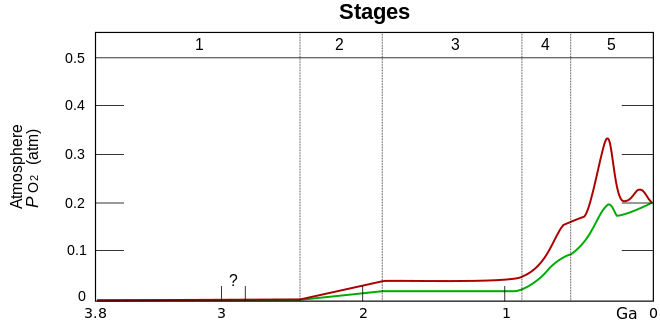
The Earth did not start out with Oxygen in the Atmosphere. Photosynthesis from plants had to put the oxygen in the atmosphere, and as you can see from this graph there was a very low level for almost the entire first half of the existence of the Earth. Free oxygen (02) does not normally occur in the universe and will not appear even on ‘Earth like’ planets until/unless life transforms them. The movie ‘Interstellar‘ is often praised for accurate science, but finding two alien planets where humans can breathe without evidence of plants that put the oxygen into the atmosphere? This does not seem real. Until around 500 million years ago oxygen breathing life was not possible on land, and remember, even plants ‘breath’ oxygen when the Sun is not shinning. It took over 3 billion years before Earth supported life on land.
Without the Ozone layer, the radiation would kill you.
Ozone is a gas in the atmosphere that protects everything living on the Earth from harmful ultraviolet (UV) rays from the Sun. Without the layer of ozone in the atmosphere, it would be very difficult for anything to survive on the surface. (Think of a very bad sunburn, only much worse!) Plants cannot live and grow in heavy ultraviolet radiation, nor can the plankton that serve as food for most of the ocean life. The ozone layer acts as a shield to absorb the UV rays, and keep them from doing damage at the Earth’s surface.
How ozone protects us: Rice University
As the above quote explains, life ‘on’ Earth as we know it requires an ozone layer. The ozone layer as required for life, only came into existence around 600 million years ago.
The amount of ozone required to shield Earth from biologically lethal UV radiation, wavelengths from 200 to 300 nanometers (nm), is believed to have been in existence 600 million years ago. At this time, the oxygen level was approximately 10% of its present atmospheric concentration. Prior to this period, life was restricted to the ocean. The presence of ozone enabled organisms to develop and live on the land.
Formation of the Ozone Layer: University at Albany (state University of New York)
So while it took a long time for the Earth to be ready to support life on land, it took a relatively short time for life to then emerge on land. The first land plants emerged around 450 million years ago (and plunged the earth into an ice age), and then there were large animals by 370 million years ago.
Only 25 million years before natural global warming, even without human impact.
While there are many making predictions that CO2 emission of the 21st century represent an existential threat, the outlook from nature within 25 million years is even worse, as nothing will end the rising temperatures even after average global temperatures surpass +60°C and mean that even the last single celled slime like extremophiles can no longer survive even at the poles, and all life one Earth ends.
While the final end for the last extremophiles could survive for as long as another 1.5 billion years, it is unlikely mammals the size of humans or larger from today could withstand the +8°C warmer than today temperatures that will be the minimum 25 million years from now.

While that +8°C is far beyond the level considered an existential threat to human society today, it is not expected to mean the end for all complex multicellular life on Earth, as Earth encountered these temperatures are recently as 56 million years ago, as illustrated in this cartoon from the Smithsonian following the discovery that the climate even in Greenland was home to alligators 56 million years ago.
Life has endured huge temperature swings and climate extremes over the 550 million years complex life has existed on Earth, but not without 99% of all species that have ever existed becoming extinct. The only way humans the other mammal species we hold dear to survive the 25 million years is by humans leveraging technology and interfering with nature.
Why will conditions similar to our current climate end forever within around 25 million years?
It turns out that the natures thermostat for temperature on Earth, is burning a fuse that now has less than 25 million years left before it triggers climate change even more extreme than that which environmental scientists are warning about human activities triggering in the present.
Between 25 and 50 million years is a huge time span for humanity, but it is only between the last 0.6% and 1.3% of the life of up until that time. The Earth is set to become too hot to still sustain life as we know it on the planet, before succumbing to the same fate as Venus.
For a civilisation that has been around only 10,000 years, 25 million years seems like a lot of time left, but for a planet that has supported life in various forms for almost 4 billion years, and life as we now know it on land for almost 400 million years (10% of the 4billion years there has been life), 25 million years remaining is not really very long. We are down to the last 6% of the time before the Earth starts warming on a path to the end of all life on Earth. How can the end be so near?
Well, this end, is really only just the start of a warming cycle that will take up to 1.5 billion years to end all life on Earth. The problem for us humans it that we are creatures of the coldest environment ever on the Earth, and as such, we are the first to go.
Stretching existence beyond the next 25 million years requires some ‘life finds away’ evolutionary step by plants or new organisms, or humans managing to disrupt nature in a good way.
Why? It turns out that the natures thermostat for temperature on Earth, is burning a fuse that has as little as 25 million years left, even without any catastrophic events such as human induced climate change. For a civilisation that has been around only 10,000 years, 25 million years seems like a lot of time left, but for a planet that has supported life in various forms for almost 4 billion years, and life as we now know it on land for almost 400 million years (10% of the 4billion years there has been life), 25 million years remaining is not really very long. We are down to the last 6% of the time the Earth support life on land, or the last 0.6% of the time the earth can support life. How can the end be so near?
- The sun just keeps gradually getting hotter.
- So far,Earth has compensated for the ever-hotter sun by reducing greenhouse gas, but CO2 is running out.
- The ability to compensate for increasing heat is almost at an end.
- The ‘end’ is nigh- even without meteor or any other catastrophe.
The Sun Just keeps gradually getting Hotter
You may have already heard how, within another 5 billion years, the Sun will become incredibly hot, expand almost until it touches the Earth, and then ‘die’ and become a white dwarf . Have you also heard of the ‘faint young Sun paradox‘? How the when the Earth was formed, the Sun only provided 70% of the current level of warmth? That the Sun has been getting steadily hotter since over the 4 billion years so far and will keep getting hotter all the way to that end 5 billion years from now? This leads to two questions:
- How has life survived the sun increasing almost to 50% hotter than when life started?
- How long until it gets too hot for us humans?
How life has survived so far: Survival through an ever-falling level of greenhouse gases.
The ‘faint young Sun paradox‘ reveals the there was so much less heat from the Sun back when life began, that it strange that the Earth had any liquid water at that time. How was it not all ice? If all else was the same on Earth as today, you would expect temperatures to be average around -60 degrees Celsius (-76 Fahrenheit), which would mean all water would be solid ice. Hence the paradox. Clearly, not all else was the same as on Earth today, and further research reveals the difference was far more greenhouse gases in the atmosphere. It is not only the sun that has been changing, so has the atmosphere also been changing. Either as some natural behavior, or just good fortune, the changes to the atmosphere have been compensating for changes in heat received from the Sun.
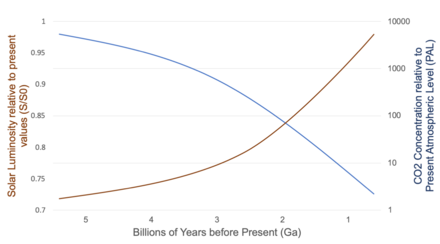
The answer to paradox part of the faint young sun paradox, is falling CO2 levels have been reducing the greenhouse effect as the Sun became warmer. Greenhouse levels down from those that worked with the far cooler sun of the past, to current levels that work with the Sun of today. What is fairly clear from the graph shown here and from the Wikipedia page, is that CO2 is now close to zero, and has little scope for further reduction of CO2 in order to continuing to save us from further increases in the temperature of the Sun. Although today, with knowledge of the greenhouse effect, that plants photosynthesise and free oxygen is not natural, and it all follows, but these are not new ideas. It turns out this was first proposed as the Gai Hypothesis back in the late 1800s, that some mechanism existed that enabled life to regulate the temperature on Earth.
How long before the temperature control fails?
Doctor: How long have we got? This is a question that has plagued me since learning the sun gets progressively hotter, rather than the Sun staying the same temperature right up until an eventual, but sudden, fireball.
Consider Venus. Venus is believed to once have had temperatures similar to those on Earth today but reached a ‘tipping point’ when the combination of the Sun and greenhouse gasses resulted in ‘thermal runaway. Overheating. The result is the current surface temperatures of 462 °C (863 °F). So, Venus likely started out capable of supporting life, but increasing heat from the Sun took over and life, if there was any, became extinct on Venus. Sound familiar? Venus is closer to the sun, so naturally it would succumb before Earth does. Earth eventually receives the same heat from the Sun Venus had billions of years earlier.
Reading this article with further analysis of CO2 levels, it appears that CO2 levels drop by around 3-4 parts per million every million years, and this drop is an appropriate counterbalance to the increasingly solar temperatures. From the Vostok charts below, CO2 levels have fluctuated between 180ppm and 280ppm over the past 400,000 years of the current geological era. Which suggests we have 280/4 = 70 million years where we could still use CO2 to control temperature. Far, far less than the 5-billion-year figure, but still quite comforting for a species that has only been on the Earth for less than half of one million years so far. On those figures, less than 1/70 of our time is up, even if most of the time for advanced life has already passed.
But can we really reduce CO2 to zero? It may be important to also consider plants, which actually need CO2 to survive. Life as we know it requires plants to produce food. While plants have been proven to tolerate as little as 180 parts per million, that has been with dramatically reduced growth rates. Note: while we know plants have could survive with CO2 at 180 parts per million in the past, this also came in the past with reduced temperature, which reduces metabolic rate, and improves tolerance to low CO2 levels. In another 25 million years, a reduction to 180ppm would be necessary to offset increased solar energy and maintain today’s temperature. A new test for plants, but still probably ok…. but… All this suggests that assuming a CO2 minimum any lower than 180 parts per million is risky. That level still would provide for a future of 25 million years, and as a species, who knows what problems we will be able to tackle in even if we have just one million years.
Could we reduce CO2 for the whole 25 million years until the limit is reached?
Reducing CO2 levels at 3-4 parts per million for the whole 25 million years would allow maintaining current temperatures but consider the impact on life on Earth.
We know that since peak life around 500 million years ago, the biosphere has halved, meaning only half the life on Earth now as there was 500 million years ago.
Plants grow fastest when there is lots of CO2, and plants can consume that CO2 at a rate which causes CO2 levels to fall. Behind the fall in total life from peak life to today is the reduced levels of CO2, which results in a reduced rate of photosynthesis in plants, which has resulted in less plant life which also means less food for animals.

The most recent 500 million years on Earth have been the Phanerozoic Eon, or time of visible life, because conditions have been suitable for the plants and animals we think of as “life”. But even in this time of “ideal conditions” temperatures have ranged between 20°C hotter and up to 8°C colder.
Controlling CO2 to keep temperatures within just a few degrees for anything like 25 million years would be an enormous challenge and a break from what has gone before.
Potentially, but if we could, it would come at a huge cost. Consider the impact of reducing CO2 by 3-4 parts per million every
Or on the other side, we will need to survive long enough for this threat to matter.
25 million years is a long time for humanity, but still an extremely short time for a planet that has supported plant life for at least 3.5 billion years. For plants as we know, this means 3.5billions years so far and only 25 million left. Without intervention, just 0.7% of their entire window of existence remains.
The oxygen can’t last: 75% of the short time already used?
So, can we count on that Oxygen atmosphere that was necessary for our evolution? The one that has only been around for the most recent 10% of the life of the Earth? Well, it seems that oxygen can’t last much longer either. And it turns out that the level of O2 is critical to humans, and just dropping from the current 20.5%, to 19.5%, would cause us distress (see below).
Earth’s modern atmosphere is highly oxygenated and is a remotely detectable signal of its surface biosphere. However, the lifespan of oxygen-based biosignatures in Earth’s atmosphere remains uncertain, particularly for the distant future. Here we use a combined biogeochemistry and climate model to examine the likely timescale of oxygen-rich atmospheric conditions on Earth. Using a stochastic approach, we find that the mean future lifespan of Earth’s atmosphere, with oxygen levels more than 1% of the present atmospheric level, is 1.08 ± 0.14 billion years (1σ)
The future lifespan of Earth’s oxygenated atmosphere

On first reading, it may sound as if ‘the oxygen threat’ will not occur for 1 billion years. However, that 1.08 billion years is until Oxygen is at 1% of current levels. This invites the question, what percentage of current levels do we need?
Approximately 78 percent of the air is nitrogen gas while only about 20.9 percent is oxygen. The remaining fraction is made up of primarily argon gas, but trace amounts of carbon dioxide, neon and helium are also present.
Minimum Oxygen Concentration for Human Breathing.
For humans and many animals to sustain normal functions, the percentage of oxygen required to sustain life falls within a small range. The Occupational Safety and Health Administration, OSHA, determined the optimal range of oxygen in the air for humans runs between 19.5 and 23.5 percent. Serious side effects can occur if the oxygen levels drop outside the safe zone. When oxygen concentrations drop from 19.5 to 16 percent, and you engage in physical activity, your cells fail to receive the oxygen needed to function correctly. Mental functions become impaired and respiration intermittent at oxygen concentrations that drop from 10 to 14 percent; at these levels with any amount of physical activity, the body becomes exhausted. Humans won’t survive with levels at 6 percent or lower
The 1 billion years is until levels drop to 1% of current levels. We need 95% of current levels (19% is 95% of current 20.5% level) to function in the ‘normal range’, 78% of current levels to be still able to exercise without damage, 68% of current levels to be able to fully function mentally, and we need 30% of the current O2 levels to survive at all.
Of course the Ozone layer would have long collapsed before we suffocate, but we could all retreat into some form of pressurised, radiation proof enclosures, provided we could escape the heat.
The paper only quotes the 1 billion years until 99% of Oxygen is gone. It if was linear, that would mean 50 million years with Oxygen in the safe range, but without more data or the full model, it is still safe to say Oxygen levels are another way the environment is fragile.
We Are In an Ice Age!
The Background: Phases of ‘Ice Age’, and ‘Not Ice Age’.
The term ice age has become ambiguous. There is a scientific term, also known as a ‘glaciation’, and by that definition we are currently in an ‘ice age’, the Quaternary Glaciation. By popular usage of a word changes its means and popular usage now uses the term ‘ice age’ to describe one phase of the original scientific term, a ‘glacial period’.
So there are three climate states:
- regular time, outside a glaciation (not for 3 million years so pre-humans)
- glaciation (described in science as an ice age)
- glacial period within an ice age ( ‘ice age’ in now popular usage)
- interglacial period of an ice age (what is happening now, and for past 12,000 years or all of civilisation)
In fact humans evolved and have only ever experience Earth during ‘glaciation’ or an Ice Age. So just because we in an Ice age does not mean it is about the get colder. In fact, the current ‘interglacial’ period is like a ‘mid temperature’ between the coldest, glacial periods, and the warmest, ‘normal’/greenhouse periods. So yes we are in an ice age, but that says nothing about whether we risk global warming or global cooling.
Normal or ‘Greenhouse’ Periods
The most common state of the Earth is ‘not an ice age at all’, which is when there are not even polar ice caps. The defining characteristic is that there is no ‘ice sheets’ of over 50,000sqKm on the Earth. In summary, the Earth is most commonly warmer than it is now. In graph below, the ‘blue’ areas are the ‘glaciations’ where there are at least polar ice caps like there are now, and for all the rest the Earth is warmer. So mostly, the Earth is warmer than now, however since life first took hold on land less than 500 million years ago there have been a fairly even divide between ‘greenhouse’ (previously the normal) and glacial periods.

Glaciations (technically Ice Age) Periods.
To geologists, an ice age is marked by the presence of large amounts of land-based ice. Prior to the Quaternary glaciation, land-based ice formed during at least four earlier geologic periods: the Karoo (360–260 Ma), Andean-Saharan (450–420 Ma), Cryogenian (720–635 Ma) and Huronian (2,400–2,100 Ma).[5][6]
from Wikipedia
We are currently in a ‘glaciation’ as there still are large ice sheets. This ‘glaciation’ has been ongoing for 3.5 million years. Which means humans have only ever existed in an glaciation (geologically, an ‘ice age’). There have been previous ‘glaciations’, but they are rare:
Glaciation has been a rare event in Earth’s history,[27] but there is evidence of widespread glaciation during the late Paleozoic Era (300 to 200 Ma) and the late Precambrian (i.e. the Neoproterozoic Era, 800 to 600 Ma).[28] Before the current ice age, which began 2 to 3 Ma, Earth’s climate was typically mild and uniform for long periods of time.
from Wikipedia ‘records of prior glaciation’
Yes, rare in the Earths history, but in the last half billion years, the time of land plants and animals, almost half of the time has been a glaciation, so not actually so rare anymore?
Glacial and Interglacial periods (like now)
During a glaciation, there are two states, ‘glacial‘ and ‘interglacial‘. We are currently in an interglacial period, from around 12 thousand years ago until the present. This means human civilisation developed entirely during this current interglacial period.
So we are a species that has only existing during a glaciation, and as a civilization that has only existed during a single interglacial period of a glaciation.
Can civilization survive outside the interglacial period of a glaciation? Can humans survive outside a glaciation? I suggest the answer to both is “yes”, and the real question is how many humans can civilisation support in one of these alternative, hotter, or colder possible scenarios.
An Ice Age termination event as of 2006?
Genuine science.
Sea Levels +70m to -125m
Over geologic time sea level has fluctuated by more than 300 metres, possibly more than 400 metres …. The current sea level is about 130 metres higher than the historical minimum
past sea levels: wikipedia
Historically, sea levels rise outside of ‘glaciations’, because during these times there are no large glaciers, such as those currently on Greenland and the Antarctic. At those times, the water trapped in glaciers raises the sea levels.
The National Snow and Ice Data Center predicts that if both Antarctica and Greenland, the world’s largest ice sheets, both melted completely, the sea level would rise more than 70 meters.
from ‘Science on a sphere’ (other references for same data to be added)
However, that last time those glaciers melted would have been prior to the current glaciation, the Quaternary Glaciation, which means more than 2.58 million years ago.
While there are many charts of historic sea levels, it is important to remember that all records for the past 2.5 million years are for within the current glaciation (or within an ‘ice age’), and records for the past 10,000 years, will all be records of what happens inside an interglacial period of that glaciation.

Sea levels were clearly much lower during the glacial period that preceded the current interglacial. During that most recent glacial period (from 11,000 years ago back to 115,000 years ago), as it seems clear that humans previously could walk from Europe to Britain, from Indonesia to Australia, and from mainland Australia to Tasmania. In fact sea level have been as low as 125 meters (around 410 ft) lower during the last ‘glacial maximum’ around 13,000 years ago, and throughout the period 11,000 years ago through to 115,000 years ago.
However recent (up to 120,000 years ago) data covers cooler times, and excludes overall more common warmer times. Even going back to the previous interglacial, only gives data on when conditions should be similar to the last 12,000 years, but still gives some frightening results, that even with lower than projects CO2 levels, sea levels can be 10 meters higher than current levels. What should be of real interest right now is about how sea levels will rise to match where CO2 levels are heading. It is clear 70m of rise is possible technically. I have seen data to support this level of rise in multiple sources, such as ‘science on a sphere’ above, this article from cosmos magazine (stating 60m rise from Antarctic, further 6m from Greenland leaving on 4m rise required from the rest of the worlds glaciers)
However the fastest recorded rises are around 2 meters per century, although these are believed to correspond to far smaller rises in CO2. Still these changes in sea level do impact the ‘carrying capacity’ of the land (the population that can be supported) do have happened in the past without threatening life itself.
Climate change: negative feedback protection by plants.
In looking at current climate change data, there are many frightening ‘trigger points’ that provide positive feedback. As it gets hotter, events take place that make it even hotter! Any system with only positive feedback is unstable and for stability, there must be some negative feedback.
The good news is there is a negative feedback.
A quarter to half of Earth’s vegetated lands has shown significant greening over the last 35 years largely due to rising levels of atmospheric carbon dioxide
Nasa CO2 making the earth greener
As CO2 levels rise, temperatures rise and plants thrive. As plants thrive, they increase CO2 consumption and CO2 levels fall, and temperatures fall. As temperatures fall, CO2 consumptions falls, and sources of CO2 (volcanoes etc) replenish CO2 and the cycle repeats.
If the feedback was sufficiently precise, then we would have stable temperatures and steadily declining CO2 to compensate for the Suns gradual temperature rise.
Over a large scale this is exactly what is observed. However, in more detail, the ‘bumps’ in the graph are revealed.

Looking at CO2 data on an expanded scale reveals just how much when examined more closely levels fluctuate within that long term trend. As can be seen from this data, there is a historical strong correlation between CO2 levels and temperature over the past 420,000 years. Temperature and CO2 tend to both spend a longer time falling, then both suddenly rise. This is consistent with thriving plant live consuming CO2 and driving down temperatures, until the cold and lack of CO2 creates a less thriving plant ecosystems and CO2 again rises until the plant population recovers. Note that each time CO2 falls to a level of close to 180 parts per million… the trend reverses and CO2 levels again rise. This is consistent with CO2 at 180 parts per million producing a very significant reduction in photosynthesis.
The good news is that human induced high levels of CO2 (as already observed) increase plant growth. The bad news is that this increased rate of plant growth will not be sufficient to provide the usual negative feedback with current rates of deforestation compensating for increased CO2 consumption to area of forest, but continually decreasing the total area of forest to consume CO2. This post is about natural climate change, but I thought it important to avoid a fact on the natural environment being misleadingly appearing to apply to our current situation.
Updates.
- 2024 September 13 : Added Poking the bear.
- 2023 October 25: Ice age termination event.
- 2022 September 30: Added CO2 been always critical.
- 2020 December 20: Just typos.

