
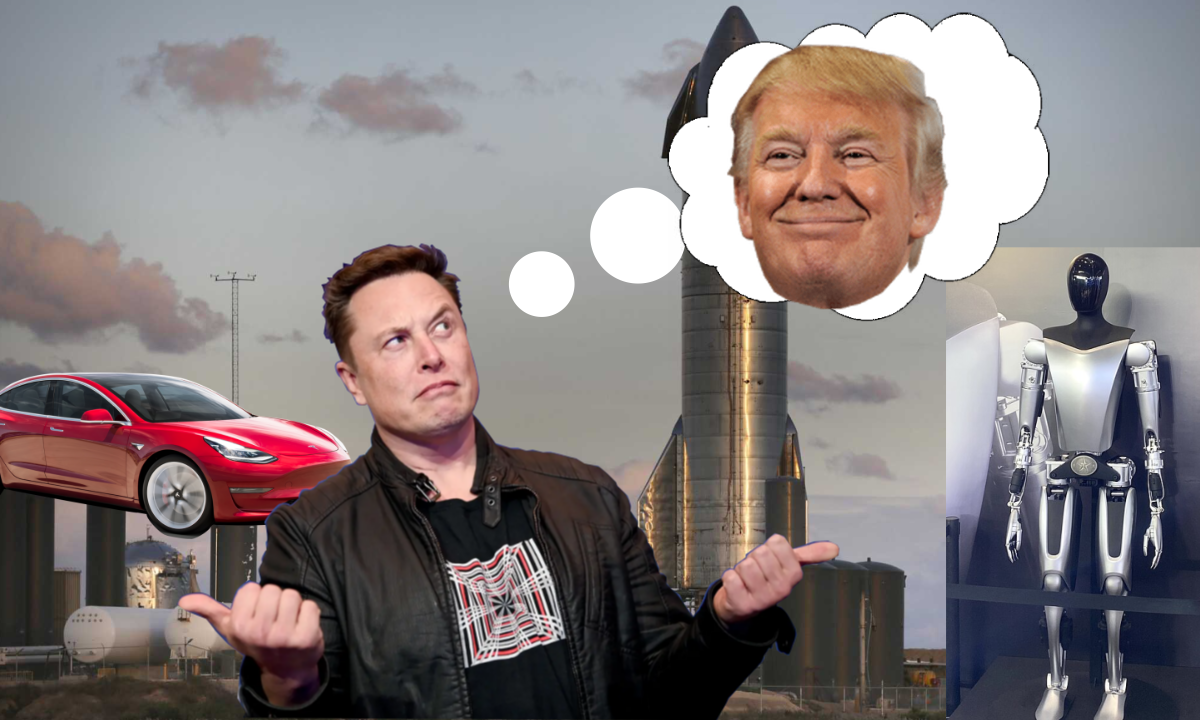
Synopsis: Musk highlights a flawed democracy and raises many questions on Tesla.
Within days of the July 13 shooting, at the height of confidence that Trump would win the 2024 election, Elon Musk first publicly endorsed Trump, and then announced he would donate $45 million per month to support his re-election. As CNN put it “going all in on Trump“.
Musk, one of the richest people in the world with an estimated wealth exceeding $250 billion, is said to have committed around $45 million per month to the Super PAC.
https://insideevs.com/news/726784/musk-trump-ev-super-pac/
People look at the motives of Elon Musk become a donor, focusing mostly on the impact on Tesla, but just as any “mega donor” as discussed below, and whether the goal for Elon Musk is to influence the politicians or the outcome of the election or both by donating so many millions Trump is discussed in more detail below in “US Democracy for sale: The basis of any motives for the donation“.
The still leaves people questioning “why support a campaign that has stated it will cut back on support for electric vehicles”. Even AI just echos the questionable logic suggesting the move may backfire on Elon Musk and looks for ways that a more negative attitude to EVs from government could still be ok for Tesla vehicle sales. Time after time analysis seems to ignore that Elon Musk himself has repeated stated “Tesla should not be seen as a car company“. The two main initiatives for Tesla going forward are robotaxis and humanoid robots, neither of which would be specifically negatively impacted by a Trump presidency. Tesla selling vehicles to consumers seems like it has been just a step towards another goal, just as the Tesla Model S was step towards a more affordable vehicle, the Model 3 and Model Y are just steps towards robot cars for transport as a service and the main market: humanoid robots.
While looking at the Tesla future counters reasons against Musk aligning with Trump, it still does not provide reasons for aligning with Trump, particularly when Musk in the past has said he is not a fan.
This is where I come back to the thought that democracy is for sale. To me it makes sense the Elon Musk is buying influence. Elon Musk famously bought Twitter, which is quite clearly buying influence. Elon Musk claims he wants the huge pay packet of Tesla shares that has been in dispute not because he wants the money, but because he wants the influence that comes with his target percentage of Tesla shares.
It is just my opinion without solid evidence, but the remarks of Trump on Musk and comments from Elon on their recent conversations give me the feeling there is a real opening for Elon Musk to have significant influence on a future Trump government, and that is something Elon Musk does not wish to pass up.
US Democracy for sale: The basis of any motives for the donation.
Should all voters be equal in a meritocracy?
The amount of money spent on a campaign has a significant impact on the success of the campaign, which means the larger the donation, the greater the impact the donor is able to have on the who wins. The end result of is that instead of a system where all voters are equal, the current electoral system in the US could instead be seen as a system where the more “merit” an individual has as determined by their “worth“, the greater impact that individual can have on who runs the country. If you believe in as meritocracy and believe that the current system accurately allocates wealth on the basis of merit, then maybe this is the best system.
The motivation for sizable donations.
Different people have different takes on the motives of those behind huge donations, but it seems every consideration of motives I have encountered is based buying outcomes of an election on the assumption democracy in the US is to some extent “for sale”.
The theory of democracy is on “one person one vote” and all voters are equal, but large political donors get at the very least privileged access to their thoughts causes to political leaders, and the political donations themselves get change the balance of the propaganda campaigns that influence voters.
Isn’t there a limit to the size of donations in order to protect democracy?
Regulations in the US recognise this effect and have placed a limit on political donations of $3,000 per individual in order to ensure widespread equal opportunity to fund the propaganda, but loopholes have been found and since 2010:
following a number of Supreme Court decisions — Citizens United v. FEC (2010) in particular—the “very wealthy” are now allowed to spend unlimited amounts on campaigns (through Political Action Committees, especially “Super PACs“), and to prevent voters from knowing who is trying to influence them (contributing “dark money” that masks the donor’s identity).[5] Consequently, as of at least 2022, critics (such as the Brennan Center for Justice) allege “big money dominates U.S. political campaigns to a degree not seen in decades” and is “drowning out the voices of ordinary Americans.”
Campaign finance in the United States – Wikipedia
Significant donors.

On January 21, 2010, the Supreme Court opened the super-PAC era with its 5-4 ruling in the Citizens United case. While the decision left the limits on donations to politicians in place, it blew open caps on outside spending—money given to groups that campaign for or against candidates without officially being part of their campaigns. The decision led to a flood of spending by corporations and unions, as well as superwealthy donors who dropped more than $3 billion on super-PACs in the past decade. As a new report by Public Citizen finds, nearly half of that money came from a handful of people—including presidential candidates Tom Steyer and Michael Bloomberg.
2020: Bloomberg and Steyer Make Top 10 List of Biggest Super-PAC Donors Ever – Mother Jones

Four megadonors have contributed a combined $459 million this election cycle to super PACs supporting former President Trump’s campaign, according to a Sludge review of FEC data through the latest reporting deadline of Oct. 16.
2024: The Final Pre-Election Reports Are In: Here Are Trump’s 20 Largest Donors
The Elon Musk “America” Super Pac.
From a logical perspective, every reason I have seen expressed by others or can myself imagine for donating distils down to one or two option. Either to “suck up” for commercial reasons to the republicans and Trump, or to help Trump win.
It could be both “suck up” and “help”, but everything distils down to some combination of these as the primary motive.
This starting point doesn’t answer the more complex questions of what Elon Musk wants to achieve by either “sucking up” and/or helping Trump win but understanding how democracy is for sale is central to those more complex questions, and it makes clear that democracy in the US has big problems.
Commercial motivation: “Seeing the writing on the wall”.
Several commentators declared that following the July shooting incident, the campaign was now “Trumps to lose”. Some have even been saying it since February, but the addition of an attempted assassination adds the elements of being seen like a martyr, having been saved by God, and encouraging sympathy.
Add these elements to the fact that many already had Trump ahead before the Biden debate disaster, and that the longer Biden delays limiting democratic choice to only Kamala Harris the worse the situation for anyone stepping up, and there is a pretty compelling case for just accepting that Trump is going to win even if it is not what you want.
But if you already believe Trump is going to win, then the money itself is not even needed, and won’t change the outcome. Despite the strange logic leading to donating a lot of money that is not needed, this is the explanation I have heard several Musk/Tesla adopt. “It doesn’t mean Musk really supports Trump, but he now accepts it is most likely Trump will win so Musk is trying to get the best for Tesla”.
Elon Musk is providing the money to help Trump win.
The other take on motivation is that, rather than simply backing the winner, Musk is providing his donation in order to try and ensure that Donald Trump becomes the winner. While this in some ways can sound like the purest motive, simply supporting the candidate you support, from a democracy perspective of “one person one vote”, it is still a big failure. The basic premise is that the more money a campaign has to spend on propaganda advertising, the greater the chance of winning. On this basis, the more a campaign can appeal to super wealthy voters like Musk, the greater their chance of winning.
In an attempt to close off this threat to democracy, the US introduced laws to limit campaign contributions, as outlined on Wikipedia, bringing the system closer to “one man one voice”. However, since 2010, a system based on “Super PACs” has been able to completely bypass electoral limits and has resulted in a very small number of extremely wealthy individuals having huge influence in political campaigns.
Examining one slice of the campaigning season—Summer 2015 of the 2016 presidential campaign cycle—the donations of fewer than 400 super wealthy families comprised nearly half of all publicly disclosed presidential campaign financing, according to a New York Times analysis of FEC and Internal Revenue Service (IRS) filings. These donors exploit the SuperPAC loophole, which bypasses the traditional donation maximum for an individual in any year.
Campaign finance in the United States – Wikipedia: Super Wealthy Donors.
Bribery, transactional and is there a fair way to influence elections?
In general, it is considered perfectly acceptable that a person can be highly influential when they their influence arises from people valuing their opinion.
The problem is ability to influence the outcome of elections through donations. A person being highly influential because they can monetarily control the media, and the information people receive is considered a threat to democracy.
It seems to be accepted that Donald Trump is “transactional” which is taken to mean that if someone does something for him, he feels obligated to do something for them in return, and I find the difference between this to be confusingly similar to bribery. For example:
Donald Trump has for months denigrated electric vehicles, arguing their supporters should “rot in hell” and that assisting the nascent industry is “lunacy”. He now appears to have somewhat shifted his view thanks to the support of Elon Musk, the world’s richest person.
“I’m for electric cars, I have to be because Elon endorsed me very strongly,” Trump, the Republican nominee for US president, told supporters at a rally in Atlanta, Georgia, on Saturday.
The transactional nature of this relationship with Musk was made clear by the former president and convicted business fraudster, however. “So I have no choice,” said Trump, who then went on to say that electric vehicles were suitable for a “small slice” of the population and that “you want every type of car imaginable” to be available.
Trump says he has ‘no choice’ but to back EVs after Musk endorsement
Something has changed Musk’s position on Trump.
In July 2022, Musk said Trump was “too old to be” president of the United States, and Trump needed to “sail into the sunset.” Musk also said he was leaning towards supporting Florida Governor Ron DeSantis for president in 2024. Trump hit back, calling Musk a “Bull***t artist”.
Then in late 2022, Twitter reversed its ban on former U.S. President Trump shortly after Musk completed his $44 billion purchase of the controversial social media platform, which he later renamed X.
Last month, Trump said he was “a fan of Elon,” adding “he does an incredible job with Tesla.”
Musk said at a recent Tesla shareholder meeting that the two men had “some conversations.” Trump is a “huge fan” of Tesla’s electric pickup trucks, Musk said.
Reuters: Elon Musk endorses Trump in presidential race, calls him “tough”
The America Super PAC: Its motives and is the money from Elon Musk?
“I am making some donations to America PAC, but at a much lower level and the key values of the PAC are supporting a meritocracy & individual freedom,” he wrote on X. “Republicans are mostly, but not entirely, on the side of merit & freedom.”
https://edition.cnn.com/2024/07/16/business/musk-trump-support/index.html
The key points being that 1) Elon Musk is confirming he is donating via the America Super PAC, although exactly how much of the 45 million per month is from him vs from his associates is not made clear, and 2) his motives in his own words are supporting a meritocracy and freedom.
This raises 3 questions:
- Who is behind the America Super PAC?
- What is a mereticocrcy and how does this super PAC support a meritocray.
- How does the Republic party under Trump, more represent freedom than the Democrats?
Whether this super PAC is an Elon Musk initiative or something he has adopted is unclear, and the nature of Super PACs is that while you can see how much they provide to help political campaigns, they do mask its origin, so exactly how much is directly from Elon Musk vs his associates is unclear, but there appears to be no denying the at least45 million per month is committed either by Elon himself or Elon together with his associates.
Meritocracy: The second point relates to a meritocracy as opposed to a democracy. Although officially the USA is a democracy, some degree of the principles of a meritocracy in theory allows for better outcomes for those who deserve better outcomes. The problem with a meritocracy, is coming up with a system that justly determines who has “merit”. In theory the meritocracy rewards merit with wealth, and those with the greatest wealth are those citizens “worth” the most.
An extreme meritocracy where merit determines wealth would mean those with the greatest wealth set the rules, and those rules will favour those with the greatest wealth.
Freedom: The third point is that Musk associates the Trump Republican party with freedom. Reality is, both parties say a vote for them is a vote for freedom, and no party is going to say they have an “anti-freedom platform”. What changes is what is seen as freedom, and who you identify with. Freedom for one person can mean oppression for another. The US fought a civil war over the freedom to own slaves vs the rules that declared slavery illegal. Opinions vary on whether allowing everyone to own guns without any restrictions would represents more or less freedom.
A democracy can seek to position the outcome for ordinary people over and above those of greater “merit”, and whether this is a restriction of freedom can depend on whether you are the people the rules seek to protect:
In recent years, Khan has spearheaded lawsuits against Amazon, Microsoft and Meta. In an interview with CNN last year, Khan described those efforts as part of a broader campaign to bring more of the government’s resources to bear on the daily economic problems of ordinary Americans.
But government regulation, however well intentioned, rarely sits well with the people who are getting rich off the status quo.
A rash of tech billionaires are pivoting to Trump — but not because they’re MAGA bros | CNN Business
Elon Musk may want a meritocracy and support MAGA for personal reasons.
The stated reasons for supporting Trump are support for “meritocracy & individual freedom”, and as a candidate of the person of greatest wealth and thus if the US is a meritocracy, the person of greatest merit, it makes sense for Musk to want a meritocracy.
He [Trump] concluded: “We have to make life good for our smart people, and [Musk,] he’s as smart as you get.”
Trump Boasts Of Elon Musk’s Huge Donations; Says “We Have To Make Life Good” For Him And Other “Smart People” (yahoo.com)
Trump considers it important to make sure Musk has a good life, and perhaps his wealth and pay is just not enough to deliver the good life he deserves?
There is also a personal motive for Musk aligning with the Republican stance on “woke”:
Under Musk’s leadership, X has rolled back safety protections for transgender people. And Musk last year declared the word “cisgender” — which describes someone whose gender identity conforms with the sex they were assigned at birth and is often used in medical contexts — as a “slur” on the site that is automatically hit with content restrictions if directed at another person.
Musk has previously spoken about his daughter, including in the authorized biography written by journalist Walter Isaacson and published last year. In the book, the billionaire blamed his daughter’s transition in part on her time at a progressive, Los Angeles school.
Elon Musk’s estranged daughter calls out his ‘entirely fake’ claims about her childhood
The impact on Tesla, and beyond.
Most debate seems to focus on the impact on Tesla the car company.
Some of the first questions raised, as seen in the video linked here to the right, have been on how this alignment with one party would affect Tesla.
While this in an interesting question, Musk has multiple companies that could be impacted by his relationship with the future president. From a commercial perspective, Musk has more to consider than Tesla, and even with Tesla, given that Musk has stated repeated Tesla should not be seen as a car company, even with Tesla has a lot more to consider than the impact on EV sales.
Some see the donations as making a difference as to whether Trump gains power, with most of that group suggesting Trump gaining power would be against the interests of a company selling EVs, and thus to them, Musk is acting against the interests of shareholders.
Elon Musk has announced his support to Donald Trump’s VP pick, Senator JD Vance. It’s hard to believe, considering Vance is pushing a bill that would crush Tesla’s sales in the US.
As we often reported in recent months, Musk is no stranger to acting against the interest of Tesla shareholders despite his fiduciary duties as CEO.
One of those cases, his threat not to build AI products at Tesla if he doesn’t get 25% control of the company, is now going to court.
Elon Musk supports new VP candidate that would crush Tesla’s sales in the US
Another interpretation I have seen from Tesla followers is the Elon Musk may now feel the assassination attempt could mean that the election of Trump is now a certainty, and Musk getting on board with Trump now is about seeing the writing on the wall, and the decision to donate is purely a commercial decision to be in the best position to influence future policy, and need not reflect personal political views.
Even those positive on the outlook for Tesla if Trump wins, as is the case with the video here by “Farzad”, still suggest that Tesla sales would be lower under Trump given the commitment by Trump to “End the EV mandate“, which is taken to mean the mandate to reduce vehicle emissions, “on day one”. This video uses the logic that as only Tesla and BYD yet make a profit from EVs, Tesla will still be ok under regulations by Trump. Reality is, just as it took Tesla over 10 years show a profit from EVs, just because these other companies are not profiting yet does not mean they are not on track for profits. Bottom line is beneath the optimistic spin, Trump won’t help Tesla cars sales or profits, and alienating the half of the public least likely to be anti-EV could make it worse.
But what it you don’t consider Tesla a car company?
Elon Musk has repeated stated that Tesla should not be seen as a car company. It is clearly true that Tesla has a market capitalisation that is way too high and simply makes no sense if you value Tesla as a car company. At one time it seemed possible that Tesla could become the world’s biggest car company, but even growing to twice the size of Toyota of 2023 would not justify the valuation, and in 2024, Telsa is falling back:
In the first half of 2024, Tesla’s US sales fell eight percent. It’s worse in Europe with a 13-percent drop. While the general public is not entirely enthusiastic about electric cars, overall demand has actually grown in both regions.
Tesla Is Losing Ground In The U.S. And Europe: Here’s Why
While BYD sales are still growing as that brand is taking the lead in pure EV sales and reached twice the sales volume when plug in hybrids are included, and it seems Elon Musk now has more interest in robo-taxis and robots, and possibly sees EVs as now yesterday’s news, as in his vision, we head to a future where people don’t own car, which may the real thinking behind the comment by Elon Musk that “Obliteration is coming anyway” for the US auto industry.
Does “transport as a service” mean the consumer car industry is just a transition?
Elon must has said on several occasions that in the future people won’t need to own cars. This follows on his repeatedly saying that without self-driving, Tesla is not worth anything as a company, which suggests he has believed for some time that the only cars industry with a future is that of self-driving cars. He has also said that robots are more important to the future of Tesla than cars:
Elon Musk likes to have a focus – and this year[2022], it looks like it might be robots.
Musk: Robots to be bigger business than Tesla cars (bbc.com)
He told investors on a Tesla earnings call his nascent robot plans had “the potential to be more significant than the vehicle business, over time”.
And they would be the most important things Tesla worked on this year.
The words of Elon Musk suggest his vision for the future of Tesla, and potentially the world, will be less about cars and far more about robots. Elon Musk has predicted the future will be a world where transport is a service, so people don’t need cars, but people do need robots. In that future, incentives for consumers to buy EVs won’t matter to Tesla because vehicles will be robotaxis for transport as a service and the US auto industry still making cars for consumers is headed to oblivion regardless of whether the auto industry makes ICE vehicles or EVs because there will be less vehicles.
Opinion: If Tesla is not a car company, what’s next for Tesla cars?
It is fact that Elon Musk has said that Tesla should not be seen as a car company. Yet Tesla is currently a car company that sells cars to consumers, and opinions vary on interpreting exactly where Elon Musk sees Tesla heading.
The most recent release has been the Cybertruck, but that was first showcased, shattering windows and all, back in late 2019. The “$25,000 low-cost car” was first suggested even earlier, and new Tesla Roadster was first announced in 2011 and 1,000 Tesla customers fully paid $250,000 as long ago as 2017 but are still waiting for their car.
In summary, there is some evidence that focus on cars has been somewhat erratic. Add that there has been more information on the Optimus robots which have reached a 3rd generation less time than it took for prototypes to production of the Cybertruck, robotaxi seemingly becoming higher priority than the next consumer vehicle, and it gives some credence to the opinion that:
- The design of Tesla vehicle from the Model 3 have assumed the vehicle will be self-driven most of the time which is why features such as a driver’s display are considered superfluous.
- Based on the assumption that self-driving cars will result in most people electing to move “transport as a service” instead of owning cars, sales of Tesla consumer vehicles are now seen as only and interim step in the “master plan”.
- Tesla cars are seen as just early version high priced “car robots” with the master plan being the larger picture of far more significant revenue to come from humanoid robots.
- Cars could never deliver the Tesla valuation of $30 trillion dollars Elon Musk has suggested as the Tesla goal.
Tesla as THE robot company: The Tesla goal.
The plan to lead with sales of humanoid robots is far bigger than and plan based around selling cars and is far more transformative in being able to shape the future of humanity. Elon Musk already has had an influence on the future, but his dreams of colonising space and building robots go so much further, and so could his influence on the future.
Musk final goal: It’s all about influencing the future of humanity.
Perhaps neither Elon Musk nor Tesla is focused on sales of EVs to consumers.
While there are suggestions that Trump will have a negative impact on sales of EVs to consumers, even Elon Musk says that Tesla is of no value as car company and if viewing Tesla as a car company you should not invest.
Musk suggests that Tesla would be worth almost nothing if it doesn’t solve self-driving, which the CEO has been confident that the company would solve despite several missed timelines.
2022: Elon Musk says solving self-driving is the difference between Tesla being worth a lot or nothing
“People think of Tesla as a car company, when they should be thinking of Tesla as an AI robotics company,” Musk said, insisting in the company’s prepared remarks that “the future is not only electric, but also autonomous.”
2024: Musk flags “manufacturing revolution” in EVs, but says Tesla is not really a car company
The upcoming products on the radar from Tesla are robotaxis and humanoid robots, neither of which is a product for consumers right now.
According to the very latest briefing, robotaxis will be produced in 2025, and humanoid robots will be for internal use at Tesla in 2025 and for business customer sales in 2026.
Elon Musk also has SpaceX, which, unlike Tesla, was Elon Musk’s baby right from the start. Plus X (formerly Twitter) and X AI. Add Tesla focused on robotaxis and humanoid robots and selling cars to consumers is likely to move far down the list.
Twitter for $43 billion: Was that all about influence?
While Elon Musk has said his purchase of Twitter has been to protect free speech, and although many agreed it was a problem, multiple sources believe the opposite has been the reality, and it seems difficult to find supporters of the case twitter has improved in either truth or accuracy.
What does seem clear, is that Elon Musk himself as owner now has both free and well very promoted speech:
Platformer can confirm: after Musk threatened to fire his remaining engineers, they built a system designed to ensure that Musk — and Musk alone — benefits from previously unheard-of promotion of his tweets to the entire user base.
Elon Musk created a special system for showing you all his tweets first – The Verge
The “55 billion” compensation package: All about influence?
The variations in valuing the controversial record-breaking compensation package Elon Musk is seeking arise from it is to be paid as share options, which makes the actual value dependent on the Tesla share price.
While all the attention is, quite understandably, and the huge value of the package, Elon Musk himself has always said what he seeks is the control, or in other words influence, that these shares provide.
Bargain: Could less than 1 billion could buy political influence?
Certainly, right now it takes less than 1 billion to be the largest individual donor. Not only is it that amount of money can have a significant impact on a campaign budget, but it also gets you a lot of attention from a potential leader.
“I love Elon Musk… he endorsed me recently. He’s great.
“I read he gives me $45million a month. I talked to him a while ago, and he didn’t even mention it. Other guys give you two dollars and you got to take them to lunch.”
Trump included a quick reference to electric cars, the potential fulcrum for any future clash of interest between him and the Tesla chief. “I’m totally for them, if it’s 10%, 20% of the market, but you can’t have 100%.”
And he lavished praise on Musk’s space program, calling his rocket engine returning to Earth “the coolest thing I’ve ever seen. How long would it take government to come up with that one?”
He concluded: “We have to make life good for our smart people, and he’s as smart as you get.”
Trump Boasts Of Elon Musk’s Huge Donations; Says “We Have To Make Life Good” For Him And Other “Smart People” (yahoo.com)
The J.D. Vance related agenda and project 2025.
Note, as per the quote above, Elon Musk has specifically declared his support for J.D. Vance, despite Vance proposing to replace subsidies for US made EVs with subsidies for
The J.D. Vance story is one I don’t understand yet and I am collecting data under this heading.
What I know about J.D. Vance is:
- He seems to be very articulate and intelligent, yet he is unpopular.
- His stated position on Trump switched from fierce critic to avid supporter.
- Vance worked for years as venture capitalist before becoming a senator in 2022.
- Wrote the forward to the book “Project 2025”.
- Former PayPal co-founder and Elon Musk colleague Peter Thiel is reported to be a key backer of Vance’s political career.
In publicity material for the book, Vance says of Kevin Roberts, president of the Heritage Foundation: “Never before has a figure with [his] depth and stature within the American Right tried to articulate a genuinely new future for conservatism.”
JD Vance writes foreword for Project 2025 leader’s upcoming book
Anthony Scaramucci keeps mentioning project 2025, but I may be missing some of the implications as I have not been following this closely enough.
Comments like these are taken to reflect Donald Trump distancing himself from his own running mate:
“I’ve always had great respect for him … but I will say this, and I think this is well documented historically, the vice-president, in terms of the election, does not have any impact. I mean, virtually no impact,” Trump said.
Trump says running mates have ‘virtually no impact’ in apparent JD Vance snub
Background. AI response to “musk trump tesla” (July 21, 2024).
Elon Musk’s Endorsement of Donald Trump and Its Impact on Tesla
Elon Musk, CEO of Tesla, has publicly endorsed Donald Trump, a self-proclaimed “EV skeptic,” despite Trump’s previous criticism of electric vehicles (EVs). Musk has pledged $180 million to Trump’s campaign, with $45 million per month, sparking concerns about the potential impact on Tesla’s reputation and sales.
Musk’s Motivations
Musk’s endorsement has been met with skepticism, particularly among Democrats, who make up a significant portion of Tesla’s customer base. Some analysts believe Musk’s goal is to gain access to Trump’s administration and influence policies that benefit Tesla, such as maintaining or increasing government subsidies for EVs.
Impact on Tesla’s Reputation
The endorsement has led to a decline in Tesla’s favorability among Democrats, with some potential customers expressing reluctance to purchase a Tesla due to Musk’s support for Trump. According to recent data, Tesla’s favorability among Democrats has dropped significantly since Musk’s announcement.
Threats to EV Subsidies
Trump has repeatedly criticized EV subsidies, and his administration has threatened to eliminate or reduce them. Musk’s endorsement has not changed Trump’s stance on EVs, and some experts believe that Trump’s administration will target EV subsidies as a way to reduce the federal deficit.
Musk’s Views on Subsidies
Interestingly, Musk has publicly advocated for the elimination of subsidies for all industries, including EVs. He believes that Tesla would benefit from a subsidy-free environment, as it would allow the company to focus on innovation and efficiency rather than relying on government support.
Conclusion
Elon Musk’s endorsement of Donald Trump has sparked controversy and raised concerns about the potential impact on Tesla’s reputation and sales. While Musk’s motivations remain unclear, it is evident that the endorsement has led to a decline in Tesla’s favorability among Democrats and may threaten the company’s access to government subsidies. Only time will tell if Musk’s gamble pays off or if it ultimately harms Tesla’s business.
The height of confidence in a Trump victory.
When America witnessed a pale, hoarse and feeble Joe Biden take the debate stage on June 27, the trajectory of the campaign changed almost instantly.
A look at the 28 chaotic days between Biden’s disastrous debate and his dropout – POLITICO
During the June 27 debate of 2024 between Trump and Biden, Joe Biden not only appeared frail, on several occasions he lost his train of thought mid-sentence and appeared to show signs of dementia.
Within the following 2 weeks, colleagues slowly came out publicly calling for Biden to withdraw, and then on July 13th, there was the assassination attempt. These events combined to make it look certain Trump would win.
At was at this time, just days before the Republican convention when Musk announced his support for Trump. In the days following the announcement by Musk, uncertainty returned to the campaign, with the convention speeches by Trump and newly nominated VP candidate Vance receiving at best mixed reviews, and then Biden stepped down leading to a dream start to the campaign by Harris.
Timeline of Events.
August 12, 2024: Musk tries to boost Trumps with blockbuster twitter event.
Following initial endorsement and revelations of donations in mid-July 2024, Elon Musk downplayed his role in the SuperPAC and his support for Trump, but that was when Trump did not seem to need help.
In early August with Harris surging in the polls to bring the result into question and holding the momentum, “the gloves are off” and Musk came out publicly has fighting for Trump by way of the August 12 Elon Musk hosted a discussion one-to-one discussion between himself and Donald Trump on Twitter/X.
The world’s richest man and its once-and-possibly future most powerful man agreed on almost everything.
Tech titan Elon Musk threw open his X platform on Monday night, offering Donald Trump a pipeline free of fact checks for his falsehoods, conspiracy theories and extremism as he tries to slow the rise of Democratic nominee Kamala Harris.
The chat represented yet another extraordinary chapter in a presidential campaign that has defied logic with its stunning twists in recent weeks, including an assassination attempt against Trump and President Joe Biden’s ending of his reelection bid.
Musk tries to help Trump halt the Harris surge
I found the position expressed by Musk on climate change particularly noteworthy:
Later in the interview, Mr. Musk said he was less worried about a more gradual shift to wind, solar and other emissions-free energy sources. “If, I don’t know, 50 to 100 years from now, we’re, I don’t know, mostly sustainable,” he said. “I think that’ll probably be OK.”
“Eventually, it actually simply gets uncomfortable to breathe. People don’t realize this. If you go past 1,000 parts per million of CO2, you start getting headaches and nausea. And so we’re now in the sort of 400 range. We’re adding, I think about roughly 2 parts per million per year. So, I mean, it still gives us, so what it means is like, we still have quite a bit of time. We don’t need to rush.”
9 Things Musk and Trump Said About Climate Change, Annotated
Donald Trump and Elon Musk both made discursive, often fact-free assertions about global heating, including that rising sea levels would create “more oceanfront property” and that there was no urgent need to cut carbon emissions, during an event labeled “the dumbest climate conversation of all time” by one prominent activist….
“If we were to stop using oil and gas right now, we would all be starving and the economy would collapse,” said Musk, who is also chief executive of the electric car company Tesla. “We do over time want to move to a sustainable energy economy because eventually you do run out of oil and gas.
The Guardian: ‘The dumbest climate conversation of all time’: experts on the Musk-Trump interview
Perhaps comments like “eventually we won’t be able to breathe and would run out of coal and gas” were targeting to gain some ground with the staunches climate deniers, and if the comments were made by Elon Musk to Trump in a private conversation aimed at moving Trump the smallest possible first step, then perhaps they could be justified. But they weren’t in private and only in that context, and instead part of a live feed to an audience of perhaps millions of listeners, it is hard to avoid those words further damaging the credibility of Elon Musk with a large portion of those listeners, whilst also failing to win over the rest.
Updates.
- 2024 Aug 14 : Musk and Trump for two hours on twitter.
- 2024 July 26 : Link to a video on same topic.