
Synopsis: A questionable system for choosing “leadership of the free world”?
“I think it’s a legitimate question to say, is this an episode, or is this a condition?”
Nancy Pelosi: It’s a ‘legitimate question’ whether Biden’s debate performance was a ‘condition’ or just an ‘episode’ (NBC News)
The specific July 2024 episode with the Joe Biden presidential candidacy following the debate is discussed below, and will be resolved, but there is also the bigger question on whether this episode is evidence of a more systemic problem with the choices offered to voters in elections of the US president. This is not just a question for the US, but for democracies across the globe.
Should a leader be a salesperson or a visionary? The main selling point seems to be “our leader is not one of the others and they would be a disaster”.
I started out thinking that the goal of democracy it to offers citizens the ability to choose their leaders, but perhaps the essence is more the direction the people are led than who leads.
Either way, what is happening with the 2024 election is definitely an episode where almost zero US voters feel that no matter which candidate succeeds, the US would have sound government. Trump voters feel the alternative would be a disaster, those against Trump feel Trump would be a disaster, and the rest feel no option is inspiring.
Surely, shouldn’t all who appear on the ballot for president be, at least in their own way, inspiring? At most one viable option is not really a proper choice. Is this episode where almost no voter feels they have a choice between multiple inspiring outcomes just a one-off episode, or is it now the condition of “democracy” in the USA?
Perhaps it is even as mistake to have the process of democracy so focused on the leader anyway?
Even in the USA, where today, where it seems like the system is designed to allow the people to choose their leader, it was never the original intent of those who designed the system to have voters directly choosing their leader, but rather for voters to have representation in the process of selecting a leader. What happens in the US today is evolution of a system that was designed to allow local representatives to appoint an electoral college who would choose a president, much like a selection panel is formed to find a new CEO for a company. This same issue of voters increasingly seeing elections designed to choose local representatives as choices on who will be the head of government is a more global issue.
The big problem is that the original constitution of the US is held sacred, which results in a system with a pretence of honouring the concept of democracy put forward for a nation of less than 4 million people, where:
Though all states allowed some rudimentary form of popular vote, only six ratifying states allowed any form of popular vote specifically for presidential electors. In most states only white men, and in many only those who owned property, could vote. Free black men could vote in four Northern states, and women could vote in New Jersey until 1804. In some states, there was a nominal religious test for voting.
1788–89 United States presidential election – Wikipedia
Realistically, in the 21st century, it would really make sense to revisit how democracy should work. Not just for the US, but also in other democracies. Currently the there is a relationship between happiness of the population of the country, with it being really difficult with a country with significantly more than 10 million people to ever make the top 10 on the world happiness list. While there may be other factors, given countries are just lines drawn on maps that determine how many people are under the same government, the indications are that current systems are less effective at ensuring happy citizen as the number under the same government increases. While the US outperforms any similar sized country for happiness, it would still be better if US citizens could enjoy happiness levels of countries in the top 10?
Although timing restricts the options for the democrats have, there is still a chance the next US election will not be a rerun of the last. The worry is that there will still be a focus entirely on beating the other side rather than plotting a course for all humanity, or even only for those that reside within the US.
The Joe Biden Presidential debate episode.
For those outside the USA and/or reading this a long time after publication, the “presumptive nominees” of the two major US political parties of the USA, the Democrats and the Republicans appeared in a televised presidential debate in late June 2024 where Joe Biden repeatedly fumbled and lost his train of thought mid-sentence in a performance significantly increased concerns that he is now too old for another term as US president. The performance by Biden was a disaster and was followed by several smaller incidents each reinforcing the problem. While finding neutral media in 2024 is difficult, when the late show circuit turns on Biden, you can be confident it is not because they are fans of Trump:
- “Are You Seeing What I’m Seeing?” – CNN’s Abby Phillip on Watching the Debate
- Jon Stewart Examines Biden’s Future Amidst Calls For Him to Drop Out | The Daily Show
- Trump-Biden Debate Fallout, Biden Refuses to Drop Out of 2024 Race | The Tonight Show
No matter what you think of Trump, it is hard to make the case that he is not divisive. One side of the divide is enamoured with Trump, but those on the other side are desperate for a viable alternative. Right now, many feel neither candidate is a viable choice for president. While many republicans are calling for Biden to be replaced, with the democrats already having held their primaries, that is no longer straightforward.
Once a nominee has been chosen, there are limited options beyond the nominee withdrawing for them to be replaced. Those limited options come down to breaking with precedent and approving new rules on the fly, which means unless Biden himself withdraws, Democrats have the options of supporting a problematic candidate or a problematic process to replace the candidate.
Democrats present this election as fight to save democracy in the USA. Does Biden want to risk his legacy being the person who lost that fight? The man who potentially stood in the way of the USA having the best candidate for that fight?
Assuming sanity and the desire to preserve as legacy his legacy, Biden will eventually be persuaded to and that risk on to someone else.
Support for Biden won’t be sustainable.
At time of writing, Biden wants to remain the Democrat nominee even though even most Democrat voters believe his age ensures he is no longer the best candidate, but the whole issue raises questions as to how things have gone wrong and whether it is because the system is inherently flawed.
The reality is that Biden and those supporting him are in denial on the reality that thing could have gone this far if Biden was not the right choice.
The problem: good days and, so far rare but increasing in number, bad days.
The debate showcased a “bad day” with Biden at his worst. “At his worst” was shown to be someone who can forget what they are discussing mid-way through a sentence. While there is evidence that on his good days Biden is extremely sharp and on top of the most complex of issues, showcasing “his bad days” reinforced the belief of those suggesting that Biden is always unable to string together a sentence, and even for those who most believe in Biden made it clear it would be difficult to be sure Biden would be always be able to handle a crisis.
This was not just someone who did a bad job of presenting their case, it was someone who often could not remember their train of thought for an entire sentence.
“The other guy has worse flaws” doesn’t justify another flawed candidate.
I find the whole, “you need to vote for us, not because we are great, but because the other team is worse” to be a very worrying trend in politics.’
In 2020, many people already said that it seemed unbelievable that from all of the USA, the best that could be found for a leader came down to choosing between Biden and Trump.
Now in 2024, after the debate, one of the main Democrat arguments to continue to support Biden is that the other option Trump, is even worse. While seeing Biden stumble may have provided cause for concern, Trump lied on average once every 90 seconds.
Regardless of what you think about Trump, it seems difficult to accept that Trump being flawed justifies the Democrats being ok that their candidate has problems.
Whether Biden has been a good president is not the question.
Another deflection is to argue that Biden is sound on the basis of his track record over the past 4 years but given how much better Biden performed in the debate leading up to the previous election, that could even highlight how Biden is no longer the man he was in the past.
What is missing entirely from this argument any suggestion that Biden brings an agenda and vision for the future.
All that can be established is that Biden is not always as bad as he was on the debate stage, but the real problem is that Biden did show how bad he can be in a critical moment despite having ample time to prepare. Trying to show that a performance like that would never be repeated in a moment when the US needs its president to perform will be close to impossible.
A survey taken following the debate indicated 27% of voters feel confident Biden has the mental or cognitive health to be president generated the response from Pelosi of “well, what do they think about the other guy?” Not a great response when the same poll revealed Trump scored nearly double at 50%. While it could be argued that no-one would score 100% with voters and even prior to the debate only Biden already only scored at 35%. It is not, like some headlines suggest, that Biden lost the confidence of 72% of voters as a result of the debate, as the confidence in fact fell by only 8%. However, given to lose around 1/4 of the people who do believe in you? That is still huge.
Democrats can’t endorse any replacement until Biden steps aside.
Those best placed to replace Biden can’t even yet declare they would accept the party’s nomination without appearing disloyal, as there is no regular process to replace the nominee now that primaries are complete.
In theory, the voting public chose Biden, and he is their choice. The reality is that Biden was chosen exposes that the process does not work, but the party machine can’t call out that the process did not work, so the real race to replace Biden won’t start until the scrutiny that will follow Biden over the next few weeks has to trigger Biden to step aside. Donors will drop support, and more and more Democrats will call for the withdrawal, but the longer it lasts, the worse the situation becomes.
The choices for replacement: It’s complex.
The main argument against change is that no other option any better than Joe Biden. But what is unknown is how well someone could poll if they get out there and campaign and are backed by the party and advertising. Is it realistic to expect that in a world where advertising shapes opinions, someone who has not been promoted as the leader would pole better than the person who is being promoter for leadership?
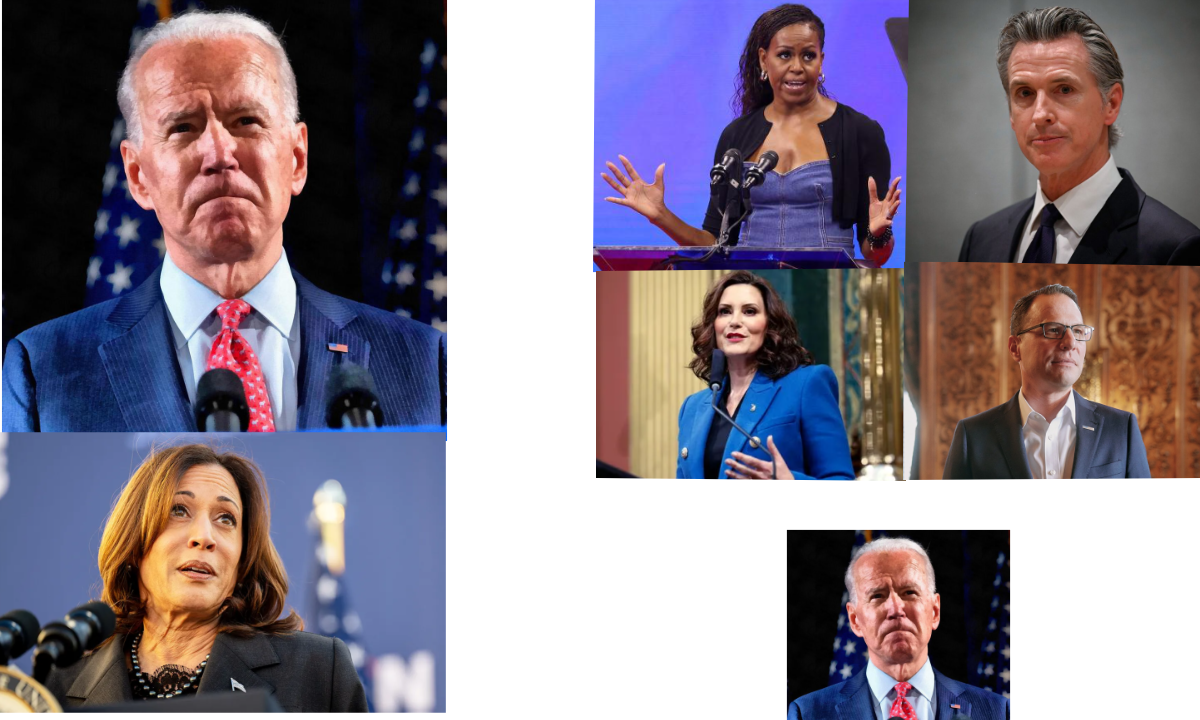
In place of my list from February, combining the lists from the Guardian and Financial Times now gives a list of:
- Kamala Harris
- Gretchen Whitmer.
- Gavin Newsom.
- Josh Shapiro.
- J B Pritzker
- Sherrod Brown
- Dean Phillips
The changes from my February list are the removal of Michelle Obama, as she has not put herself forward and it is now just too late, and the additions of Kamala Harris, J B Pritzker, Sherrod Brown and Dean Phillips.
There is also a June 28, 2024, list of 10 options from the Washington Post that adds back Michelle Obama, as well as Pete Buttigieg, Jared Polis, Raphael G. Warnock, Amy Klobuchar and Andy Beshear.
The combinations: Kamal Harris could be pivotal.
The key addition now on lists now is Kamala Harris. Although an omission back in February due to her low approval rating, that rating has improved due to her well-regarded role in selling the Democrats position on abortion, and plus, at this late stage, no other candidate brings the same level of diversity, and to move backwards on diversity can risk a backlash from relevant segments of voters.
While many call for Kamala Harris to also be excluded from any new ticket, she brings both continuity and diversity to any proposed new team proposal. If Kamala Harris is needed to either remain VP nominee or be elevated to being the presidential nominee, as I believe makes sense, then half the team is settled, and the other half has to fit with well with Kamala Harris, which opens the second place to any of the white males on the list.
If Kamala Harris is on the ticket, I feel this rules out a second woman such as Gretchen Whitmer as I feel a ticket with only two women would be too much of a change for the US public.
However, Kamala Harris is not on the ticket, then really the only solution someone like Gretchen Whitmer together with someone like Raphael Warnock. In some argue that specific pair to be the best alternative, but that is the New York Post.
Given I feel Kamala Harris being at least on the ticket is essential, then the best foils would be Gavin Newsom, or Josh Shapiro to bring the greatest amount of new vitality from the remaining group.
The problem is both Newsom and Shapiro would undermine Harris if she is 1st on the ticket, and keeping her second would not be seen as bypassing Harris.
At this time, I feel the ideal team would be Kamala Harris, with someone other than either Newsom, Shapiro or Whitmer. Choosing the candidate without a primary really changes the picture.
However, my observations are those of someone outside both the process and the USA. The bottom line is getting it right at this late stage is complex.
It is up to those in the US and in US politics to decide what to do, this page reveals how things can look to someone from outside of the US and outside of politics. From this perspective, it does not feel like leading the free world is even seen as part of the picture, with both sides looking to erect walls to the world as politics descends into popularism, and now the democrats only offering a candidate many of their own side now see as no longer viable.
US Presidential Elections: An outsider’s primer.
The section now moved to a separate paper.
US citizens are all also citizens of their state. This is in some ways similar to how citizens of EU are also citizens of their own member state, and the people of France are both citizens of France and of the EU. However, the rules are reversed, as all citizens of France are automatically citizens of the EU, while all US citizens residing in a state are automatically citizens of that state.
When the rules for electing the president were created, citizenship of a state was well established, but the idea of being a citizen of the union of states was new. It was not intended that citizens of the US states would directly vote for the President of Union of States that make up the USA, and technically, they still don’t. Instead, citizens now technically vote for “electors” for each state, who have pledged to vote for two specific presidential candidates, with one being a candidate for president and the other for vice president.
Even though the aggregate national popular vote is calculated by state officials, media organizations, and the Federal Election Commission, the people only indirectly elect the president and vice president. The president and vice president of the United States are elected by the Electoral College, which consists of 538 electors from the fifty states and Washington, D.C. Electors are selected state-by-state, as determined by the laws of each state.
https://en.wikipedia.org/wiki/United_States_Electoral_College#Modern_mechanics
When the first US presidential election was finalised in January 1789 just prior to the constitution being ratified in March 1789, there were only 11 states (Delaware, Pennsylvania, New Jersey, Georgia, Connecticut, Massachusetts, Maryland, South Carolina, New Hampshire, Virginia, New York) in the union, the total population was under 4 million, Federal power was strictly limited, there were no political parties and “democracy” did not mean everyone got a vote:
Though all states allowed some rudimentary form of popular vote, only six ratifying states allowed any form of popular vote specifically for presidential electors. In most states only white men, and in many only those who owned property, could vote. Free black men could vote in four Northern states, and women could vote in New Jersey until 1804. In some states, there was a nominal religious test for voting.
1788–89 United States presidential election – Wikipedia
The president was, and still is, elected by “electors” of the presidential college, with each state allocated a number of electors determined by the number of members of congress for their state, which is in turn determined by a combination of representatives in proportion to population plus 2 state senators.
Each elector votes for 2 candidates, which to prevent each state simply voting for its own candidates, must be from 2 different states. Originally the candidate winning the most votes from the electoral college became president with the second choice becoming vice-president, but this was later changed to become two separate votes for president and vice president.
In theory, the idea of an electoral college would allow for the election of presidents who, unlike today’s politicians, would not need to first achieve celebrity or fame to be elected, as presidential candidates would only need to become known to the relatively small number of “electors” instead of needing to achieve the fame required to be voted for by the majority of the entire population.
Companies appoint selection committees to find and choose new CEOs rather than hold a vote for the most popular staff member to become the leader. It is recognised that a popular vote would likely end up choosing people focusing on popularity over what is good for the company.
In many countries, the people vote for politicians who themselves choose the head of government, but it would seem the goal was to avoid the processes of politics.
The problem with turning the theory into practice is “how do you choose electors who would reflect the will of the people, or could be trusted to make a wise choice?” For electors to win a popular vote, they would then have to be politicians or widely known celebrities. Some states tried different systems for appointing electors were tried, but over time states settled on a system of the people choosing electors not because of their ability to choose, but because the elector has already made their choice, making the elector a proxy for the candidate of choice of the voter.
How the electoral college works today.
In practice, now in the 21st century, instead of the “electors” of the electoral college having freedom of how they will vote, electors are chosen solely on how have they have “pledged” to vote, which means once electors are chosen, their vote is predetermined. The identity of the “elector” immaterial, and all that matters is for whom they have pledged to vote.
Votes for electors are run for each state, with voters voting for electors who have already pledged to vote for the party of their choice. Rules for how electors for the state are chosen by the election vary slightly from state to state, but in every state, technically in 2020, instead of “voting for Biden or Trump”, each person was voting for “electors who will vote for Biden” or “electors who will vote for Trump”.
For most states, the votes for electors for the state are tallied and all electors appointed by the state are those voting for the most popular choice within the state. So, in states where “electors for Biden” won, all appointed electors would be those having “pledged” to vote for Biden.
Rules differ from state to state, but other than for Maine and Nebraska where electors are allocated for each electoral district, all electoral college votes for the state are allocated to “the winning ticket”, which is for electors having pledged their vote with the choice gaining the most votes.
other states are all to allocated to the winning candidate, so those who are the most popular candidate within a state receive all votes allocated to that state.
In practice: There are differences, but it feels like direct voting for the president.
Even though technically voters are voting for electors who in turn then vote for the president, in the process of voting, it feels just like directly voting for one of the combinations of president and vice president.
For example, in the 2020 election in California, a voter could choose between voting for Biden-Harris and voting for Trump-Pence, and whichever combination of the two received the most votes.
Even before the final runoff, there was a hotly contested Democratic primary with voting from the public which at times seemed to favour candidates other than Biden.
Because votes in the actual election are technically votes for electors, the voting choices are offered as “tickets” such as the Biden-Harris ticket or the Trump-Pence ticket, and as there was no Trump-Harris ticket, it was not possible to vote for Trump for president and Harris for vice president, despite the fact that there is nothing to prevent electors voting this way.
Primaries: The hope for democratically elected leaders?
The outcome for the original the electoral college system of the USA was one where, as Westminster System countries like the UK, Canada, Australia, New Zealand etc., voters can who represents them in parliament, but not who leads the executive branch of government. In all these countries, some form of “pledged voting” for the leader of government has evolved where, even though voters are not directly voting for the leader of the government, because they are voting for representatives who have declared who they will support to be leader, their vote is largely a proxy vote for the leader of the national government.
While in countries with a Westminster System and a prime minister as the head of executive government it is always the politicians who choose the prime minister from amongst the members of parliament, in countries such as the USA with a president as head of executive government, there are more options on how the president can be selected.
While the goal of the system of “electors” was to further distance the choice of President from politics and being a popularity contest, the system of primaries and “pledged electors” has turned things to the opposite direction and into a popularity contest not just with parliament, but within the entire voting population.
The current system of primaries and pledged electors only arose in 1972, with all previous presidents including those of Mount Rushmore George Washington, Thomas Jefferson, Theodore Roosevelt, and Abraham Lincoln, were all chosen by electors not bound to a popular vote. The people did get to vote for their party knowing who their party had pledged to have as president should they win, but the voters could not choose the party’s nominee.
The promise of primaries and pledged electors is that the people get to directly chose the candidates for President, and then people get to choose from those candidates. Still, the problem becomes how do you make that work?
Neither the concept of primaries nor pledged electros is part of the constitution or legally required, but initiatives of political parties themselves.
The United States Constitution has never specified this process; political parties have developed their own procedures over time. Some states hold only primary elections, some hold only caucuses, and others use a combination of both
United States presidential primary – Wikipedia
The two main political party now hold their own elections called primaries where the voting public gets to indicate which candidate has the most support. However, the next question becomes: “who gets to vote in the primaries?”, with the following options:
- Closed primaries: Only people registered as voters for the party can vote in primaries, but this has the limitation of only polling those already committed to voting for the party, and failing to choose candidates who have broader support.
- Open primaries: Allowing all potential voters to vote in primaries, adding the risk that those who support other parties will intentionally misdirect the vote.
Even in open primaries, voters can at least in theory only vote in the primaries for one party, which limits those voting in primaries predominantly those sufficiently motivated to vote for the party to give up their time in order to bother.
The end result is that participants in each primary are not only predominantly people already aligned with the party, and most passionate about support for their party.
How well does having the people chose candidates and the winner work?
In a country with two political parties with almost equal support, winning a primary requires the support of around 50% of people voting in the primary, and at most 50% of people can vote in each primary, which means the primaries select two candidates who each have the support of up to 25% of voters.
However, since the voters most engaged in the electoral process tend to be those with most extreme views, the 25% of support has the potential to be the most polarised 25%.
Biden highlights system failure?
The democrats didn’t even run real primaries when they should have, with Biden as the only mainstream candidate, and even now most discussion is about “who can beat Trump” rather than who has the vision for the USA over the next 4 years.
Trump: Love him or hate him, there seems little in between.
On one hand there are Trump fans with an almost religious level of devotion and on the other, there is even a project, “The Lincoln Project“, for republicans dedicated to being anti-Trump.
The videos below are not selected to show balance, but that people, in most cases the makers of the videos, are so strongly anti-trump, and others, those in the videos or discussed in the videos, are so strongly pro-Trump even when people don’t expect them to be.
Disclaimer: I am no political expert.
Ok, so I may believe I am a scientist, engineer, futurist, entrepreneur or even philosopher, I have no claim to being a political expert or commentator, or even American, so take any opinions here as the point of view of an outside observer.
Updates.
- 2024 August 29: Primer moved to separate paper.