

Synopsis: Parents wanting the best for children in the conditions, not the education of women, is ending our explosion.

Yes, around the world, birth rates have fallen.
Key background is that we have just had a population explosion, and despite many voices claiming “The population bomb” predictions of 1968 were just alarmist, without the rapid fall in birthrates from 1968 levels, population that has grown from 4 billion to 8 billion would have grown instead to over 12 billion. Considering the impact that needing double the growth in food resources and potentially emissions and pollution would have created, most people consider this fall in birthrates happed at time when humans needed to reduce birthrates.
This page, part of a journey to understand population, looks at three main types of explanations for the decline in birth rates, which just happened to occur at a time when the fall in birthrates was needed to slow an unprecedented population explosion:
- “Coincidence theories”: which propose causes for fall which are not directly related to birthrates falling at the time humanity needed birthrates to fall.
- “Intervention theories”: which proposes that birth control and other interventions such as “the one child policy” explain the fall in birthrates.
- “Response to conditions”: theories, which propose that by some mechanism, humans, like most other complex species, adjust their birthrates to conditions.
The conclusion is that only “response to conditions” fits with all the data over all human history, and the reality is that humans are highly motivated, perhaps above all else, to try to seek the best life for their children and will always feel compelled to have the number of children that will provide the best life for those children. There may be a mix between biological triggers and responses that affect birthrates, subconscious behaviors in response to environment that affect birthrates, and conscious decisions on whether to have a child or not, but all work towards humans having the number of children that will ensure the best life for those children. The best life for children, not simply the maximum number of children, is what ensures the survival of the species and result that naturally arises as a result of evolution.
Could humans naturally adjust their number of children in response to the environment? As explored in this webpaper, it is very clear that many other species do adjust birthrates in response to the environment.
The human instinct to have children clearly fits as being natural or and even perhaps instinctive behaviour. It is also clear that at least throughout all history it has not be human reproductive behaviour to focus purely on having the maximum possible number of children. The natural behaviour is for people to choose a desired number of children to have.
The conclusion of this webpaper is that the only explanation that fits all available data, is that people responding to cues from the environment determines the number of children they have.
The decision part of how many children to have would be a combination of environmental factors increasing or decreasing the instinct to have children, and logical calculations like “I can afford to put only this number of children through college”. Yes, some will end up having more children than planned and others end up having less children than planned, but all evidence over the history of humanity is that something results in humans normally on average having close to the ideal number of children for the situation.
In addition to the decision for how many children to have, there is also the possibility of biological responses, as with most other complex species, that affect the rate of reproduction. While this could include factors such as “sperm counts” that sound like they could play a role, the consensus appears to be that so far, factors such as sperm count are not playing any role in the fall in birthrates (BBC article).
With this theory, the surge in population growth during the recent population explosion resulted from a delay between child survival rates increasing and humans adjusting their birthrates to the environment with much higher child survival rates. As survival rates improved it meant less births are required for same number of surviving children, and people needed to keep adjusting.
If people target a number of surviving children who can then go on to have their own children, then the dramatic change in child survival rates logically necessitated a reduction in birth rates. However, even prior to the population explosion, the human population was still growing. Ever so slowly, but still growing. Humans were able to have births in almost balance with deaths and produce near population stability, but only near stability. The population still grew, which under the theory that people have the ideal number of children for the living conditions of their children, the ideal population to produce best living conditions was increasing. Now, after the population explosion, many countries are having less children than needed for population stability, so either this is because the population overshot the ideal level during the population explosion, or there was some other fundamental change during the 20th century.
One possibility for this fundamental change, is that not only did the world during the 20th century grow from 1.6 billion population to 6.1 billion, but most people also became wealthier which increased their environmental footprint. Can an increasing global population further increase environmental footprint and simultaneously improve quality of life?
A complication is the largest population an environment can support depends on living standards. The wealthier the people, the fewer the environment can support.
The implication that some people do not want to consider, is that if the population birthrates may continue to fall unless people can be made to feel the need for reduced birthrates has passed and the people feel not just billionaires, but most of the population feel confident that a growing population would again improve the wealth of their children.
Why so many theories persist.
There are countless studies of population trends, but in the end, many explanations for the fall in birth rates just don’t add up, and many seem to simply apply confirmation bias and select only the subset of data that supports a desired outcome.

Many explanations ignore the bigger picture and only consider data from the last stages of the fall in birth rates near the end of the population explosion, overlooking that the fall in birth rates began at the beginning of the population explosion, despite population growth accelerating at that time, and also seem to ignore the decline infant mortality that produced the population growth.
The reality is the fall in birth rates largely tracked the need for a fall in birth rates to reduce the impact of the reduction in child mortality.
Most explanations offered for the fall in birth rates can be grouped as “coincidence theories“, as they effectively assume it was just a lucky coincidence that the events triggering the fall in birth rates just happened to occur during the time when humanity urgently needed birth-rates to fall. Note that if birthrates did not fall during the 20th century, in the absence of something creating billion of deaths, by 2020 the population would have climbed to 25 billion. Humanity needed the birthrate to fall.
I label theories that propose a cause of falling birthrates unrelated to the fall occurring during a population explosion and thus when birthrates needed to fall as coincidence theories. Problems with such theories matching available data are explained in more detail below, but common to these theories is that if what they are stating as their trigger or cause had arisen just a few decades earlier, before the fall in infant mortality, then the human population would have collapsed. For example, consider if the education of women was the major factor in falling birth-rates, that would mean if we had educated women prior to the fall in infant mortality then at that time the human population would have had a total collapse. Remember, birth rates have fallen from an historical average of 6 or 7 per woman early in the industrial revolution, to as low as 1.5 per woman in modern Japan. If education of women could have anywhere near this level of impact, then with poor medical facilities in Afghanistan, it could even make sense to limit the education of women. But the truth is, that like other “coincidence theories“, while there may be motivation to want to believe it is true and apply confirmation bias, and there may be some impact on birthrates from these factors, but when considering all the evidence including that changes to education in isolation from changes to infant mortality show no impact from education alone, which makes it clear that any contribution of education of women towards a fall in birth rates are, as explored below at most, very minor.
Factors like population planning are not the answer either, as we know that birth-rates have fallen by very similar levels in most countries, despite most countries not having any population planning initiatives. Population planning initiatives have had mixed results, sometimes resulting in birthrates almost identical to neighbouring countries without any initiatives, and almost always having less impact than expected. In some cases, making a contribution, but never a sole explanation.
So, with neither coincidence theories or intervention being able to explain the change in birthrates, that leaves the possibility that a change could occur in response to the surge in population and without intervention being required.
Background: Birthrates had to fall to offset reduced child mortality.
“The Population Bomb” was defused not by technology supporting continuance of 1968 birthrates, but by a rapid fall in birthrates.

The Population Bomb is a 1968 book co-authored by former Stanford University professor Paul R. Ehrlich and former Stanford senior researcher in conservation biology Anne H. Ehrlich.[1][2] From the opening page, it predicted worldwide famines due to overpopulation, as well as other major societal upheavals, and advocated immediate action to limit population growth.
Wikipedia: The Population Bomb
“The Population Bomb” predicted without action to reduce birthrates, the birthrates of 1968 would, within decades, produce a level of overpopulation that would create famine other global problems. Yet there was no intervention, and yet the famines did not occur. According to the book, without progressive reduction in birthrates population would exceed 12 billion by 2020 and this would lead to famines and other consequences. In fact, this part was correct.
While the very popular myth is that the authors of “The population bomb” failed to account for improved technology allowing support for continued unconstrained population growth, this ignores the fact that birthrates began falling rapidly from the time of publication of the book, defusing the “bomb”. It turns out, that what the population bomb authors got wrong was that intervention was needed for birthrates to fall in the way they recommended.
Humanity never proved that the birthrates of a global average of 5 per woman from 1968 could be sustained, what humanity did prove, is that no intervention was required for these birthrates to fall.

What most people miss, is that birthrates did fall from the 5 children per women level of 1968. The 1968 birthrates meant doubling the population every generation, but by 2022, birthrates had fallen to 2.2 and resulted in peak child, effectively ending population growth and delivering exactly what the book suggested was needed to avoid the predicted problems!
What humanity has managed, at least so far, has been to limit population growth to that which happens whilst coming to a stop. This growth is like the distance travelled by a car after the brakes are applied. Just as the distance a car travels in the time coming to a stop is far less than the car would travel in that same time had the brakes not been applied, the reduced population growth while stopping, was, actually as predicted in the book, manageable, although perhaps not sustainable.
In fact, ramping up food production to avoid famine with the current population has come at the cost of sustainability. While the current situation something we hope to fix, as of 2022, humanity is still existing beyond sustainability, which means the problem is not yet fully solved and there is damage to the environment reducing the ability of the environment to support the populations of the future. So far, we are only supporting the current population by borrowing from the future, and that current population is the result of the brakes being applied on population growth. There is debate about what made birthrates fall to replacement level, but that birthrates have fallen is clear from the data and beyond debate.
Belief humanity managed to cope with the rate of population growth of 1968 is a myth because birthrates did fall and fell very much in line with that called for by the authors of the “Population Bomb”. Their real error was the failure to predict birthrates falling even without action targeting population control.
Had birthrates remained at 1968-1972 levels, by 2022 population would have tripled from 4 billion to over 12 billion by 2022 instead of doubling to 8 billion. Yes, the population kept growing due very much to the population pipeline effect even with the fall in birthrates, but population grew at only half the rate the Stanford University professor would have predicted to happen in the absence of the fall in birthrates.
The myth that birthrates remained high despite them clearly having fallen is so pervasive that even the Wikipedia entry on The Population Bomb entry currently as of 2024 currently misses the reality that birthrates fell dramatically reducing the population bomb.
They further argued that the growing population placed escalating strains on all aspects of the natural world. “What needs to be done?” they wrote, “We must rapidly bring the world population under control, reducing the growth rate to zero or making it negative. Conscious regulation of human numbers must be achieved. Simultaneously we must, at least temporarily, greatly increase our food production.”
Wikipedia: The Population Bomb
Yes, we did greatly increase food production and having reached “peak child“, the growth rate has been reduced to zero, and the only question could be as to whether this was “rapidly”. But we also did bring the birth rate down to the level for the growth rate of zero.
Clearly, managing to support growth from 4 billion to 8 billion does not prove whether or not we could have supported growth to over 12 billion, so we can’t say the “The Population Bomb” underestimated humanities ability to cope, and instead what we can say is that the authors failed to foresee birthrates would fall even without intervention, which is not that surprising given many fail to see it now after the event even when the data makes it very clear.
But could we have coped with growing the 12.5 billion people by now? Given even coping with 8 billion has meant going into “environmental overdraft” of unsustainability and borrowing from the future.
The total biosphere, or total amount of life on Earth has not been increasing, and without growing the biosphere, any increase in any one species requires a decrease in other species. In adding that extra 4 billion people, a lot of other life has vanished with a lot of native forests converted to human land use for crops and mining and has resulted in the near extinction of many species other than humans and food for humans. Perhaps we could have managed growing to over 12 billion by 2022, but if so, at what cost?
The birth-rate falling centuries earlier would have been disastrous.
The population explosion beginning in around 1650 is evidence that child mortality rates had already started to fall in 1650, but it is not until around 1750 that there are medical records of the improvements.
Data we have from pre-1650 suggest the “births per woman” throughout most of history was around 7 children. As explained separately, births per woman is the number expected for a woman who is healthy throughout her fertile years. As not everyone does remain healthy the entire time, average family sizes that include those where a parent dies or become infertile may have been lower, and as some people have no children, some families would have far larger for this number to still be the average.
The higher “births per woman” at 7 prior to 1700, was offset by the higher child mortality rate and resulted annual population growth, as noted by “our world in data” of an average of only 0.04% from 10,00BCE to 1700CE. Further examination reveals growth early in that time span was as low as 0.01%, and then slightly higher at 0.066% from 1000 BCE until around 1650CE. Overall, for our entire history prior to the population explosion population growth never remained 50 x lower than for the peak of population explosion.
But what would have happened, if something, as is suggested results from educating women, began in 1,000BCE and did lower birth rates back then? If birth rates were lowered not necessarily to today’s low levels of below 2 per woman in most developed countries, but to even to 3 births per woman, back before medicine managed to reduce child mortality, in the then already by 500BCE the population would have fallen to just 200 people globally! If birthrates had fallen fell even to 5 births per woman, then by the year zero there would have been only 2,000 humans on Earth.
Any significant fall in birth rates prior to the reduction in infant mortality, would have seen the human population collapse. If educating women is the cause of the fall to the birth rates from over 7 to below 2 widely seen in 2020, then any society without modern medicine would be doomed by the education of women, and conversely, any society with modern medicine and uneducated women would experience record population explosions. Historical data for societies with differing religious groups having different education practices proves that neither applies, and birth rates fall with declining infant mortality independent of religion.
The explosion was an unfortunate side-effect of improved medicine.

Humanity has just experienced a population explosion. While there are various factors that enabled the explosion to continue, there is one single clear reason why the explosion happened. It was not increased birth rates, which actually fell during the population explosion. Birth rates fell, and at no time during the explosion reached pre-explosion birth-rates, even during ‘baby-booms’.
The difference between the time of population explosion, and the time before, is that during the time before the population explosion over half of all children died before growing up to have their own families. Once we solved the huge historic problem of half of all children dying before becoming adults, almost all children then went on to have their own families, driving a population explosion.
There are people who explore theories such as how improved farming allowed supporting an increased population, and factors such as these explain how societies managed to sustain the increased population, but it not the cause of the increased population. Given that birth rates did not increase, it is clear that is the advances in medicine that caused the explosion, and improved farming that prevented catastrophe as a result of the explosions.
The medical science that has reduced human infant mortality and dramatically reduce the tragic loss of young lives could be considered one of humanities greatest achievements. If the population explosion has resulted in overpopulation, that would be an unfortunate side effect of a great achievement.
The population explosion was an unfortunate, accidental side effect of saving children’s lives. It is an ‘accident’ in the sense that we did not pre-plan the population explosion, it was just a side effect that, without something bring the resulting growth rate to an end, could have ended civilization.
The explosion ends due to decreased ‘births-per-woman’.

At their peak during the 20th century, population growth rates reached 2.1% annually, or 42 times the average of the previous 12,000 years. At that rate, the same increase in population as had occurred the previous 12,000 years, would happen in just 200 years. Such a rate of increase would quickly completely overrun the planet if continued, but now births per woman has startlingly fallen back to levels similar to those previous 12,000 years. Population growth is back to the historic normal.
Births per woman, which has already began falling prior to 1960, in the 60 years to 2020, fell from over 5.0 to around 2.3. Why did the births per woman then fall? Was it another ‘accidental’ side effect of something unrelated to humans needing the birthrate to fall, just as the start of explosion was not due to humans needing more population but improvements in medicine that reduced child deaths.
How did the explosion end just in Time?
How many times in movies is the bomb diffused with just moments to spare before there would have been a disaster?
The ending of the population explosion in some ways seems just like those movies. In the 1970s, at the peak of population growth, many people were already predicting disaster unless something was done. Birthrates had already fallen limiting the impact of the reduction in child mortality, but could they fall even further?
The 2.1% percent growth per annum growth of 1972 would have increased to 2.5% by 2022 since global infant mortality fell from over 90 per thousand in 1972 to under 40 means by 2022, creating an effective average rate of just over 2.3%. So, for each year since 1972 multiply the population number by 1.023 to get the number next year. For a 50-year period, this is multiplying by 1.023 fifty times, or multiplying by 1.023 to the power 50.
The population explosion.pop2021 = pop1972 x 1.023(2022-1972) = 4 billion x 1.023(50) = 4 billion x 3.12 = 12.5 billion
If, instead of the ever further continued fall in birth-rates taking place from 1972 the population growth of 2.1% of the 1970s had continued, the 3.7 billion population of 1970 [1] would have already grown to 11 billion people today (2021), in place of the less than 8 billion in 2021. This would have been a near double increase in the world’s population over that period. Already 8 billion exaggerates every environmental problem.
If population had instead grown by near double to 11 billion, what would the world now be like? Imagine CO2 levels now in a world with double the population. Plus, accelerated deforestation to access resources for over twice the number of people, and all those mouths to feed.
And yet, even 11 billion is not the whole story. Just maintaining the birth rate of the 1970s would not have stopped population growth from accelerating as mortality rates continued to fall, and this is still ignoring impact of the fall in birth-rates prior to 1970.
Without the fall in birth rates falling from the historical 7 per woman to under 5 by 1970, already in 1970 the global population would have been over 5 billion in 1970.
If the historical average of 7 births per woman had continued throughout the entire 20th century and beyond to 2022, without some new source of deaths the global population would in 2022 be at over 25 billion.
Just imagine, every city with 3 times the population and producing 3x the emissions and needing 3x the global food production. Just finding 3x the water for many cities would become impossible.
The population explosion.
It could be argued that the population explosion should have ended sooner but had not birth rates fallen from the very beginning of the population explosion, it would been a much greater explosion that may have ended with some significant damage to humanity and the entire planet would have even worse problems right now.
[1] 3.7 x 1.02151 ≈ 11
All theories have a long human history as a source of test data.
There is a lot of data to consider. In addition to historical population growth rates, which are broken down by time period here, we know that following either catastrophe or reaching new territories, human societies experience population growth higher than normal, where the “normal” for humans is close to population stability, but perhaps curiously, still rising.
Coincidence theories: suggesting a fall unrelated to population.
Correlation is not causation: Confirmation bias, or just ignorance of history?
Many theories on the fall in birth rates make the mistake making comparisons to a previous period of time with data from that previous time assumed to be “normal”, or even assume use the very extreme population growth of the 1950s to 1980s as being the “normal” and overlook just the full scope of change in birthrates and population growth rates over the entire industrial revolution. The result is often theories that correlate well only with the data between the two selected reference points, but totally fail in explaining trends outside the chosen few decades.
Commonly, theories find factors that correlation with the fall in birth rates and that provide a good news story if correct, and then apply confirmation bias when considering other evidence, and completely fail to even try to apply the theories to historical data.
So yes, the idea that the education of women brings birth rates down to levels practical with modern developed economies with modern health care, can provide an argument supporting the worthy cause of educating women around the world, but that doesn’t automatically make it the correct answer, anymore that the corollary that if this theory is correct then educating women in societies without modern medicine would cause population collapse automatically makes the theory wrong.
A real test is does the theory also fit with full historical data set, and ideally in cases where the only change between data sets is the proposed cause. For example, with the theory on education of women, is there a decline in birth rates in situations with more education of women but without changes to alternative possible causes of the change, such as child mortality rates, living standards, availability of health care in general, etc. A robustly tested theory has checked for that exact type of data to validate the original hypothesis. The lack of any evidence of a change in birthrates when education of women changes within society or between otherwise similar societies is the basis for my rejection of that theory.
Negative confirmation bias: The economists’ worst nightmare.
Just as there are some theories that some people want to believe, there are also ideas that some people just do not want to accept.
“Anyone who believes in indefinite growth in anything physical, on a physically finite planet, is either mad or an economist.”
Attributed to Kenneth Boulding in: United States. Congress. House (1973)
Economists and economic journalists generally do not want to accept that, at least in “successful economies”, population growth will eventually end.
What’s more, China faces some long-term challenges, such as a population crisis, and strained relations with key trading partners such as the United States and Europe. The country’s total fertility rate, the average number of babies a woman will have over her lifetime, dropped to a record low of 1.09 last year from 1.30 just two years before, according to a recent report by state-owned Jiemian.com, citing a study by a unit of the National Health Commission.
China’s economy is in trouble. Here’s what’s gone wrong
Time after time, any suggestion population growth will end in any country is reported as a “population crisis”.
In consequence, any theory that suggests population may stabilise, or even undergo a correction, will meet with staunch opposition from groups who feel they have sufficient financial motivation to invest in discrediting such theories.
The reality is that population growth provides a simple way to grow an economy without needing to raise per capita incomes, which does still benefit the largest national or international companies, but not necessarily the average citizen.
Consider that if you are Apple, Amazon, Facebook, or any of billionaires Jeff Bezos, Mark Zuckerberg, or Elon Musk, a world with only half as many people would logically halve your wealth, while a world with an increasing population could easily provide for further growth of wealth.
Edit: Notably now in 2024, Japan’s economy provides an example of how a “population crisis” can result in what could be seen as economic success:
TOKYO — Japanese incomes will rise faster than inflation in fiscal 2024, a new government forecast will show, a hopeful sign for consumers even if much of the anticipated boost comes from one-time tax cuts.
Per-capita income will increase by 3.8% next year on a combination of lower taxes and higher wages, under a Cabinet Office forecast to be announced Thursday at an economic and fiscal policy council meeting. Inflation is expected to be in the mid-2% range for fiscal 2024, which begins in April.
Japan forecasts income growth to outstrip inflation in fiscal 2024
The common proposals: Education, the pill, working women etc.
A common explanation is that a variety of factors have in combination been responsible for reducing birth-rates. Going through the factors, most of them were not planned to reduce population growth, specifically:
- Education of Women, which started even before the population explosion, was not motivated by a need to reduce population.
- Increased participation of women in the workplace did not happen in order to reduce population either.
- Even the pill, a new contraceptive, was not invented primarily to reduce population growth.
The challenge to accepting that a variety of factors resulted in the reduction of birth-rates, is that it provides no explanation beyond luck for the reduction in birth-rates resulting in population balance, or for the factors responsible for the reduction just happening to occur at the right time to for the balance, neither to early, or too late.
Just imagine if all these factors, such as educating women, the invention of the pill, increased participation of women in the workforce happened before infant mortality was so dramatically reduced? In that case, the population would have crashed as births were previously at replacement level, so there would been significantly insufficient births! Or alternatively, if the delay between reducing infant mortality and these factors reducing births had taken longer, the peak explosion could have gone another 100 years resulting in 8x the current population.
This “variety of factors” requires the balance being achieved neither too late nor too early simply being a lucky coincidence.

The requirement of coincidence can be overlooked, if it assumed the population growth seen at the time of the reduction in birth rates had been in place for hundreds of years. While an examination of the history of population quickly makes it clear that the growth had not been in place for hundreds of years, not everyone looks. Once you look, it also becomes clear that the rapid growth prior to the reduction in birth-rates was unsustainable.
This means, accepting the ‘variety of factors’ explanation, requires either:
- Ignoring the history of population, and previous almost stable population.
- Or, accepting the coincidence of the factors happening at the right time and rate.
Data does not support education of women as a cause of falling fertility.
There is a correlation between increases in the education of women and falling birthrates, but correlation is not causation. Just as the increases in ice cream sales correlating with increased use of air conditioning does not mean people buying ice cream causes the increases use of air conditioning, the increase in education during the time birthrates were falling does not make education the cause.
To test for causation, other it is necessary to eliminate the possibility other factors that could impact birthrates that also happened at the same time, in the same way considering as considering how hot days increase both sales of e-cream and air conditioning.
Many, many factors changed in the industrial revolution other than just the education of women. In fact, the timeline of education of women does not correlate very well with the fall in birth rates during the population explosion, with the fall beginning significantly before steps for widespread inclusion of women in education programs.
The education of women in ancient Egypt, at a time when across the world population growth was at near zero levels, would provide a better data set, but in fact, no fall in birth rates was evident.
An even better example would be the Taliban in Afghanistan. In a country like Afghanistan, where infant mortality rates are very high and even with high birthrates population growth is slow, then the population could collapse if the further education of women did lower birthrates. However, data from periods of Taliban rule makes it very clear that there has been no surge in birthrates during periods of Taliban rule with heavy restrictions on the education of women, and in fact population growth has slowed at times of Taliban rule.
The reality is studies do find that education of women in some circumstances can have some impact on birthrates, but nowhere the impact required to explain the changes in birthrates humans have recently experienced. This recent change in birthrates requires some other factor having a more significant impact on birthrates, which means that while some education pathways corelate with having less children than others, it is likely that this changes the balance of children within some groups but may have no impact on the overall number of children women have on average, depending on the nature of the main factors determining birthrates.
“The Pill”: A Key Factor In The Balance, Or Maybe Not?

Did the availability of the “pill” cause the fall?
The pill introduction in the USA:
🔹 Technically available in 1960
🔹 Widespread among married women by ~1965
🔹 Truly universal access by 1972
Note that the fall in birth rates from 6.0 in 1900, to 4.7 in 1950, is the similar to the fall after 1960 when the pill was released.
| Year | Event |
|---|---|
| 1960 | The FDA approves Enovid, the first oral contraceptive, for general use. Initially prescribed for menstrual disorders, not birth control. |
| 1961–1965 | The pill becomes more commonly prescribed explicitly for contraception, especially among married women. |
| 1965 | The U.S. Supreme Court rules in Griswold v. Connecticut that married couples have a constitutional right to access contraception — a major legal turning point. |
| Late 1960s–1970s | Widespread availability and uptake accelerates, especially among middle-class and urban women. |
| 1972 | In Eisenstadt v. Baird, the Supreme Court extends contraceptive rights to unmarried individuals, making the pill broadly accessible to all adults. |
There were many charts at one time showing the strong correlation between the availability of the pill in the USA and a strong correlation to decline birth rates, but looking more closely at the data, there is the issue of why birthrates in the US fell more before the pill was released and rose in the years after its release.
While there is some correlation for a short period after the introduction of the pill, market saturation of the pill in many countries was reached quickly, and birthrates continued to fall. Note a better correlation exists for the USA between the uptake of colour television and decline in birth rates, plus a similar timeline for the decline in birth rates occurred in many countries where the contraceptive pill was restricted, or the introduction delayed.
The pill was not invented by a company planning to solve the world’s population crisis. The market was families wanting control over family size and timing, and families only wanted control over family size when they had already made the choice for smaller families. Interestingly, prior to the population explosion, humans had almost the exact balance of children required to be in balance with parents with infant mortality raising the number of children required for balance. This means that had the pill been available prior to the reduction of infant mortality, and if the pill did achieve a reduction in children at that earlier time, the human population would have declined following the introduction of the pill.
During the population explosion, there was certainly a market for the pill. Perhaps during this time there was an increased appetite to also reduce family sizes? How much the pill has changed when people have children compared to how many children, is hard to know.
Overall it is clear not all reduction was due to the pill, but the introduction did very likely accelerate the process.
Given the invention was not in response to population growth, then to whatever extend the pill has reduced family sizes and population growth, the pill becoming available at the right time was certainly lucky. Much earlier, and there was no reduction in family sizes needed, much later and overpopulation could be far more serious.
The full list of potential factors.
Here is a list from ‘our world in data’ of factors linked to the change in the number of births per woman.
– Empowerment of women
Source: Ourworldindata Fertility rates.
– Women’s labor force participation
– Increasing well being and status of children
– Increasing prosperity and structural transformation of the economy
– Culture and norms
– Family planning (Untargeted)
– Religion and fertility
– Contraception
– Family planning (Targeting having less children as in Bangladesh)
– Coercive policy interventions [As with the “one Child Policy” in China”]
– Fertility is first falling with development – and then rising with development
Note none of the top entries were measures targeting reduction of birth-rates. This section is targeted at those reasons, and yes, there are measures directly designed to target birth rates in the list, but these are discussed further in ‘planned responses’.
This is not my list, but the list from ‘our world in data’. I would change ’empowerment of women’ to ‘education and empowerment of women’, although when I follow the link, it does become clear they do associate ’empowerment’ and ‘education’.
These ‘explanations’, can be divided into three categories:
- Actions specifically intended to reduce birth-rates. (see planned responses)
- Family planning (Targeting having less children as in Bangladesh), Contraception as part of targeted programs, government programs to reduce births.
- Changes/actions which target other outcomes but do also anticipate reducing birth-rates, or sometimes are targeting birth rate reductions.
- Family planning (Untargeted), Religion and fertility, Contraception (simply providing a method for avoiding unwanted children together with sexual freedom)
- Changes/actions with no intent to change to birth-rates an not the intent, and are not a planned outcome, but may be a bonus.
- eg, Women’s labour force participation, Increasing well being and status of children, Increasing prosperity and structural transformation of the economy, Culture and norms
As already covered, the vast majority of countries have not taken any steps intended to reduce birth-rates, so the first two classes of explanations have already been ruled out as a universal explanation. Coercive policy interventions as applied in China, family planning that also targets population growth, as practiced in Bangladesh, can have an impact, but there are too many counties with no such measures for these to explain it all. Improved contraception has also had an impact, but again simply does not explain the extent of the change.
This leave only class number three, factors not are not designed to reduce birth rates, as the only explanations capable of applying in most countries where birth rates have fallen.
It has nothing to do with sperm counts or the usual things that come to mind when discussing fertility.
Instead it is being driven by more women in education and work, as well as greater access to contraception, leading to women choosing to have fewer children.
In many ways, falling fertility rates are a success story.
BBC- Fertility rate: ‘Jaw-dropping’ global crash in children being born
This quote from the BBC represents a typical attempt to explain the falling birth-rates. A combination of factors, but with changes to society, not at all intended to reduce birth-rates at least partially responsible for a “success story”.
Birth-rates having been reduced by side-effects, puts the reduction of birth-rates into the same category as the reducing child mortality triggering population growth: a predicable but unplanned accident.
The implication is that if we had a society where, if religion or some other factor delayed the globalisation of education of women for years, or we had not invented the pill at the time we did, our society we would probably have collapsed due to overpopulation.
If, as is generally proposed, changes/actions which predominantly did not have reducing birth-rates as a primary goal, have played a critical role in preventing a catastrophe, then we have been saved at least in part by luck.
Summary: So, all explanations from the above list that are not linked to efforts to lower birth-rates still amount to luck and coincidence that birth rates fell when needed, as above. While these explanations provide more detailed analysis, all of them share the concept that some change to society just happened to result in a reduction in birth-rates.
Can We Explain The Pure Luck: Are We Just The Lucky Ones?
If there is only one planet in this galaxy of over 100 billion stars with an advanced intelligent life form, what are the odds of being born on that planet? Incredibly low, but since only and advanced intelligent life form would contemplate those odds, the only people thinking about the odds, have already won that very lottery. In other words, unlikely as any event may be, if the event is required for our survival, that event must have happened, because we are here to think about it. So anything required for us to be alive, no matter how unlikely, happened in our past, because in order to think about what happened, we have to be on a planet where it did happen.
The same principle could be applied to the fall in birth rate. Perhaps it just happened randomly, despite it being incredibly unlikely. The only reason we are still able to contemplate those odds, is that it did happen, which enabled us to still live in a civilized society. All the people on planets were the birth rate did not fall, at a similar point in their society on their planet, died from overpopulation, and this is just another reason why we are not seeing other advanced civilizations.
Summary: It is possible that the reduction in birth rates just happened almost randomly, and just as there is no point in a lottery winner wondering ‘why me’, there is no point in wondering about birth rates, it is just chance. That we are on the planet where the lucky event happened, enables us to wonder about it all.
Intervention Theory: Action reduced birth-rates.
Intervention summary.
Programs to reduce birth-rates may have played a role in ending the population explosion, but on all evidence contributed no more than at best around 15% of the reduction globally.
This still requires an explanation for the other 85% of the reduction, and the situation where, as in China, the lowest level of birthrates came after the intervention ended.
Birth Rates didn’t fall in accordance with planning.
While a few countries, most notably China, did launch planned responses to end the population explosion, as most countries with a fall in birth rates did not launch any planned responses, this is not serious candidate for a global explanation. Planned responses do not explain with birth-fell across the globe without most countries having such responses, which allows ruling planned responses as an explanation, but it is still a contributing factor in birth-rates falling.
A key point is that birth-rates have fallen to ‘peak-child’/stable population levels, without a planned response from humanity.
So here is what has happened from deliberate planned responses that were specifically designed to reduce birth rates. While they cannot explain global trends, measures include:
- Family planning (Targeting less children as in Bangladesh)
- Coercive policy interventions
While these measures are certainly not a full explanation for global trends the include countries where no measures were adopted, planned responses have contributed to the global reduction.
There is a full spectrum possible between trying to educate people on the advantages of less children, through to the one child policy of China which went as far as mandatory contraception and sterilization in some cases for women who already had two children. In between education and the more drastic measures are financial and employment based incentives and limitations.
Certainly there were place in the world that took steps some time after 1960 in order to reduce birth rates.
- China introduced the one child policy in 1979 after around 10 years of an earlier two child policy.
- Various countries introduced public campaigns to encourage parents to only have 2 children, including:
- Vietnam (1960s), Hong Kong (1970), Singapore(1980).
- Some countries including India (2019), have introduced incentives for less children, and others (UK, 2012) have contemplated such measures,
- Other countries have had ‘family planning’ programs, and education programs encouraging parents to have less children.
- see Bangladesh example in Hans Rosing video here.
China and the one child policy.

The one child policy was introduced in China in 1979, when world population growth rate was still close to the 1972 peak, China had just had a decade of a population or “baby boom”, very soon after experiencing the great famine of 1959-1961. Although some earlier measures may have had some impact looking at the 0-5 band from the China population pyramid, there was fear that if birthrates did not fall, the same thoughts of disaster laying ahead that in the USA were predicted in “Population Bomb“, were echoed in China.
Overall effectiveness was highly questionable, even though many resources report how the birth rates in China fell dramatically under the one child policy, for example:
From 1979 until 2015, Chinese citizens were generally permitted to have only one child, with certain exceptions.[14] The ongoing Cultural Revolution and the strain it placed on the nation were large factors. During this time, the birth rate dropped from nearly 6 children per woman to just under 3.
Wikipedia: Two-child policies.


Others report the birth rate fell to under 2, which although technically also is under 3, is more accurate.
However, would the birthrates have fallen even without the policy, as they did worldwide? When considering the effectiveness of the one child policy, it may help to consider that the birthrate in the USA fell from 5 to 1.6 during the time period of the one child policy. The birth rate in China during the time of the policy never fell anywhere near to the level of 1.0, as the name suggests. It takes a birthrate greater than 2.0 per woman, or 2 per 2 parents, for growth and population in China rose from under 1 billion (0.968) in 1979 to over 1.4 billion (1.425) in 2021, a very similar gain to that of the USA (218 to 336) and a larger gain than countries without such high immigration such Germany (78 to 83). The population of China over the time grew by 68% while the US, even with high levels of immigration, grew by 64%, and with the 2021 China population pyramid having now become very similar to a country such as Germany suggests that although there were some Chinese even who suffered inhuman injustices under the policy, the total impact on population levels was not as effective as is widely believed.


The biggest fall in birth rates has been in recent years after the end of the one child policy. Birth rates in China (1.2) have not fallen quite as low South Korea (0.9) or Chinese territories Hong Kong (0.8) and Macau (1.2) not subject to the one Child Policy, and to the same level as Taiwan and neighbouring country Singapore both with a population of Chinese people, with all these in 2023 at the very bottom of the list of countries by fertility rate.
China does now have one of fastest falling populations in a world of falling populations, but perhaps current data is slightly misleading.
There is also a complication that results in population in China going through where “booms” repeat and ripple through age groups, which complicates the interpretation of data.
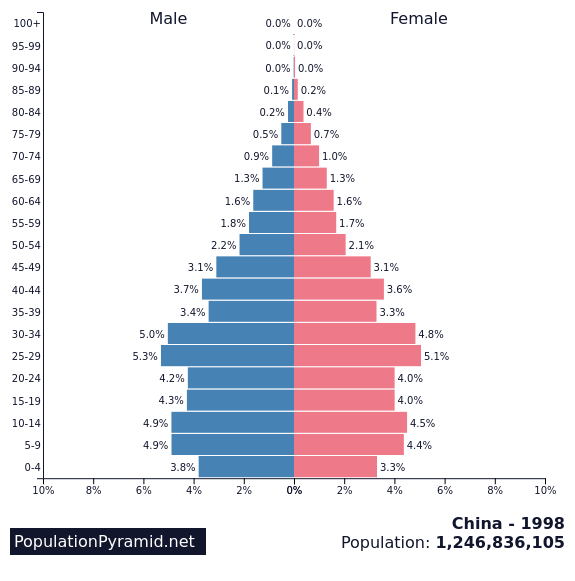
Looking at the 1998 pyramid, at first it looks like the first decade of the policy, shown in the now 15-24 age bands, was the start a trend of population decline, but then you realise those where children not to the previous two “boom” bands.
Each five-year band represents the children born to the population around four bands, or around 20 years earlier.
This allows new insight into the data. The first years of the policy were children born to people reduced in numbers by the great famine, and then when the children of the “boom” years arrived, there were again more babies. The 2021 population pyramid shows the “boom” was even still somewhat apparent for grandchildren generation, and the most recent children are from outside of the boom, partially explaining the current low level.
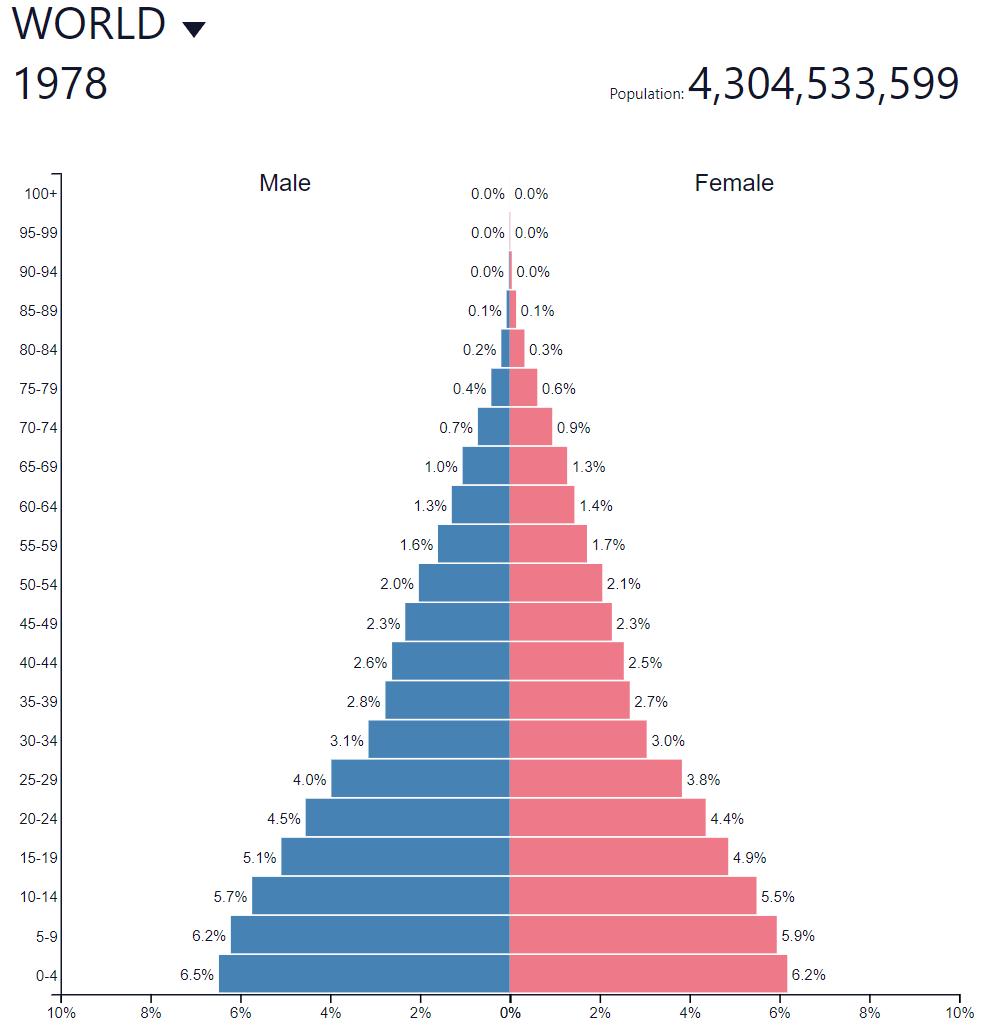
Back to overall effectiveness of the policy. At least in the early years, it appears birthrates fell faster in China than the world average. The world population in 1978 was 4.3 billion and increased 40% to almost 6 billion by 1998. The 31% increase in China from 0.97 in 1978 billion to 1.27 billion is below that world average.

Overall, from 1978 until 2021, the population of China grew by 48% from 0.97 billion to 1.44 billion, while the world population grew 81% from 4.3 billion to 7.79 billion. If China had increased population at the rate of the rest of the world, China would have 317 million extra people. Considering growth in China was over world average before the various one, two and three child policies, perhaps China, unlike its neighbours, could have kept growing beyond the world average? It is hard to project exactly what would have happened had China not introduced the one child policy. Would an extra 317 million people, or more, been able to survive? If the population in China had grown well beyond the current 1.4 billion, would that population had been able to survive, would the environment of China look like as a result, and how would having so many people have changed the economy?
Just looking at averages, the global fall in birth-rates since 1972 globally have spared the world needing to support an additional 4.5 billion more people, as without the fall in birthrates or mass death, the population would have exceeded 12.5 billion by 2022. The efforts by China have outperformed the rest of the world, and if that contribution by China meant that the rest of the world had to find around 7% less reduction. Without China, provided the extra people survived or had no other impact on birthrates, there could be 317 million extra people on Earth today.
The result is significant, but it seems this policy only explains around 7% of the world reduction in population growth. Perhaps the policy of Bangladesh and other countries can account for another 5% of the impact, but that still leaves over 85% of the reduction in birth rates arising from the fall in birthrates outside of any impact of programs targeted at reducing birth rates. Why the entire rest of the world also reduced birth-rates is debatable, but what is clear is there was no world-wide deliberate program as in China.
The fall in birthrates is also not in the same category as the way the population explosion started, where although the goal of eliminating child mortality clear was not targeted at increasing population growth, this was clearly a quite obvious direct consequence. Measures such as ’empowerment of women’ may arguably be a reason for less children, but lower birthrates are not a direct consequence. Like many other proposals, this is a feasible, but untestable possible factor in the explanation.
The biggest conundrum with all explanations that did not deliberately seek to address birth-rates, is just how co-incidental it is that these events not only produced the lucky result of reducing birth-rates but took place and had the effect just when we needed birth-rates to be reduced.
Worldwide, the birth-rate (Niger and some other countries in Africa excepted) birth-rates fell dramatically without intervention as implemented in China, or strong education programs as with Bangladesh. Why? Is this just luck? Or something more?
Best theory: Humans adjust birth-rates according to conditions.
Disclaimer: Unproven, although this is the one theory not in conflict with the data.
This theory has been tested against available data, but there is still a lot of scope for research projects collecting data specifically targeted at this theory. Acceptance of this theory really requires the reader to examine the evidence presented.
Birth-rates have historically been remarkably appropriate for the environment.
Humans have existed for over 300,000 years with an amazingly stable population. Prior to around 10,000 BCE, we just don’t yet have clear enough evidence of what life was like to be certain of variations in birth rate, or whether people faced starvation by having too many children for their ability to find food. All that we can be quite certain of, is that their population was very stable over the long term, even though there were events, such as the Toba eruption of 74,000 years ago, that could have driven humanity to the brink of extinction. Over most of those 300,000 years, just like other species humans faced have catastrophes and rapidly increased population to rebounded back to their level to fully populate their environments, as discussed in the webpaper “Population on a finite world: A zero-sum game with no vacancies”.
But the overall long term growth over the period up to the Toba eruption, was almost neglibably
However, unlike other species, the population size that would fully populate human environments kept rising, and humans have kept finding new ways to be the winners in the zero-sum game of species finding niches within environments where they can thrive. Unlike other species, which keep living in much the same way throughout their existence, humans have managed to continually improve competitiveness and extend the environments where they can thrive through the development and improvement of tools and clothing in a process I have labelled “accessorised evolution“.
The desire to have children is hard-wired into humanity, just as the instinct or desire to reproduce is hard-wired into all living things. Yet over millions of years, most plants and animals experience a population that can fluctuate, but in the big picture is amazingly stable. Perhaps those instincts and desires are more sophisticated than we give credit, and the instinct or desire to have children is sensitive to the need to have an appropriate number of children?
Consider our nearest relatives, chimpanzees and gorillas. They seem to have stable populations, without accidentally having population explosions that lead to them living are unsustainable. Just perhaps, our basic instinct to have children, is also to have children in balance.

People in the past never lived in ecological balance with nature, they died in ecological balance with nature. It was utterly tragic!
Hans Rosling (see video, at 19m18s)
The point made by Hans, is that the birth rate only produced a balance when coupled with the high child mortality rate. But it was in balance. Historically, humans produced the right number of children such that, overall, there was balance. Now consider, what if there is a natural balancing system that takes time to adjust to changes in environment, and in fact humans have now simply adjusted to this new lower deathrate, by naturally having a lower-birth rate?
Evidence suggests “normal” is not necessarily stability, but population growth only within constraints.
Even prior the population explosion and before 1650 CE, humans experience population growth.
The long-term trend growth over the 300,000 years of humanity is averages to a very gradual growth at average rate of a mere 0.007%. This level of population stability would be ever so slightly above being completely in balance and provide for a very gradual increase in population. The real picture would not be so simple. As with other species would likely dramatic population collapses following natural disasters, time of population growth following those collapses and long periods of population stability.
Actual data for those 300,000 years can be divided into two time periods:
- The first nearly 300,000 years with very little data beyond a starting and final population.
- The time from around 10,000 BCE when historical records began and there is greater certainty.
During those first almost 300,000 years, the human population, like that of most advanced species, would have needed to be able to reproduce grow the population to near the level supported by the environment both initially and to recover population levels after natural disasters such as the Toba bottleneck, but also be able to adjust reproduction to keep population below levels that lead to habitat destruction and collapse of food sources, varying the balance between births and deaths according to conditions in the same manner as many other complex species.
However, in the more recent, 12,000 years since 10,000 BCE there is evidence of an additional dynamic in addition to those normally seen in nature:
- A trend of very gradual growth over thousands of years.
For thousands of years prior to 1650 and the recent population explosion, families had on average had approximately between the 6 to 7 children needed to between just maintain the population or allow it to double every 17,000 years up until around 4,000BCE, or double every 1,000 years up until 1650 CE and the start of the population explosion. So yes, historically the human population had been growing prior to the explosion, and although accelerating, it was still a very gradual rate up until reaching around 0.5 billion in 1650 BCE.
The history of population growth during this time has been considered in more detail in “Why Population Growth Even Before the Explosion?“
The details just confirm that historical population levels reveal remarkably population stability. Growing so slowly requires almost exact balance between births and deaths.
This history shows population levels did slowly rise, both as civilization evolved and technology enabled support for population increases within existing areas and as technology allowed humans to more into more areas and climates and increasingly displace species in more environments.
But the growth was very constrained. If growth has occurred at just even 1/10 the growth levels of the population explosion, within the time from beginning to end of Ancient Egypt, humans had time to completely overrun the planet. But instead, during that time, population was to stable for thousands of years.
Population growth within restraints requires adapting birthrates or “excess people”.
It seems very clear that births and deaths have been in remarkably well matched throughout history and managed to produce a population close to the limits possible at each time period.
To keep this close balance, either both births and deaths vary according to the environment, or both always remains as the same levels, as if one varies without the other, then there would be huge population swings.
If birthrates do not change depending on environment, then people would always have sufficient children to cope with highest possible level of child deaths, resulting in “excess people” whenever anything but the worst conditions apply. But then, something would have to kill the excess people outside times of disasters to continue keep populations stable during those times. However, this does not add up.
When people first evolved from a common ancestor shared with chimpanzees, and before the invention of farming, like chimpanzees, humans would have had natural predators, and needed higher birth-rates able to maintain population stability even with the predators. As tools improved and people moved to early civilizations, deaths from predators were reduced, so either deaths from other sources increased, or the birth rate fell. This would mean that either, that historical the 6-7 children know to keep populations stable within early civilized societies, was the same as the birth rate required in prehistoric societies and there was no increase in survival rates, or that 6-7 level itself had adjusted from prehistoric birthrates.
Clearly human birthrates can change depending on the environment, yet the one possible factor not explored in material I have found so far as an explanation for what caused the fall in birthrates, is that humans are responding to the environment and lowering birthrates.
What if, the whole panic in China leading to the “one child rule”, and “Population Bomb” fears were all about the lag between a change in environment, and people adjusting to the change.
What if the explosion occurred because the change in infant mortality was too rapid for humans to keep exact pace without a time delay to adapt, but now the rate of infant mortality has become stable we are now adapting to our changed situation?
The attraction of this hypothesis is that, instead of requiring a belief that it was only coincidence that birth rates happened to fall the right amount, just when they needed to fall, it requires only a belief that it is our nature to find balance.
Sure, other factors affect birth rate, but perhaps regardless of other factors, humans will find a birth rate balance, at least provided nothing interferes to a level beyond our ability to adjust. History shows humans have been able to adjust birth-rates in the past, and by reaching peak child again, while the pill and other factors may have all helped, the fact that birth rates have fallen to the replacement rate suggests that human behaviour has also played a role.
On this basis, that fall in birth rate is in response to the fall in infant mortality. There is a lag, and modern society may make us slow at picking up cues, but if this is true countries with low infant mortality will find balance sooner or later.
Yes, there is correlation with many factors such as education of women, but these factors also have a strong correlation with reduction in infant mortality.
To me this seems possible. However, perhaps the instincts that while in the jungle or the savanna, could pick up signals to trigger people to having more or less children in order to maintain the balance, have difficulty adapting to pick up the signals in our modern city environments?
Nature: Instinct affects birth-rates for an ‘optimum’, sustainable population.
This explanation is based again on reproductive behaviour playing the final role in determining rate of reproduction, but instead of population stability, proposed the target is to match perceived environmental carrying capacity.
This proposal is explained in more detail in the ‘Optimum Population’, but in summary the concept seeks to explain some details not covered by an assumption of an instinct for a stable population:
- Population must grow following disasters or a decline in numbers, as for example has happened with whales.
- In response to changes in climate, the ideal population can either increase or decrease, and species need the ability to adjust to changing circumstances.
- Human population did increase with advances such as the invention of farming that provided for a larger population.
- It is easier to explain people being able to sense that population feels appropriate, than being able to sense the correct number of children for population stability.
People now make decisions to limit their family size to 2 or 3 children, and in fact some people even make the decision to be be child-free. The choices people make go beyond While women being more educated or having an increased role in the workplace may factor into some of these decisions, the choices go beyond into other factors as well. To ignore the role of a change in how many children people want to have, seems to be ignoring something significant.
A key difference with the theory that nature targets a stable population and thus humanity will remain at ‘peak child’, is that if nature targets instead an ‘optimal’, or sustainable population, then birth-rates may continue to fall, and stabilises for some time at level that results in a population correction.
There is a lot to explore before declaring everything adds up. How could the signals work in society? Wouldn’t it be logical if people are responding to environment for people in crowded areas to have less children? So many questions that require a dedicated exploration.
It does seem that the fall in birth-rates compensating for the previous fall in child mortality, provides a better explanation than just coincidence or intervention.
Rural vs Urban birth rates.
Across the world, studies from diverse countries ranging from the “global south” to India, China and the USA find birth rates in urban areas lower than in rural areas.
To be clear, the fall in global birthrates is not explained by increased urbanisation alone, as the difference between urban and rural birthrates at any point in time is far less than the change between pre-population explosion birthrates and global average birthrates in the 21st century. Birthrates have fallen even in urban areas when the population density of the local area is unchanged, so redistributing the current global population to return more people to rural living would not see a return to pre-population-explosion birthrates.
What the change in birthrates between rural and urban areas does confirm is that environment impacts birthrates. Exactly what about these two different environments is making the difference is less clear, but the potential factors most likely be those factors common across all scenarios.
Most significantly, the factors that do change between urban and rural areas have a broader impact. For example, population density is one factor, and it not only changes between urban and rural areas, but this factor has changed on average for all areas as the global population rose from 1 billion to over 8 billon people during the time birthrates have been falling.
Here is a set of papers and reports found so far to provide sample data:
- Papers:
- Finland: Why Do Fertility Levels Vary between Urban and Rural Areas? (also here)
- Sub Saharan Africa: Fertility Decline in Urban and Rural Areas of Developing Countries
- Ghana: Urbanization and Fertility: An Event-History Analysis of Coastal Ghana
- Global: The difference in fertility between urban and rural areas and its impact on the process of urbanization
- India: Rural-urban fertility differentials in India
- China: The difference in fertility between urban and rural areas and its impact on the process of urbanization
- Reports
Across all cases the following observations are quite consistent.
- Birthrates in rural areas are higher than in urban areas.
- Population growth is higher in urban areas due to migration from rural to urban areas outweighing the impact of the higher birthrates in rural areas.
While individual papers sometimes explore the impact of specific local factors, the factors potentially influencing birthrates that can be considered in common to all examples are:
- Population density is higher in urban areas.
- Rural areas experience net emigration and urban areas experience net immigration.
- Increased individual living space in rural environments.
Technically it is possible that just one of these factors is possible for all change in birthrates, but all that can be assumed is that the combination of factors changes birthrates.
The role of population density.
It is possible that people respond to their perception of population density and have less children when the feel population density is high.
Migration and population.
When there is net migrating into an area, it may feel like the current birthrate is resulting population increase, even when the reality is that the increase is driven by immigration. If this does have an impact, then people leaving an area could trigger people to feel the need to have more children that they would otherwise.
Abundance of living space.
Another possibility is in areas where there is a greater total living space per person, the instinct is that the population can increase.
Updates
- 2024 April 6 : Added debunking myth humans coped with high population growth future “The Population Bomb” feared.
- *2024 Feb 10 : Minor update with quote on economic success in Japan and validation of lack of restricting education of women in Afghanistan increasing birth rates.
- 2023 August 23 : Updated introduction and synopsis, general clean-up for clarity.
- 2021 August 30: Updated to reflect observations from exploring optimum population.
- 2020 March 6th : 1st version.
Update Aug 2021:
At the time I first explored this topic, that none of the existing answers I had found stood up to scrutiny was a paradox.
But further consideration, and particularly exploration of just how stable populations in nature are to not complete overrun the planet in the millions of years most organisms have been reproducing, has led me to believe ‘optimal population‘ to provide the explanation.